 |
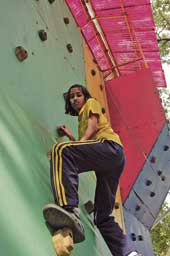
| A South Pointer has a go at rock climbing. Picture by Sanat Kumar Sinha |
Scaling new heights has always been the practice for South Pointers. Now they are doing it in adventure sports, with an artificial rock climbing wall installed on the school premises.
“We are trying to incorporate activities that will keep students physically fit and mentally alert. It definitely improves their concentration,” says Jayati Solomon, principal of South Point High School. “The activity requires regular practice and knowledge of proper techniques and it is not always possible for students to go to natural rocks for training,” she adds.
The wall, where students train in sports climbing, was set up in 2006, designed and constructed by West Bengal Adventure and Mountaineering Federation. A plyboard on iron structure, the 16 feet wall has galvanised iron channels with several gradients, depending on the levels of expertise. The wall has different kinds of holds.
Rock climbing classes are compulsory once a week for students of classes VI, VII and VIII. There are also extra classes on Saturdays where any one can join in. Students are not allowed on the wall without harnesses and ropes anchoring them. They are taught the techniques of climbing and knot making, like the fisherman knot, a hardy knot that can be tied and untied easily. They are also taught different kinds of holds.
“In the initial stages, we give them big holds that can be grasped easily, gradually making them smaller and reducing the number,” says Shambhu Chandra Roy, the trainer. “The training here is not just for fun. We encourage the children to take up adventure sports as that will make them confident,” says Kavita Banerjee, physical education teacher. “Most students are eager to climb but a few need to be assured that the sport is not risky,” she adds.
Students are also taken for camps to Purulia, Darjeeling and Jamshedpur. The five-day camp during winter vacation is a must. “The artificial climbing in the school is good for the basics, but taking them to natural rocks gives them the right exposure,” says Roy.
“I have always been interested in adventure sports, and when I climb, I feel like never stopping. It is a very heady feeling,” says Class VIII student Priyadarshini Chatterjee. However, Class X student Masoom Pachisia confides: “I was initially a little afraid while climbing down. But with practice I have mastered my fears. One needs to balance oneself and maintain time.” Masoom takes time off her studies to practise in school.
Jhinuk Mazumdar
Rising above odds
 |
| Students of Rainbow stage a skit at American Center on Monday. Picture by Anindya Shankar Ray |
Mou Mondal looked flustered as she narrated her horrifying experience as a child domestic help in a city household in 2003. She recounted how her employers would harass her, once locking her up with hardly any food before going away on a holiday to Bangalore. The minor girl was finally rescued and handed over to Rainbow, the shelter for street children run by Loreto Day School, Sealdah.
Mou has come a long way since then. Trained by students of Loreto, Sealdah, she now studies in Class VIII of Baptist Mission High School and dreams of a better future.
Biswanath Das proudly told an audience how he loves going to school and would like to work in an ‘office’ when he grows up. But life has not been easy for the Class IV student of St Teresa School in Moulali. Born to a family that lives below the poverty line, Biswanath has to work almost seven hours a day for Rs 10 at a tea stall to supplement his family income. His gruelling day leaves him with no time to study at home. But his mother, a domestic help herself, will not let him give up his studies. Mou and Biswanath’s tales of bravery were recounted at a workshop on child labour held at American Center on June 9. Organised in association with Loreto Day School, Sealdah and the Confederation of Indian Industries (CII) ahead of the World Day against Child Labour on June 12, the event saw several organisations and individuals brainstorming on the issue.
“In West Bengal, children continue to be employed in brick kilns, garment factories, leather goods manufacturing units, beedi making and the fireworks industry,” said US consul general Henry V Jardine. Research by NGO Save the Children shows that 74 per cent of child domestic workers (CDWs) are between 12 and 16 years. “Education is a human right. It is integral to reducing poverty and child labour,” he added.
Loreto student Debparna Lahiri explained how they formed clubs in their locality and encouraged neighbours to send minor domestic workers to school — even at the cost of being shooed away by dogs — while three other underprivileged children of Rainbow enacted their predicament through a small skit.
Dark Future, a short film on child labour by IT professional Anirban Basu was also screened. It had been shot in Manali, Digha and Calcutta.
Said lawyer Sarfraz Khan, who spoke about the need for more legal awareness: “The law does not allow the police to take immediate action against employers of CDWs. That needs to be changed.”
As participants trooped out of the hall, a question raised by a member of the audience remained unaddressed. Can child labour be totally erased when underprivileged children — even if put in schools — must continue to work to keep the fire burning at home?
Chandreyee Ghose