 |
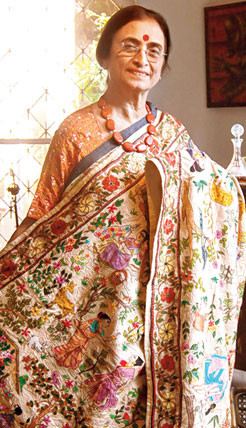
| Shamlu Dudeja at her Calcutta home |
Every year August 15 brings with it memories of the beginning of India’s tryst with destiny but also rakes up the ghosts of Partition. Kantha revivalist Shamlu Dudeja was a little girl in Karachi in 1947. She looks back to the tumultuous times and shares her memories with Metro
It was today, 66 years ago (August 14). The independence of Pakistan came a day before ours. Sometime in the afternoon, Lord Mountbatten and Muhammad Ali Jinnah met in Karachi, in the Sindh Assembly.
There were about four houses in a gated community — ground floor and first floor — adjacent to the Sindh Assembly. We had a common wall. In front of us were these ground-floor quarters of people who worked in the Assembly, not senior officers, clerks and chaprasis. My brother (Gul) and sister (Indu) were very small, three and six. I was nine.
My father (RR Kirpalani) had been talking about Partition. A white horse-drawn carriage with Lord and Lady Mountbatten arrived... we went and stood outside in our balcony and then we went up to the terrace. There was a narrow red carpet that ran all the way in front of the Assembly, where the security personnel and staff were standing. The carriage came quite close to where we were and stopped. The one thing I remember is Lady Mountbatten was wearing a white dress. Jinnah came forward and welcomed the Mountbattens and they went inside the Assembly.
Soon after, a couple of people from the staff quarters came to our compound with a dagger. ‘Abhi sooraj dhalney doh, toh hum dikhatey hain kya hota hai (Just wait till sundown and see what we do to you),’ they threatened.
Some of the people in our compound gathered in our house with all their jewellery tied up in little potlis (bundles). They gave them to my father and said, ‘Put these near your entrance and if this man comes, let him take all this jewellery and leave us in peace.’
We were all very tense. One special thing about my father was that we were born Hindus but we read the Guru Granth Sahib and we also had a Sufi pir called Naseer Fakir, who used to live in Jallalani Sharif, at the centre of Sindh, far away from Karachi. He must have heard in his village about our situation and sent his two attendants. Those two men came with guns before nightfall and shouted out my dad’s name. My dad was praying. He ran downstairs as soon as he realised that they had come to protect us. ‘No harm will come to you,’ they said. I don’t remember for how long they stayed but they guarded our premises and nobody was able to enter our compound. Everybody could go back to their homes with their jewellery.
I used to study in a Gandhian school called Hardevi High School in Karachi, which was on the other side of the Assembly. That immediately shut down. The Sufi pir told my father, ‘You don’t have to go to India. You stay here and we will protect you.’ We stayed on for a month and a half… till about the end of September.
After our school shut down, there was curfew. My father would take a cycle and go around Karachi to see how our other relatives were doing… whether they were still there, had they been killed?
My sister and I started going to a convent school. We used to go by school bus and I remember ours was a Sindhi-medium school and we did not know too much English. The girls would pull our hair and say, ‘Go to your country!’ But we did not know what that meant. We thought Karachi, where we were living, was our country.
Daddy had studied mathematics and was a professor at DJ Sindh College. I went and visited the college five years ago. My father had also worked as a statistician with the government of Sindh, from 1945 to ’47, till he left.
It was raining very heavily when we came by ship from Karachi to Bombay. The ship would roll and people would literally fall off! The ship did not stop, though. We were inside a cabin, the five of us, but there were people sleeping outside our cabin. There were thousands of people at the docks.
All we had as luggage was an aluminium trunk with three or four outfits for each of us. Mummy used to sew on a Pfaff machine of German make, a foot-operated one. She wrapped the machine in woolly blankets that one used to get in Bangkok, or so I had heard. This machine was then stuffed in a brass water container. Mummy had taken out her two diamond bangles and one large emerald ring with diamonds around it and these were in the instrument box of the sewing machine, which we didn’t know then. These were the only things we had, along with Rs 100-200.
On the ship, one literally had to step on people if one wanted to get to the decks. It was a three-night journey. We got strange food. I cannot remember what it was, though. In any case, nobody was interested in eating because we were all so scared. As we went up the ship there were a lot of guards. I am trying to remember the name of the ship, but I cannot. We had got on the ship around 10 or 11am.
When we came to Bombay, we stayed with my mother’s brother. Daddy, because of his government experience, went to Delhi to look for a job. Fortunately, we never had to live in a refugee colony. We were in Bombay for a month or so and then Daddy got a job in Delhi and all of us travelled there by train. There we got a barsati-kind of an apartment. We were in Delhi from 1947 to ’57. Then again in Bombay, between 1957 and ’62, where I did my modelling. I got married in Bombay in 1962 and came to Calcutta.
The experience [of Partition] has left a scar. My elder granddaughter was once watching riot news on television. They were showing this ring of fire. I told her to switch off the TV. It was taking me back to my Karachi days. And I was scared of darkness for a long time.
What I wonder now is how did we survive it? I don’t know! Coming to my uncle’s house and knowing that we had no home… we did see thousands of people bundled together at the Bombay docks. My bua’s (paternal aunt’s) husband, who was a school principal in Hyderabad, Sindh, had to sell vegetables!
Moving to another country did not make much of a difference to me then. The major difference was we were leaving our home without any furniture, jewellery or money. At that moment, India and Pakistan were mere words. My sister would just lie on Mummy’s lap, holding on to her pallu. She did not understand as much as I did. The fear of the unknown… the insecurity of leaving our home, but then we had the security that we were going to my uncle’s house.
Daddy was able to bring us up in a simple manner with all the confidence in the world that we were okay. We were never made to feel that we were poor. We never knew sorrow.