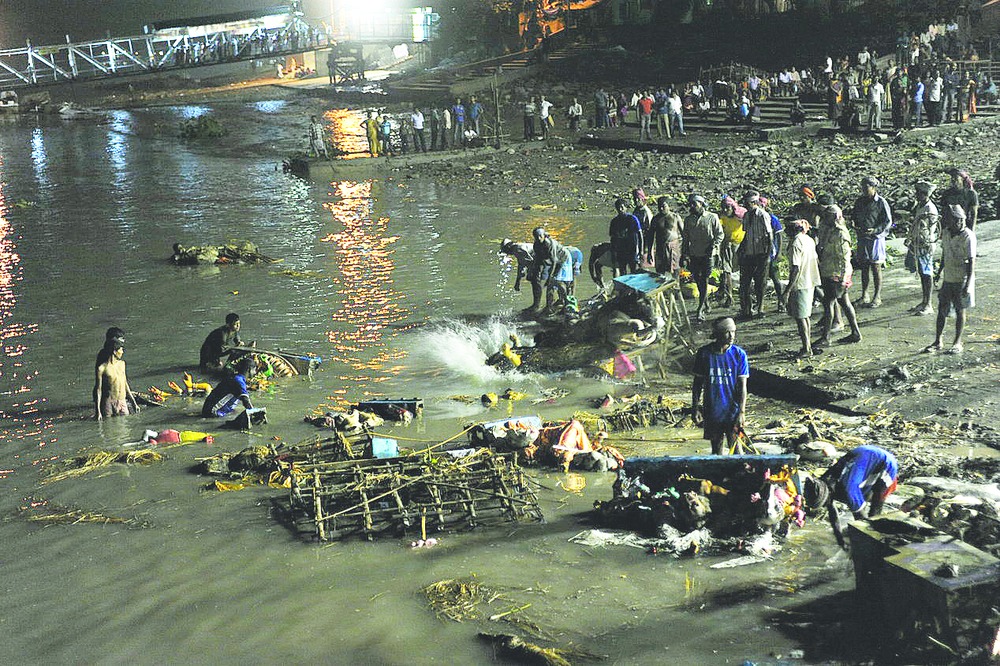

Durga Puja immersions were completed early on Monday, almost 24 hours after it began at 7am on Sunday. Poor planning was blamed for the unusually long duration and the pollution of the Hooghly.
Metro prepares an appraisal of the immersions after witnessing the process from a boat.
What was the situation?
The government's diktat that immersions would only be held on Thursday and Sunday - to avoid overlapping with Muharram - led to more than 2,000 idols being immersed on Sunday. Most big pujas skipped the Thursday option.
The attempts by the civic body, police and the port trust to minimise pollution by deploying volunteers and crane-mounted barges were limited to two major ghats - Baje Kadamtala and Nimtala.
This despite the fact that two-thirds of the idols were immersed in other ghats. With time running out, congestion at the two ghats increased and wheels seemed to come off the arrangements.
What went wrong?
The planning seemed flawed. Take the crane-mounted barges at Baje Kadamtala and Nimtala ghats for instance. They were meant to quicken the process by lifting the immersed idols and dumping them on the barges and banks before disposal.
In reality, the barges proved to be a liability as low tide hampered their operation. Moreover, the barges reduced the immersion area by almost half at Nimtala ghat and one-third at Baje Kadamtala ghat. Clearly, the authorities did not take into account this problem.
Adding to the problem, there seemed to be no coordination about the timings of the immersions. While there were only a few immersions during the day, the count kept increasing in geometric progression from the evening.
Several ghats remained underutilised, while a few were crowded beyond capacity. At Gwalior Ghat, which was hardly fit for immersion, Metro observed that idols were being made to slide along concrete slabs on the flight of stairs. The ghat witnessed the highest number of immersions according to civic records - close to 485.
Doi ghat, a couple of kilometres away, had better infrastructure but only around 100 idols were immersed there.
How did the river get polluted?
The river, especially close to the immersion ghats, looked like a flowing waste dump. While many idols were found floating on the river, even those dumped on the banks after immersion were found melting in the water. Experts said pollutants like heavy metals present in the colour of the idols got mixed with the water. "So much of heavy metal pollution during the immersion would affect the ecosystem. A part of the pollutants will be present in the drinking water, too," an expert said.
What were the lessons learnt?
High and low tide timings should be taken into consideration while preparing the immersion schedule. The organisers of each puja should be given a specific time for immersion. Also, the ghats should be properly utilised.
Administrationspeak
"We have tried our best. The huge load was a problem," said Debasish Kumar, a mayoral council member.
Expertspeak
"There was too much of much disorder," environment activist Subhas Datta said.