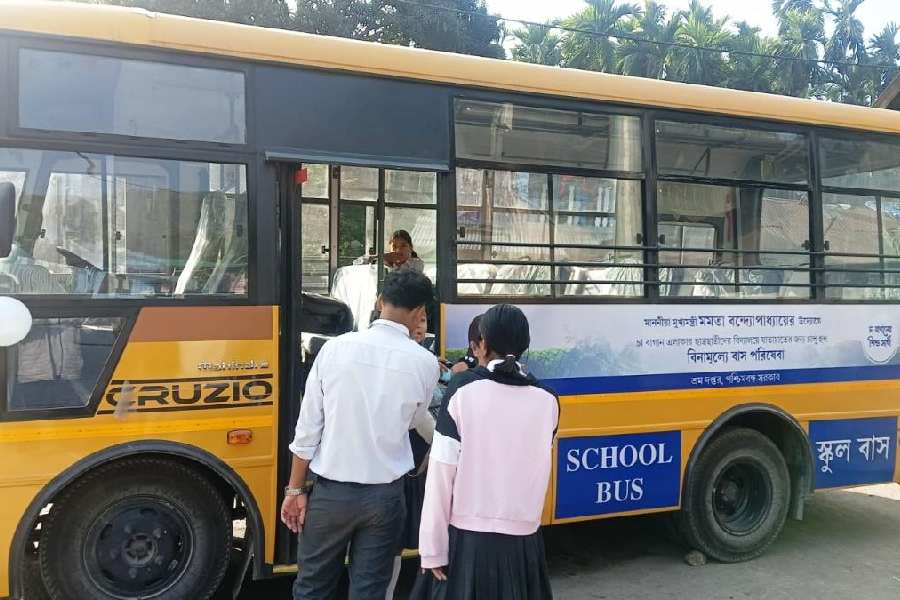
The state labour department introduced 11 school buses for students residing in the tea estates of Jalpaiguri and Alipurduar districts on Monday, within 48 hours of Trinamool’s national general secretary Abhishek Banerjee’s interaction with tea garden workers.
On Saturday, while speaking at the programme, Abhishek, also a Trinamool MP, had announced that dedicated bus services would soon be introduced in tea gardens to ensure safe transportation for students.
The buses have been launched under the state government’s “Shishu Sathi” project to ferry schoolchildren from the tea estates.
Of the 11 buses, six will operate in Jalpaiguri district, while five have been deployed in Alipurduar.
Although the service was initially scheduled to start in November 2025, delays in the arrival of buses from Pune postponed the launch, which finally took place on Monday, said a source in the administration.
“It is an absolutely free service for the students,” the source added.
In Alipurduar, four buses have been introduced in Madarihat block, while one bus is operating in Kalchini block. In Madarihat, the buses will carry students from different tea estates to schools in Birpara and Madarihat.
While the buses have been provided by the state government, the expenses of maintenance will be borne by the state labour department.
“Students from at least 20 tea gardens in these two blocks will benefit from the service. In due course, the number of buses would be increased to provide the facility to more students of the tea belt,” said an official of the district administration.
In Jalpaiguri, the buses will operate in different tea-garden-based blocks like Malbazar, Matiali, Banarhat, Kranti and Nagrakata.
The students, as well as their parents, many of whom live in remote areas, have welcomed the initiative. They pointed out that over the years, the transport service to schools, which the tea companies are supposed to provide, has either stopped or goods vehicles like tractors are used to carry the children.
“In most of the tea estates, students were forced to travel on the roofs of buses, or in tractor trolleys, or in overcrowded public vehicles, thus exposing themselves to serious safety risks. The daily travel costs also made regular school attendance difficult for families dependent on tea garden wages,” said a senior trade union leader.
Himanti Kujur, a student from the Dheklapara tea estate, which is in the Madarihar block, said: “A student from our garden needed at least 40 rupees every day to go to school and to return home. It was difficult for most of the families to bear the cost. Now, we can travel free in these buses and will be able to attend school daily.”
Political observers described the move as a significant step by the Trinamool government while noting that tea garden workers and their families play a decisive role in 10 to 12 Assembly seats of north Bengal.
“The service will also help Trinamool to drive home the point that they are serious in addressing the workers’ issues. It is likely to have an impact on the upcoming Assembly polls,” said an observer.
In the 2021 Assembly elections, the BJP had won most of the seats in the north Bengal tea belt.
Initiative for girls
Abhishek Banerjee also addressed another issue related to Rupashree, a scheme under which girls from economically weaker families are provided a financial assistance of Rs. 25,000 for their marriage.
While Abhishek was interacting with the tea workers and their families, Meela Nagasia and Saraswati Munda, who attended the event, informed him that despite getting married two years ago, they had not received the scheme’s financial assistance.
Banerjee immediately directed Suman Kanjilal, the Alipurduar MLA, to intervene. On the same evening, Kanjilal reached their homes in Vivekananda–II panchayat under Alipurduar-I block and spoke to them.
On Monday, the duo submitted the required documents to the local BDO. The payment process would be complete soon, said a source in the administration.