 |
| Intach’s team restores The Last Supper at St John’s Church |
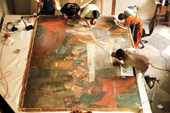
Johann Zoffany’s painting, The Last Supper, will be unveiled on Sunday evening at St John’s Church after its restoration over a period of five months. This project jointly undertaken by the Indian National Trust for Art & Cultural Heritage (Intach) and the Goethe Institut/Max Mueller Bhavan, Calcutta, highlights the woeful lack of conservation facilities in this city.
Here, priceless collections of Bengal School artists, the Tagores and others are rotting away in the care of such organisations as the State Charu Kala Parishad, Academy of Fine Arts and Rabindra Bharati Society, which in typically dog-in-the-manger fashion, will not allow them either to be displayed or stored using state-of-the-art technology. Guarding vested interests matters more than heritage.
The skills and knowledge of local conservators, too, need to be upgraded through better exposure and workshops. Conservator Renate Kant, who guided and supervised the project, is happy the way things have turned out and the way the Intach team of five responded to her rigorous training.
She, however, admits it needs years of experience to make a decision on at what stage a damaged painting should be left the way it is, for a work should never be compromised by retouching. The Intach team headed by Subash Chandra Baral, she said, was good at stabilisation of a canvas and documentation, but they “were not used to working so deeply and thoroughly”.
To make up for the lack of many varieties of good material and certain tools, they had to improvise. Even a heating spatula was not available. “Precision tools are required,” she stressed. The enormous project has given them more confidence but they require some more years of training to be on their own.
The last time a huge painting conservation project was executed in Calcutta was in connection with the 300th birth anniversary of Calcutta. Prompted by concern for the valuable collections at the Victoria Memorial Hall, the Calcutta Tercentenary Trust (CTT), a British Indian trust was formed in 1989, and a year later the conservation project was launched.
Renowned conservators from leading British museum studios were involved in the project and a group of Indian conservators with Victoria Memorial was trained. As a continuation, the CTT envisages a joint project with Victoria Memorial.
One element that both the projects have in common is their enormous budget. Goethe Institut/Max Mueller Bhavan granted about Rs 11 lakh for the Zoffany project and CTT had raised the equivalent of $1,000,000 in 1990.
However, in a city where money is not the easiest thing available, veteran conservator Sukanta Basu, 80, has never felt the pinch. Basu began his career at the National Gallery of Modern Art when he restored its collections of Amrita Sher-Gil, Jamini Roy and Raja Ravi Varma. He was with the National Museum in 1986 and does work for Raj Bhavan and Victoria Memorial as well. “If conservation is not of international standards it is not worth it. Funds have never been a problem,” he says. He is, however, quite dismissive about the work done in the city.
Over the past two to three years cash-rich Asiatic Society has been getting its collection of 78 paintings restored by Sukumar Menon. Ganesh Pratap Singh, 39, is a successful restorer who lives in Howrah. He was trained in Lucknow by his uncle, who was the central government’s senior restorer, and at his sister-in-law’s art restoration lab.
Here he has restored the paintings in Tripura House, both contemporary and antique art and books as well for corporate houses, private museums and collectors all over the country. “I consult international experts through email who share their knowledge with me. I do things scientifically and do photographic documentation as well,” says Singh.
However, not all local conservators are that fortunate and are used to working on a shoestring budget. Narayan Srivastava, 60, readily admits he can’t go by the book. No question of photo documentation or using anything but local material. He has recently restored a collection of 20 portraits of Indian personages belonging to the British Indian Association. But if the budget is Rs 1.75 lakh and he has to service 20 paintings how can he afford to be “scientific”?
There has been no concerted effort to train conservators or upgrade their skills. G.M. Kapur, state convener, Intach, says the organisation is keen on collaborating with Goethe Institut as there is great demand for restoring works in the private domain. “We can fill up the vacant space.”