snapshots from second edition of bengal bird day


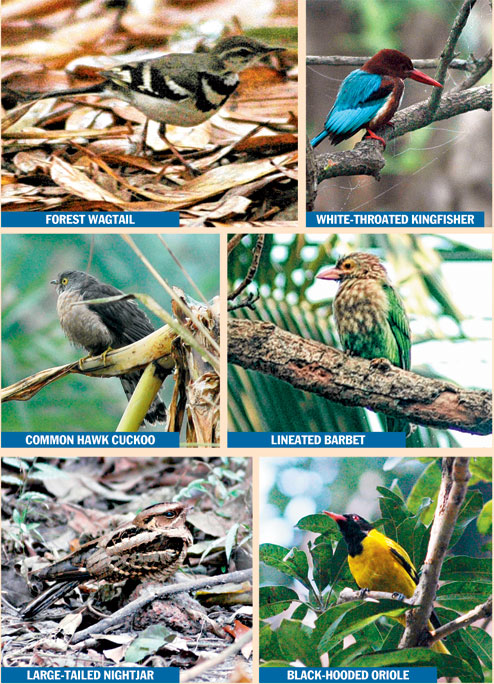
Some of the species sighted at Shyamkhola and the Chintamani Kar Bird Sanctuary in Narendrapur on Sunday. Pictures by Bishwarup Dutta

Sunday was the most-awaited morning of the year for some Calcuttans, though not for the same reason that had the rest of the city excited all day.
The second edition of Bengal Bird Day, a daylong survey conducted by amateur birders across the state to help create an avian database and note threats to habitat, started under a veil of fog but ended on a satisfying note just like the night did for India at Adelaide.
Metro accompanied a five-member team of birding veterans first to Shyamkhola, about 7km from Hiland Park on the Bypass, and then to the Chintamoni Kar Bird Sanctuary (CKBS) in Narendrapur for a session of birding where fog was as much an enemy as the bounce of the Adelaide pitch seemed to be for India's openers.
While spotting birds from barely 50 metres away was a challenge early on, the count and the diversity of species started to improve once the fog lifted to make way for the first rays of the sun.
The team, including this year's event organiser Bhaskar Das, flitted from one marshy patch to another before venturing into a bamboo thicket in the hope of recording the day's first significant catch. Success came with the sighting of a Forest Wagtail perched on a bed of dry leaves on the floor of the bamboo thicket. The bird, a migrant from the Himalayas, is seen in and around Calcutta twice a year.
'The Forest Wagtail usually stops by en route to south India at the onset of winter. The bird can also be seen resting here for some days on its way back to its breeding place across the Himalayas,' said former banker Sumit Sen, whose website www.kolkatabirds.com is a treasure trove of avian information.
Prosenjit Singha Deo, a professor at the SN Bose National Centre for Basic Sciences in Salt Lake, Anirban Chatterjee, who works with consultancy firm KPMG, and Srikumar Bose, an engineer with CESC, were the other members of this Bengal Bird Day team.
After Shyamkhola, the birders proceeded to the nearby CKBS, where the sight of an Indian Pitta made their day. This bird is a passage migrant from the foothills of the Himalayas. The bird may be a beauty but it isn't easy to sight as it moves through the forest floor in camouflage.
The Large-tailed Nightjar, whose colours are very similar to fallen brown leaves, is just as difficult to sight. But CKBS usually rewards the keen-eyed visitor with a sighting of this bird and Sunday was no different.
Other common sightings of the day included the Black-hooded Oriole, White-throated Kingfisher, Lineated Barbet and a flock of Cotton Pygmy Goose.
The Bengal Bird Day format requires teams to register for the event, mentioning the places they intend to survey. These places needn't be protected areas; any spot in the vicinity of human habitation that has some avian presence is considered a zone worth exploring.
Shyamkhola, for instance, comprises marshy patches and some water bodies with villages all around. Construction activity in that belt has increased as urbanisation spreads its claws, reducing what was once a bird-rich area into several tiny, scattered habitats.
A survey such as the BBD helps identify any threat to a bird habitat, be it in terms of weather or rapid urbanisation. 'Our surveys tell us that to see birds one now has to go a little away from the city. The Rajarhat-New Town belt used to be a good birding spot but now moving a little further helps,' said Sen, who used a mobile phone app called BirdLog Asia to update data in realtime.
This year's BBD was organised alongside the four-day Great Backyard Bird Count, a pan-India activity to create an exhaustive database of birds.
Fifty-three teams in Bengal participated in BBD 2015, about 25 of them from Calcutta. The data provided by each team will be collated over the next week to reveal the larger picture.
The team count may have been fewer than last year - about 80 groups had participated in the first edition of BBD - but the organisers said no area had been missed in terms of coverage.
'More the number of teams, better it is for more accurate reporting of birds. But the teams this year have by and large covered the significant places,' said Das.
So, did the War of Adelaide have anything to do with fewer teams enlisting for the survey this year?
'An India-Pakistan cricket match won't affect the survey. Those who are committed to this cause will spend the entire day doing this rather than anything else,' said Das, an engineer who until recently worked for an oil PSU.
In a post on Saturday in the Google Group Bengalbird, fellow birder Sen had written: 'I am hoping that birdwatchers will match the Cricket World Cup run feast with a bird count feast. And what better way to keep tensions away than being far away from the TV tomorrow, if you are a cricket lover, that is! :)'