 |  |
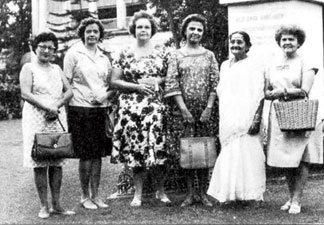
| From left are Mrs Job, Mrs Sybil Martyr, Mrs King, Mrs Nick, Mrs Doss, and Mrs Woodsell. (Right) | I was born and bred in Calcutta. I have had a happy childhood and life - Sybil Martyr |
Picture by Sanat Kumar Sinha | |
An old grainy photograph in an attachment that recently has been doing the rounds via email and Facebook shows six women posing for a shoot in front of the bust of Claude Martin (only the pedestal is visible in the print) opposite the rotunda of the La Martiniere for Boys, Calcutta, building on Loudon Street. Apart from the Bengali woman in a sari, the five others are all Anglo-Indian teachers in dresses and hair typical of 1960s Park Street, always decades behind trends in the West.
One rarely meets Anglo-Indians of this ilk any more in Calcutta for most of them left either for Australia or Canada by the end of that decade when I went to that school.
From left are Mrs Job, Mrs Sybil Martyr, Mrs King, Mrs Nick, Mrs Doss, and last of all, Mrs Woodsell, and it is on account of Mrs Martyr that the attachment has been zipping across the Internet. Mrs Martyr, who is a resident of Lawrence D’Souza Old Age Home on Lenin Sarani (next to Union Chapel), will turn 100 on October 19, and this created a buzz of excitement among us sexagenarians, who went to that school in the 1950s right up to the late 1960s. And although Mrs Martyr never taught us, I distinctly remember the dignity with which she carried herself.
Vinoth Kumar, a former Martinian (1954-1962) and once-resident of Madan Street, who lives in London now, had taken the initiative to create the attachment on Mrs Martyr’s birth centenary, which also contained another old group photograph of teachers which showed the self-contained lady sitting beside then principal of La Martiniere, Colonel Eric Joseph Simeon. There was another colour photograph of hers taken possibly a few years ago when she was already 90. It must have been taken inside her room at the “home” for the curtain with floral prints still hangs there. She had aged, but she looked smart and poised in her chequered salmon pink blouse, the blinding flash notwithstanding.
The attachment contained a letter from the current principal of La Martiniere for Boys, Sunirmal Chakravarthi, dated September 4, 2010, which described his meeting with Mrs Martyr at the home. “I have returned home five minutes ago after visiting the charming and redoubtable Mrs Sybil Martyr! I say “charming” because she is just that and I say “redoubtable” because age has done nothing to diminish her grace or her strong spirit!… At 96 she doesn’t look a day over 70! She has a very sharp and alert mind, a wonderful memory and speaks with a strong and clear voice.”
Sadly, Mrs Martyr’s appearance has changed dramatically over the past one year or so, ever since she suffered a fall in her largish room with a spacious and tidy bathroom. When I first went to meet her on Monday the ladies were already having lunch. The afternoon heat was enough to make one feel faint but tall trees shaded the facade of this rather large, ancient building that had seen better days. The parlour with its heavy table, sofas, plastic flowers and framed pictures of Christ could have been from any Anglo-Indian home — only you don’t see them any longer.
I met her later in the day, when the harsh sunlight had already faded, a time propitious for such a meeting when nostalgia buffs the rough edges of harsh reality. Mrs Martyr was propped up on her bed with a backrest behind her. She was not alone. From time to time, Mrs Martyr would call out for her helper, Razia Begum of Topsia, to do her bidding — switch on the light or cover her wasted body with a sheet. Razia patted some powder on her emaciated face for the shoot.
And sitting in a chair next to her bed was Rudolph L. Rodrigues, who taught us in school before moving on to the international relations department of Jadavpur University. He addressed her as “auntie” and explained that Mrs Martyr had taught him when he was a kid.
She may have lost the will to leave her bed and her hearing is very poor, yet from time to time she would correct Rodrigues as he related Mrs Martyr’s story.
“I was born and bred in Calcutta. I have had a happy childhood and life,’’ she interjected from time to time. She had taught for 23 years at Pratt Memorial before joining La Martiniere, where she taught maths for 15 years before retirement. She had lost her mother early in life and was brought up by her grandmother who lived in what was then Corporation Street, SN Banerjee Road of today.
Rodrigues, who visits her three times a week, clarified that when she came to live in the home in 1990 her “finances were dwindling”. But now she is comfortably off. If there is any “shortfall” it is taken care of by an anonymous benefactor.
Her husband, who died in 1986, was with the Patent Office, and she still gets family pension. This is supplemented by La Martiniere, and so she can manage to pay for both her helpers who work in shifts. A frugal eater, she subsists mostly on chicken soup. For her birthday she wants baked fish and mayonnaise sauce. The rest can have biryani, she says with a smile. She punctuates her words with smiles. Her resignation is characteristic of a waning community that sees no reversal of its fate. Mrs Martyr puts on a brave face though.