 |
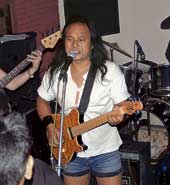
| Lou Majaw on song. A Telegraph pictureKanika Bandyopadhyay |
Jiving on the stage in short pants, Lou Majaw is most unlike the quiet Bob Dylan bent over his guitar. Yet, Majaw is known as the Dylan of the Northeast.
Smitten by Dylan’s songs since he heard them for the first time in 1965, the 61-year-old Khasi musician ritually raises a toast to the tambourine man every year on Dylan’s birthday in Shillong. For more than three decades, Majaw has been belting out Dylan anthems in the town drenched in rock ’n’ roll, blues and country music.
In Forever Young, documentary filmmaker Ranjan Palit’s camera tracks six years in Majaw’s life to capture his music, passion and philosophy. Steered by Steps India, an organisation that commissions Indian documentaries for global reach, the film premieres on the BBC this month. Ahead of the broadcast, Dylan and Majaw’s fans in Calcutta got a glimpse of the troubadour’s musical journey at a special screening in Max Mueller Bhavan on Tuesday evening.
Palit was introduced to Majaw’s Dylan-inspired world by drummer Nondon Bagchi. Along with Arjun Sen on guitar and Lew Hilt on bass, Bagchi and Majaw had formed the band, Ace of Spades, to mark Dylan’s birthday several years ago.
Forever Young’s kick-off point is the year 2000 when Majaw is singing Everybody must get stoned to a bunch of giggling schoolgirls.
“I did not have any premeditated thoughts about what exactly I was about to film when I started out. The first year was just about exploring Lou’s concerts. I didn’t have much idea about how the film would move. I kept going back, took things seriously, explored more till I got to understand Lou better,” explained Palit.
The film takes the audience through Majaw’s his energetic gigs to his escape to Calcutta and falling in and out of love. The camera steals a few private moments — of Majaw sitting by himself, or with his wife Tina and son who he has named Christopher Dylan. In a candid frame, Tina talks about her separation with Majaw, describing him as a “good father but not a very good husband”.
The focus shifts to Majaw’s old band mates who are peeved about not moving on to newer songs and lack of practice. The film ends with schoolgirls dancing to Majaw’s music, with one familiar face amongst them (Larissa, an ardent Majaw fan whom Palit managed to track down).
As for the legend himself, Dylan is apparently aware of the film, said Palit. “We’ve used 11 of Dylan’s songs in the film and I panicked when we were asked to pay a royalty of $2,000 per song. Luckily I bumped into a woman who works in Dylan’s office. I sent them a copy of the film. They loved it. Now I pay $700 for each. Since Dylan won’t sit through 75 minutes of the film, they have asked me to cut out strips and make a shorter version for him to see,” added Palit.
Remembering boromashi
 |
| Kanika Bandyopadhyay |
It may be eight years that Kanika Bandyopadhyay has passed away but her admirers still miss the dulcet voice. They may do well to book a seat for a concert on May 30 at Gyan Manch. Relations of the iconic Rabindrasangeet exponent have formed a body called Mohorkanika and the evening will mark their maiden performance.
“All of us have imbibed boromashi’s style from the closest quarters. We want to keep her legacy alive,” says Shyamashree Banerjee, a niece. Twelve of Bandyopadhyay’s kin feature on the performer list. While Shyamashree is the oldest, Rwitaja, a grandchild to Bandyopadhyay, is the youngest. Two sons-in-law of the clan are also taking part. “We plan to share our memories of boromashi,” Shyamashree says.
Says Shubhashree Roy, another niece: “She was my teacher at Sangeet Bhavan but my introduction to music was through songs like Phule phule dhole dhole that she’d hum even before I joined school.”
“People know her as a soft-natured person. That she was, but few know about the hold she had on the extended family. She being the eldest among her 12 siblings, boromashi’s was the last word. She was also a stickler for discipline.”
The world may know Bandyopadhyay as a singer named and often trained by Tagore himself (he died when she was 17) but a chat with her relatives reveals other facets. “Every Wednesday we’d drop by at her Nichubangla quarters in Santiniketan, and taste mangsho-bhaat cooked by her. We still use her cooking tips,” says Shyamashree.
She had an eye for jewellery designs, too. “She’d experiment with ethnic artefacts. Once when I won a singing contest, she took off the necklace of mini Santhali dhols and beads that she was wearing for me. Such things are back in fashion after all these years,” Shubhashree adds.
Many such anecdotes are in store for May 30. “We have requested Dwijen Mukhopadhyay to inaugurate the programme. Chaitali Mazumdar, a dear friend, will do the narration along with Rajat Bandyopadhyay, a relative who is the registrar at Jadavpur University.”
Can there be a Kanika programme in town without Suchitra Mitra?
“Of course, we have invited Suchitramashi. She was delighted with our effort. When boromashi had stayed for treatment at my Salt Lake home for a month, she was among those who would drop by to meet her. From the intimacy in the conversations it was clear that all talks of rivalry between the two were bunkum. Suchitramashi is unwell but has not ruled out her presence at the show,” Shyamashree says.
(Contributed by Mohua Das and Sudeshna Banerjee)