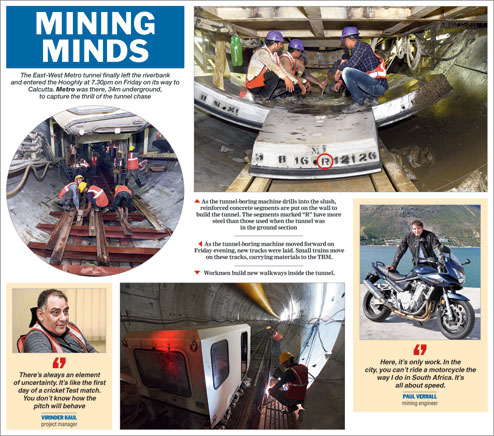

April 14: The blur of the tunnel walls as a Metro train hurtles down the beaten track has become a part of my daily life. But clambering down 10-odd flights of stairs into the abyss of a tunnel in the making under the Hooghly is not quite the same feeling as entering Kalighat station.
The heat and humidity add to my discomfiture. There is no air-conditioning 34 metres below the ground, not even a fan. A yellow pipe on the roof is the lifeline for hundreds of engineers and workers toiling for hours to build the first of the East-West tunnels that will connect Howrah with Calcutta via the Hooghly. I am told that the pipe is a ventilation shaft through which compressed air is supplied from outside.
Walking down the tunnel for more than a kilometre and back, I sweat like someone who has just had a long session on the treadmill. As I take slow steps through the narrow, makeshift walkway made of iron mesh and railings for support, several possibilities play on my mind.
Would there be seepage of river water as the tunnel-boring machine drills its way through the underbelly of the Hooghly?
An Afcons engineer instantly assures me that there is hardly any chance of such a thing happening. And even if it were to happen, the entire construction crew would be able to come out safely.
"The tunnel-boring machine has doors that will shut down automatically if there is water leakage. It will turn into something like a submarine. Before anything dangerous occurs, repairs can be carried out and our people evacuated," he explains.
Just as we approach the opposite end, I spot water leaking from a pipe and almost press the panic button! I point this out to the young engineer behind me, only to be assured that this is not the 'leakage' I had asked him about a little while ago.

The seepage, it turns out, is from one of the pipes through which water flows into the tunnel-boring machine to keep it cool. It's a small leak that gets repaired almost immediately.
Another concern for me as we walk a few metres inside is the disappearance of mobile phone connectivity. Cut off from the outside world, who would I send an SOS to if nobody inside is able to help me in the event of unforeseen trouble?
I feel reassured to spot the first of several telephone handsets attached to the tunnel wall. These are part of the intercom system through which workmen inside the tunnel contact those at the site office above.
Before going down, the safety officer had advised me to carry a bottle of water because it would be humid inside. Ditto the safety gear - yellow helmet, fluorescent jacket and special boots. The makeshift steel staircase of the Howrah Maidan station was my path to the entrance of the twin tunnels.
There are two rail tracks leading into the tunnels, both meant for transportation of construction materials, including the rings that form the diaphragm walls. Small locomotives like the Darjeeling toy train move in and out of the tunnel. We go till the other end of the Calcutta-bound tunnel, where the boring machine is drilling its way through the bottom of the river.
It's a long walk, I am warned. I resist the offer of a joyride on the toy train. The brightly lit tunnel is oval-shaped, unlike the square-box one through which Metro rakes on the north-south route run.
The steel walkway on the left side of the tunnel (going towards the direction of the river) is barely half a metre wide with a railing on the right. Workmen coming from the opposite direction stand sideways or alight on the tracks to make way for us.
I skid twice but hold on to the handrail. Taking the temporary tracks is not an option because of the slush. My shirt is sweat-soaked already and I realise how difficult it would be for the workmen spending hours inside.
The temperature is not very high - between 28 and 30 degrees Celsius - but the humidity is killing. There is hardly any noise other than the hum of machines and strands of conversation.
Maybe I will narrate to a co-passenger on the East-West Metro someday how this technological marvel was created.
Reporting by Sanjay Mandal
Pictures by Sanjoy Chattopadhyaya