 |
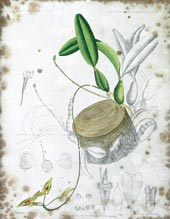
| (Top) Illustrations by Robert Pantling. Picture by Sanat Kumar Sinha; (below) Orchid icones, 200 years old, in the collection of the Central National Herbarium, Calcutta |
 |
 |
Thousands of people visit Indian Botanic Garden in Howrah, but few would have either heard of or have had the opportunity of seeing the treasure trove of late 18th century botanic illustrations housed in an air-conditioned room of the five-storey office building inside the 273 acre sprawl. The Botanical Survey of India has only recently undertaken a project to scan these illustrations, many executed by unknown Indian artists.
M. Sanjappa, the director of the Botanical Survey of India, says “the material lay scattered and it is only now that a project has been undertaken to catalogue these illustrations. Within a year or two the paintings will be digitised and then put on the Internet. In 1920 these paintings were remounted when a glue was used that has given them a brown background.”
Sanjappa wants the complete series of more than 10,000 paintings (1,500 represent orchids) to be conserved, and the V&A in London has been consulted for knowhow. Since no publication exists on these illustrations he also has plans to bring out a book highlighting these paintings.
The illustrations are kept in the type section of the Central National Herbarium. After the Roxburgh Building and its adjacent library and herbarium, where these were originally housed, were abandoned in the late 1970s, these illustrations and other valuable archival material like the specimens, books and glass plates, were shifted here.
William Roxburgh, called the father of Indian botany, was the first salaried superintendent of what was known as the The Hon’ble Company’s Botanic Garden, Calcutta, and subsequently renamed the Royal Botanic Calcutta in the early 1860s, during Queen Victoria’s sway.
Roxburgh would commission Indian artists to create likenesses of the plant species in the garden, and they executed the drawings with the exactitude of scientists coupled with the sensibility of artists.
Subsequent superintendents of the garden enriched the exquisite collection of icons by commissioning artists both Indian and some European to create them using locally available dyes but English paper. The artists involved were Lutchman Singh, Gopal Dass, Kali P. Dass, A.N. Banerjee and others.
Also included in this collection are the orchid icons of botanist Robert Pantling, many of which appeared in the book titled Annals of the Royal Botanic Garden, Calcutta, King & Pantling, Orchids of the Sikkim-Himalayas that was printed at Bengal Secretariat Press in 1898.
The heavy, lavishly illustrated leather-bound tome is in the library of the Central National Herbarium, Calcutta, in the garden.
According to an article on the “Orchid icones of Central National Herbarium, Botanical Survey of India, by M. Sanjappa, C. Sathish Kumar and S.D. Biju, “Like Roxburgh, Robert Wight (1796-1872) and Col Richard Henry Beddome (1830-1911) continued illustration of Indian plants with the help of local artists who were initiated into the art of plant illustration…Wight used to proudly acknowledge the skill of his favourite artist P. Govindoo, after whom he even dedicated the orchid genus Govindooia (=Tropidia Lindl).”
 |
| William Roxburgh |
The Royal Botanic Gardens, Kew, near London possesses a set of duplicates of these illustrations.
According to the garden’s website, Roxburgh had left at the Calcutta garden a set of 2,542 life-sized coloured drawings with botanical dissections, among which are depicted nearly all the Indian species described in his Flora Indica.
The “duplicate set” at Kew was sent home by Roxburgh to the East India Company. The Kew set of copies can be viewed online at http://www.kew.org/floraIndica/home.do The website was launched in February 2006, and the illustrations were digitised around 2004.
Lynn Parker, assistant illustrations curator, Herbarium, Library, Art & Archives, Royal Botanic Gardens, Kew, wrote in an email: “… artistically, the illustrations are important, and offer an alternative style to Western botanical illustration. Stylistically, the two modes of illustration have similarities, but the Indian works have a decorative surface, a flatness and richness, and I think immediacy, not found in the European style, which can be more analytical. This flattened, linear technique, used by the Indian artists working for the Company School, joined with a scrupulous attention to detail, is well suited to the needs of botanical illustration, although initially, the artists were not accustomed to requirements of scale that the botanists stipulated. Traditionally, the artists’ worked by coating the surface of the paper with a thin ground, over which layers of bright pigment were added, seemed at odds with the often muted palettes familiar to the contemporary European eyes.
“Although the paper used could be of a low quality, I believe that Roxburgh imported good quality rag-pulp paper for his commissioned illustrations, and this, together with the techniques used by the artists, is why the works have kept so well and look so fresh. I think one can see the influence of techniques used by miniature painters of the Mughal Empire, as towards the end of the 18th century, the brushwork becomes finer and more contained, though I think it would be true to say that the artists were probably drawn from the textile industry. Scientifically, it is important to make the point that many of the Roxburgh drawings are types, that is a specimen or illustration used by a botanist to accompany a plant name when it is originally described. Whenever a plant is subsequently used, the type remains as the prime source for reference.”