 |
The more stridently Bengal declares its devotion for Rabindranath Tagore, the more neglectful it is of the poet’s legacy.
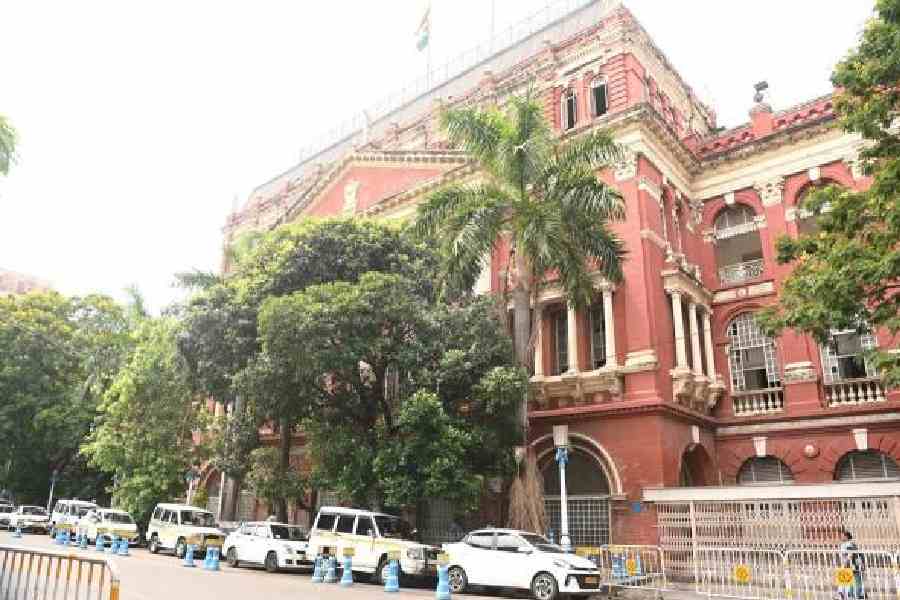
This becomes absolutely clear as one enters what was once India’s premier culture club — Jorasanko Thakurbari — at 6 Dwarkanath Tagore Lane in north Calcutta. It is not the most showy of palaces in this area of north Calcutta, which has such mansions scattered in every winding alleyway. What distinguishes it from others is that this was the family seat of the Tagore clan, where Rabindranath was born and where he died in 1941.
The building had been taken over by the state government during Tagore’s birth centenary celebrations in 1961, but only after the section of the house (Baithak-khanabari at 5 Dwarkanath Tagore Lane) in which the two famous nephews of Rabindranath — Gaganendranath and Abanindranth —resided had been demolished.
The space is now the lawn where celebrations are held occasionally. The original building was founded in 1784. Dwarkanath used to host his grand dinner parties in Baithak-khanabari.
Sadly, what was once Rabindranath’s realm is in a pitiable state now. And not for lack of funding. The government has not been close fisted. But granting imagination and creativity is beyond the government’s powers.
Elbow grease could work wonders, but over the past 35 years or so, many people in Bengal have become so used to getting paid for doing nothing that it is their second nature now. Yet the museum attracts hundreds of visitors everyday from all over the country and the world.
The ungainly concrete archway on Chitpore (now Rabindra Sarani) leading to this hallowed precinct is painted a dirty salmon pink. The elaborate terracotta portal on the CR Avenue side is a joke.
The sprawling building, which had been cut up into several sections and divided among the members of the Tagore family, was tenanted and was falling to pieces at the time of the takeover in 1961. Some rooms of the building had been turned into warehouses, workshops and shops, and the presence of riff-raff defiled this meeting place of the best minds and talents from all over the world.
The sections of the building at No. 6 Dwarkanath Tagore Lane that have survived the ravages of time are now labelled Maharshi Bhavan, named after Debendranath Tagore, Rabindranath’s father, Vichitra Bhavan, where Rabindranath stayed whenever he took time off from Santiniketan, and Ram Bhavan, which was occupied by the family of Hemendranath, Debendranath’s third son. The museum was started with the help of Kshitindranath Tagore, Hemchandra’s son, who had gifted a wealth of archival documents. Another relative, Kulada Prasad Sen, too had helped.
After the takeover, the PWD had repaired the building in its typical bull-in-a-china-shop style. The thakurdalan of Maharshi Bhavan has concrete with mosaic slabs for steps now. Since nobody had heard of “conservation” then, the PWD left traces of its heavy-handed manner all over the building. “Documentation” is still an unheard of process in these parts of the world, and 50 years ago it was unthinkable.
The floors are of various colours from pale to deep red oxide to grey, although Amitendranath Tagore, son of Abanindranath’s eldest son, Alokendranath, says the floors were either of stone or wood. Only the famed “dakshiner (southern) verandah”, where Gaganendranath and Abanindranath used to work and lounge, had red floors. But that section is gone.
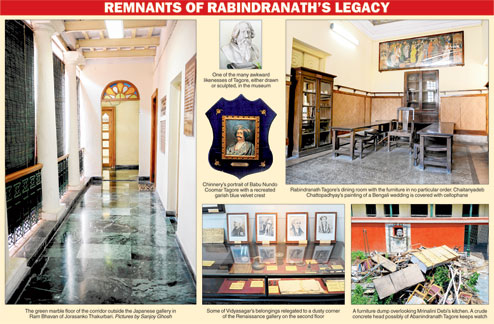
A concrete staircase leads to the museum, which begins with Rabindranath’s dining room. Here the tables and chairs, many with plastic fibre seats instead of caning, are arranged in no particular order. The cupboards set in the walls contain some chipped china of indeterminate age and quality.
On the wall above is a big painting covered with a cellophane sheet. It is by Chaitanyadeb Chattopadhyay and depicts a Bengali wedding. The Sunday afternoon that this correspondent visited the museum, a man — presumably a staffer — walked in in a wet gamchha and started combing his hair.
A narrow passageway leads to the kitchen of Mrinalini Debi, the poet’s wife. Water drips from a rubber tube hanging from the upper floor into a bucket kept under it. Rising damp is a perpetual problem in this building and the walls and mats that cover them are mouldy and moist, as a result.
A cobwebby wall cupboard in the kitchen contains some broken marble plates. The kitchen overlooks a small yard turned into a dump for broken furniture. On a wall rests a large concrete head, presumably Abanindranath’s, going by the broad forehead. The head is perhaps the handiwork of a student.
Visual arts and music classes were once held on the Jorasanko campus of Rabindra Bharati University that Thakurbari had been turned into initially. This accounts for the two ugly buildings in front and behind Maharshi Bhavan. Now the academic section has moved to Emerald Bower on Barrackpore Trunk Road, and these two buildings house several offices.
The floor of the gallery in which various Bengal School paintings are hung is marble, while the portrait gallery of various male members of the Tagore family done in oils is red — a bleached red, to be accurate.
These are all mainly late 19th century and early 20th century paintings, which were recently conserved at the National Research Laboratory for Chemical Conservation of Cultural Property based in Lucknow, says Indrani Ghosh, curator of the museum, who joined on January 2, 1998. But some viewers could raise questions about the quality of the conservation.
Rupika Chawla, Delhi-based restorer, explained the process of conservation over the telephone: “One has to bring out what was original. The original artist’s intention has to be greatly respected. It has to be completely invisible and revocable.”
One wonders if these rules were respected when these portraits were conserved. Dwarkanath’s well-known portrait by Baron de Schwitter seems to have been overpainted and so does Chinnery’s portrait of Nundo Coomar Tagore, the embroidered shawl glaringly so.
The shiny blue velvet of the recreated crest of this painting is perfect for a jatra artiste’s costume. A careful look at the paintings reveals an interesting fact — some of these had been touched up by Paresh Nath Sen in 1902. Some of the paintings and objects here and elsewhere lack labels. These portraits were all sourced from the P.N. Tagore collection of Pathuriaghat, symbolically unifying the two branches of the immense Tagore family.
Art historian Tapati Guha-Thakurta says the colouring of the portraits seems to have undergone change since the time she saw them last when they were hung on the top floor. They were of a darker hue then.
The “before” and “after” images with the museum are not of much help. True, the portraits appear unchanged though cleaner, but then the images are of a poor quality.
The state government had acquired 42 of Tagore’s paintings from his son Rathindranath but none of these are on display.
Ghosh explained that they were so brittle they needed to be conserved first. So digitised prints of Tagore’s paintings are on display. The entire collection of Rabindra Bharati Society is with the Victoria Memorial Hall for conservation.
The walls of the Japanese gallery in another section of the building known as Ram Bhavan are hung with rather small and faded prints of the works of both Japanese and Santiniketan artists. The gallery, which opened in 2003, has a wealth of photographs though not a single original object is on display.
The floors of this part of the building are of green and white marble. Was this an ideal choice of material for an antiquated building which mostly had plain floors? Partha Ranjan Das, member, West Bengal Heritage Commission, who was earlier involved in the restoration of Maharshi Bhavan, says “Marble floors don’t go with the character of the building.”
The floors of Vichitra Bhavan and the new Chinese gallery are of linoleum. The Chinese gallery — yet to be opened to the public — with its proliferation of red lanterns, seems to have been inspired by Tangra restaurants.
The Renaissance Gallery on the floor above perhaps does not enjoy the privilege of a sweeper. Vidyasagar’s books and writing implements are relegated to a corner. The bed linen could do with a scrub. But that could be said about all the sheets displayed here.
Indrani Ghosh says the museum is short-staffed. It has only two other technical staff members. The Union ministry of culture has sanctioned Rs 42,45,00 to the museum for development of the museum’s infrastructure.
The museum in a proposal sent in 2010 had sought a total of Rs 7,41,60,000. Now Rs 1,04,90,000 has been sanctioned, of which 50 per cent has been released.
The Centre has released funds to the Archaeological Survey of India for restoration of Ram Bhavan. A tender had been floated recently for this work but there was no response.
So it will be floated again soon. Phanikanta Mishra, regional director of the ASI, said another proposal must be made for consolidation of the drainage system of this building. Unless this basic fault is taken care of it will be just hogwash.