 |
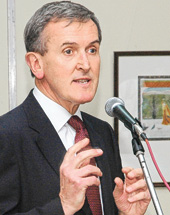
| Neil MacGregor at the lecture. (Bishwarup Dutta) |
A British art historian who sees the history of the world in 100 objects on Wednesday paid tribute to the vision of a Danish doctor who was the driving force behind the Indian Museum.
Museums help connect people from all over the world, the director of the British Museum, Neil MacGregor, said while delivering the Nathaniel Wallich lecture at the Asutosh Birth Centenary Hall.
Wallich, who had worked as a surgeon in Serampore in the early 1800s, was also a botanist with a keen interest in the flora of India. He was the first to propose the idea of setting up tea plantations in India to save the trouble of journeys down the South China Sea to procure the beverage. Later, in collaboration with Dwarakanath Tagore, he set up the Tea Committee.
While working for the Asiatic Society in Calcutta, he suggested a museum for the city and offered some objects from his own collection. So the Asiatic Museum came up, later called the Indian Museum. The Nathaniel Wallich lecture, delivered at the India Museum each year since 1986, commemorates his contribution.
Sir Hans Sloane, whose collection largely formed the basis of the British Museum when it was established in 1753, was, like Wallich, interested in plants. He was also interested in objects, as was evident when he asked the captains of ships, which arrived in London, to bring one object from countries they visited that would show how people elsewhere led their lives.
The British Museum still has these items, and more — starting from a Stone Age hand axe to a lamp run on solar power — to “encompass every part of human history”.
History as narrated through objects must hold a special fascination for MacGregor given the fact that he has written a book, A History of the World in 100 Objects, which has also been made into a successful radio series by the BBC in collaboration with the British Museum.
In an interview with Metro, MacGregor, who has been the director of the British Museum since 2002, pointed out how approaching history through objects was the only way of learning about cultures that had no written records.
Every object tells the story of the culture that created it, but in its own voice, unmediated by texts.
This introduces the possibility of accommodating different points of view, making for history without a centre. Besides, an object moves in time after it is created. So one starts by describing the world in which a thing was made. Its subsequent story brings in other histories, and a multiplicity of voices.
MacGregor talked about a seal from Harappa that is now housed in the British Museum. It was found in the 1850s somewhere near Lahore and taken to the museum, where it joined similar seals gathered from Iran, Iraq and Afghanistan.
Nobody had any idea about the importance of the seals. Then in the early 1900s, they were noticed by John Marshall, who later became the director of the Archaeological Survey of India.
Knowing that one of the seals came from Lahore, he undertook excavations there, and the Indus Valley civilisation was discovered. So in the 1920s, it suddenly became clear that the history of India was as old as that of Egypt, Mesopotamia or China. This revelation went a long way in boosting the morale of India’s freedom fighters.
The story of the seal doesn’t end here. The Indus Valley civilisation collapsed suddenly probably because of climate change — a fact that continues to have immense resonance for us today.
Amartya Sen, who is one of the members of the board of trustees of the British Museum, has praised MacGregor’s project by saying that a history of the world through objects stresses not the clash of civilisations but the interconnectedness of people.
Is a similar venture involving the Indian Museum, which possesses some of the world’s rarest artefacts, possible?
MacGregor shrugged before saying that such an idea would require a powerful public forum to execute.