 |
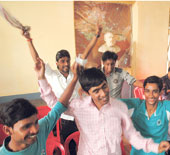
| Students dance to Bollywood beats in front of the bust of Surendranath Banerjea at the Indian Association. Pictures by Sanjoy Chattopadhyaya |
On a searing, arid Friday afternoon of April, the traffic stands still as the burnt air in Bowbazar Street, officially known as BB Ganguly Street, a name not too popular.
From a pale cream stone-façade building, whose looks suggest age and yet which seems better cared for than almost any other except the freshly painted church, blasts out a song unsuitable for a summer day past its midpoint when it is at its hottest.
Do ghunt mujhe bhi pila de sharabi/dekh phir hota hai kya.
The tall windows on the first floor rising up from the ground, with wooden railings, were possibly not meant to funnel out the blaring music emerging from the voice of a seductress asking to be fed a few drops of wine to see where that can lead.
Inside, there are no rose-coloured pouting lips challenging to be served liquid ecstasy. But something is happening all right.
A group of youth dances, arms and legs helter-skelter. Red plastic chairs are laid out for them to sit in the large high-ceilinged hall in a bizarre mix and match of incongruities presided over by one of the first deities of Indian nationalism, Surendranath Banerjea.
From its pedestal, Banerjea’s serious-looking bust watches a performer, in a glistening body-hugging electric blue costume, make crotch-thrusts and such other moves on a stage as the song changes to Bengal’s other “funsion” favourite, Kaanta laga, hai laga, aah haa…. The dancer grins, revealing black teeth.
The words ricochet off the walls within which one of the association’s founders, Ananda Mohan Bose, had stood and said: “Let every brick of this building bear testimony to the devotion of patriotic ardour of our people.”
Banerjea’s bust sees but is not seen. The framed pictures along the walls, of Banerjea’s fellow travellers who came together on July 26, 1876, to form Bharat Sabha, or the Indian Association, have even little hope of being noticed.
Bose, Romesh Chander Dutt, Monomohan Ghosh, Dwarka Nath Ganguly, Shiva Nath Shastri and Guru Doss Banerjee are names that may have caused some ripples in the still history-book memories of the teachers accompanying the boys of Central Engineering and Technical Institute.
The principal and director of the institute, Protik Siddhanta, says: “I know it (building) had something to do with the freedom struggle. I couldn’t imagine it (the music and the dance) would be this bad.”
He is right. The Indian Association did have “something” to do with the freedom movement.
As the first organisation of Indians to highlight nationalist issues, it could even be called its cradle — and of the Indian National Congress, which was formed in 1885. Its founder, Banerjea, who was the first Indian to be imprisoned by the British in the discharge of public duty, became the Congress president twice.
Satyabrata Chowdhury, the association’s current general secretary, said it could be called the precursor to the Congress also because it was a democratic body, formed “with the object of representing the people, of helping the formation of a healthy public opinion, and of promoting by every legitimate means the political, intellectual and material advancement of the people”. Membership was open to all, irrespective of caste and creed.
Historian Barun De says: “Although there were nationalist umbrella organisations in other Indian cities like Pune, Chennai and Mumbai, the Indian Association was the only organisation to deal solely with nationalist issues rather than regional ones.”
Several of the foundation’s founders spelt their very Bengali names in a heavily anglicised manner, but their collective soul was not elitist. The annual subscription was reduced from Rs 5 to 2 in 1879 so that more people could become members. For the poor, the rate was Re 1.
Rates are going low even now — to hire the first-floor meeting hall of the association that owns the three-storeyed building.
Plaban Nandi, who is a clerk at the association, says the hall was rented out for Rs 875 for three hours to the engineering institute. “We had told the institute authorities that they would have to play only Rabindrasangeet and Nazrulgeeti.”
Siddhanta denies any such correspondence. Subhash Routh, who studies automobile engineering at the institute, says: “I had not heard of this place before. But in retrospect I can say the institute authorities should have been more careful while choosing the venue…”
The hall earns the association Rs 6,000-10,000 a month and the furniture shops that occupy the front of the ground floor pay between them Rs 5,500. A school spread across several rooms on the third floor pays a rent of Rs 4,000 and a resident tenant Rs 1,500. For the rest of its annual budget that varies between Rs 3.5 lakh and 4 lakh, the association depends on handouts from its about 170 members.
An association that began with the vow of “promoting by every legitimate means the political, intellectual and material advancement of the people” is selling itself real cheap.
Pranab Chatterjee, a member and a former director of the West Bengal state archives, says that with the average age of its members being over 60, the association lacks initiative.
Talks had been held with the state government on turning the heritage building into a museum. “No one pursued it after a point,” he adds.
At least a couple of similar other moves had been made. One was a proposal from Chatterjee last year to set up an archive or a research facility. About six years ago, a proposal was submitted to the human resource development ministry, then headed by the BJP’s Murli Manohar Joshi, but was not followed up after the Congress-led government assumed power.
Pradip Bhattacharyya, who is the working president of the Congress in Bengal, says: “This is where the renaissance of the masses had started.” But, according to him, it is the state government’s responsibility to ban hiring out of the association building and to turn it into a museum.
De has a word of caution for the votaries of a museum. “In this day and age, no one will bother to visit the museum if it is not professionally done.”
Bhattacharyya proposes though that if the state fails, “we can talk to the Union government and request them to save this great institution”.
This “great institution” did send a plan to the Union government, though to the previous one. But nothing stops Arjun Singh, Joshi’s successor, from dusting off that proposal.
Mohsina Kidwai, the Congress general secretary in charge of Bengal, says: “I will ask our Bengal unit to send a report and on the basis of it, we will try to do our best. We in the Congress accord a lot of importance to preserve heritage and culture.”
The Indian Association might beg to differ. Since Indira Gandhi’s tribute on the association’s centenary in 1976 during the Emergency, Congress leaders have not turned their eyes towards the Bowbazar Street slice of its heritage.
Maybe, someone should bring the letter Indira had written to Sonia Gandhi’s attention. And the inscription on the outer wall of the building that expresses the hope: “Bengal will raise a pantheon dedicated to her great men. Such an institution will be an honour to the dead, and an incentive to the living.”
“An incentive to the living” it possibly cannot hope to be any longer. But one can imagine — without the benefit of the two drops of wine — it still becoming “an honour to the dead”.
Bengal has a record of indifference towards history. Here are some more examples...
 Clive House, Dum Dum: The Archaeological Survey of India has taken over but restoration stopped as part of the house is occupied by squatters.
The Adi Brahmo Samaj building, Chitpur: It came up in 1829. The Samaj was started by Rammohun Roy under the name of Brahmo Sabha in 1828. The Sabha moved into its own premises the following year and came to be known as Kalikata Brahmo Samaj. Kesub Chandra Sen’s breakaway group in 1865 came to be known as Adi Brahmo Samaj.
Michael Madhusudan’s house, Kidderpore: Now in the clutches of local toughs.
Bankim Chandra Chattopadhyay’s house, Pratap Chatterjee Lane, near Medical College: The house was demolished and a library came up in its place.
Social reformer Kesub Sen’s birthplace, Colootolla: The house in which the Brahmo leader was born was razed to make way for a new building. Only a plaque remains.
Dutt house, Rambagan: It has been taken over by Karmibrinda, a guild of local artisans who make decorations for pandals. It was the home of administrator-writer Romesh Dutt, and poets Aru and Toru Dutt. Toru was the first Indian woman to write poetry in both French and English.
Film director Pramathesh Barua’s house, Ballygunge Circular Road: The building was razed but no construction has been allowed.
Linguist Suniti Chatterjee’s house, Hindusthan Park: The ground floor has been rented out to Fabindia. The Chatterjee family lives upstairs.
Nationalist Raja Subodh Mullick’s house, next to Creek Row: It is at the centre of a legal wrangle over ownership. The property belongs to Calcutta University, which has appealed to the Supreme Court.
Rammohun Roy’s residence, APC Road, opposite Rammohun Roy Reading Library: It now serves as the office of the deputy commissioner (north).