BL Block
The Nava Varsha celebration in BL Block started with a tribute to the past. A minute’s silence was observed in remembrance of 11 neighbours lost in course of the Bengali year 1419. Then it was over to looking forward to 1420 and celebrating the present.
 |
| Bidhannagar Walkers Club (Salt Lake) celebrated Poila Baisakh outside Aayash hotel in DD Block. The club has been around since 1985 but its members walk separately, wherever convenient for them. They come together once a year, to celebrate Nava Varsha. This year too members sang, recited and shared jokes with one another. |
Four residents were felicitated for bringing honour to the block, though in one case it included a lot of shattered window panes along the way. “It is tough to stand here and speak in front of the kakus and kakimas who saw me grow up. Amit kaku (Amit Bose) used to bowl to me sometimes. And when I broke his drawing room window with a lofted shot, he would mildly say: ‘Baba, ektu soja mar. Pull korish na.’ There’s Mullick kaku (Srish Mullick) who always knew who the culprit was when his glass pane shattered but never said a word. This must be one of the most memorable moments of my life,” said Aparup Chakraborty, who captained India to the indoor World Cup victory in 2011 in the plate group.
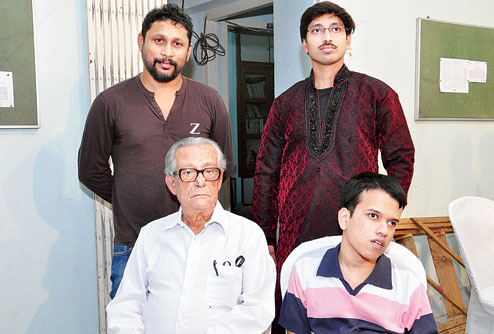
Debasish Das’s father Nikhilish recited a poem that his son had composed for the occasion. Debasish was born in 1989 as a healthy child but today suffers from cerebral palsy with hydrocephalus (see below).
The least-known face as a neighbour but the best-known name on stage was Shoojit Sircar. The man who made the National Award-winning film Vicky Donor has made BL Block his home for a year and half now. “I shifted to Calcutta as I wanted my daughters Koyna and Ananya to imbibe Bengali culture and ethos,” he declared. The youngsters in the block are delighted with his decision. “Awesome film,” a teenaged boy gushed, shaking his hand, as soon as he got off stage.
Aparup too had drawn a fair share of the audience. Mrittika Chatterjee was a former neighbour of the Chakrabortys. Though she has shifted to FE Block, she came to cheer for him. “Many of his childhood playmates are here too,” she said.
The longest speech of the evening came from Dhrubajyoti Lahiry, who was being felicitated for his contribution to refugees in the Bangladesh Liberation War (see box below).
After a string of solo performances by local singers, the final act was an audio drama called Bharate Chai by members of the block’s ladies wing. “It is a comedy by Jyotishman Chakraborty but we have changed the gender of the dramatis personae. All six of us are women,” said Nilima Ghoshal, president of the ladies wing. Arati Banik raised a few laughs even before taking the stage. The lady, who was to essay the crucial role of the new tenant, had forgotten the name of the play itself!
HB Block
Residents of HB Block celebrated Poila Baisakh at their community hall for the first time this year. The highlights of the event were recitals by singer Subhamita Banerjee, who delighted with Rabindrasangeet and her own hits, and Calcutta Choir which presented evergreen songs of S.D. Burman, Hemanta Mukherjee and Shyamal Mitra.
The event drew around 1,000 people from different blocks. “I’ve come to hear Subhamita; she’s my favourite,” said Chayanika Moulik of FE Block.
The block association had organised a prabhat pheri in the morning and felicitated local councillor Debasish Jana in the evening. The celebrations cost Rs 1.15 lakh. “We had not pressured residents to pay for this but accepted donations from whoever wanted to give. This is an attempt to remain rooted to our traditions,” said Anil Chakraborty, president of HB Block Residents’ Association.
 |
| Bidhannagar Walkers Club (Salt Lake) celebrated Poila Baisakh outside Aayash hotel in DD Block. The club has been around since 1985 but its members walk separately, wherever convenient for them. They come together once a year, to celebrate Nava Varsha. This year too members sang, recited and shared jokes with one another. |
Dhrubajyoti Lahiry, BL 89 Felicitated by the Bangladesh government in March 2013 for his role in helping refugees in the Bangladesh Liberation War Dhrubajyoti Lahiri was a lecturer at Charuchandra College when the Bangladesh war broke out in 1971. Concerned at the genocide, he and his friends formed the Calcutta University Bangladesh Sahayak Samity. “Our first task was to raise funds. We took newspaper cuttings of the Pakistan army’s atrocities on the then East Pakistanis and sent them to as many addresses as we could find. Funds poured in, especially from foreign universities,” says Lahiry. The first person to write them a cheque was scientist Satyendra Nath Bose. Next, they had to take the relief to the needy. “We were allowed to travel 2km into Bangladesh under the eyes of the Indian border security forces. The relief camps would be cramped with people sleeping, eating and defaecating under one roof,” recalls the 77-year old. In every camp that he visited he saw torn saris and blouses on the ground — signs of atrocities on womenfolk. He is still haunted by images of bloody palm prints on the walls. At one camp where they were distributing sweaters, they fell one short. “The boy who didn’t get a sweater had tears in his eyes so I gave him the one I was wearing and promised to bring him a new one the next time I came,” says Lahiry. But the next time around, the boy was nowhere to be seen. “He might have got killed, who knows? I never knew the boy’s name but I have never forgotten his face.” Another task was rehabilitating the youths who crossed over. “We got the teachers among them inducted into colleges across India and got some of them to document the war as it would one day be the history of their country.” The group’s efforts lasted till the end of the war in December 1971. Thereafter Lahiry moved to Delhi. In 2001 he retired as professor of biology from NCERT and shifted to Salt Lake. Last year, the Bangladesh government decided to honour the Sahayak Samity and since Lahiry is the only remaining member of it, he went to receive the award. This year, the government invited Lahiry in his personal capacity to receive the Friends of Liberation War Honour. “I met Prime Minister Sheikh Hasina and was delighted to see the people there happy. The sacrifices of their forefathers had not gone in vain,” says Lahiry. Debasish Das, BL 84 Has published two books despite being afflicted by cerebral palsy Can you picture a boy with 80 per cent brain damage writing poetry? Can a boy who utters gibberish and gestures incoherently express himself through his writings? Can a boy who is unable to hold a pen, at all write? Till 2009, Debasish Das’s parents thought the above impossible but then suddenly their son, who suffers from cerebral palsy with hydrocephalus, started writing. “He has been going to Indian Institute of Cerebral Palsy since he was a child but never responded to any teachings. One day I asked Debasish if he knew his tables and he nodded. So I wrote 2x2 on a paper, held a pen up so he could hold it and asked him to try to write,” recalls his mother Swarnamayi. Not only did Debasish scribble the right answer, but he went on to write up to 2x30 correctly. Shocked but encouraged, his mother gradually got him to write a diary. And then there was no looking back. With his mother holding the tip of his pen, Debasish wrote every day about how happy he felt when his granny gave him toy cars or how scared he got when a baby was crying next to him (he cannot bear shrill noises). When he visited the US, he wrote that the country has the best of facilities but that the people are self-centred. Soon his words took the form of poems and Debasish’s first book Amar Moner Kalpana O Asha was published in the 2012 Book Fair. The government has asked all state-run primary schools and libraries to stock the book. A second book Amar Kalpanaye Swadesh Goda came out in this year’s Book Fair. The books are available at Ujjwal Sahitya Mandir in College Street. The 24-year-old’s poems, stories and articles are simple and emotions universal. He has written on nature and water shortage as well as foreign direct investment and the paradox of some people starving and others wasting their food. He is inspired by Swamiji’s teachings, that his parents read out to him. But his most heart-rending poems are the personal ones. “Sometimes I feel sad when others do not spend time with me,” he writes. “But I console myself thinking they are busy at work. I too will work, I will write and make my parents proud.” “No one in our family has ever been into literature and we have no idea how he’s so talented,” says his father Nikhilesh, a retired IAS officer. “I appeal to all parents of special children not to lose faith in them.” In his poem Agami Diner Kotha, Debasish tells his parents not to worry about him as he is now grown up and can support himself by writing. “But who will hold my pen so I can write?” he asks his mother. — Brinda Sarkar |