Trump will reiterate 2-3 week timetable to end Iran war in address, says official
US President Donald Trump is expected to reiterate the two to three-week timetable for ending the war in Iran during an address on Wednesday night, a White House official said.
Rosatom to evacuate more than 200 staff from Bushehr nuclear plant
Russia's state nuclear corporation Rosatom plans to evacuate more than 200 of its staff from Iran's Bushehr nuclear power plant this week, Rosatom chief Alexei Likhachev said on Rossiya-24 state television.
Likhachev said up to 50 Rosatom personnel would remain at the plant, all of them volunteers.
Kuwait puts out fire after Iranian drone strikes airport fuel tanks
Kuwaiti firefighters on Wednesday extinguished a fire that broke out earlier in the day in fuel tanks at Kuwait airport following an Iranian drone attack, the government said. There were no casualties, and only material damage was reported.
US VP Vance engages 'intermediaries' on Iran tensions
U.S. Vice President JD Vance has been talking to "intermediaries" about the Iran conflict as recently as Tuesday, a source briefed on the matter told Reuters on Wednesday.
President Donald Trump directed Vance to communicate privately that he was open to a ceasefire as long as certain U.S. demands were met, including reopening the Strait of Hormuz, the source said.
Iran leader calls Trump's remark on ceasefire 'false, baseless'
Iran Foreign Ministry spokesman Esmail Baghaei on Wednesday called US President Donald Trump's remarks on Tehran allegedly asking for a ceasefire 'false and baseless'
UK to host talks with 35 nations on reopening key oil shipping route
Foreign secretary Yvette Cooper will host a virtual meeting of around 35 countries on Thursday to discuss viable diplomatic measures for reopening the Strait of Hormuz - one of the world's busiest oil shipping channels, reports BBC.
At a Downing Street news conference earlier, UK PM Keir Starmer said the best way to address rising costs of living is to push for de-escalation and ensure the strait is reopened.
Iran emergency chief says 24 health workers killed since start of war
At least 24 healthcare workers have been killed while providing services during the war, as medical staff and infrastructure come under sustained attack, while 114 healthcare workers have been injured and 330 healthcare facilities destroyed.
Attack in northwestern Iran Mianeh, leaves five dead
At least five people were killed in a US-Israeli strike on a residential area in Mianeh, in northwestern Iran, according to Iranian media reports.
UK PM says Iran war will impact Britain's future
UK PM Keir Starmer assures the citizens that while the Iran war escalates, and while countries are trying to restore peace, Britain will be able to weather it all.
He said UK will not be "dragged into" the war against Iran as he announced to host an international conference this week to discuss all viable diplomatic and political measures to reopen the Strait of Hormuz.
Speaking at a Downing Street press conference, Starmer also sought to dismiss US President Donald Trump's recent comments on NATO as "noise".
He said the impact of the war in the Middle East will "affect the future of our country", but emphasised that "no matter how fierce this storm, we are well-placed to weather it." Earlier, President Trump said he was considering withdrawing the US from NATO, after allies did not join his war with Iran.
Trump also criticised the UK for refusing to get involved in the US-Israeli war against Iran, and suggested the Royal Navy was not ready.
Asked about the US president's comments, Starmer said: "NATO is the single most effective military alliance the world has ever seen, and it has kept us safe for many decades.
"We are fully committed to NATO. Secondly, that whatever the pressure on me and others, whatever the noise, I’m going to act in the British national interest in all the decisions that I make.
"And that's why I've been absolutely clear that this is not our war and we're not going to get dragged into it." Starmer emphasised the need for closeness with Europe, and announced that Foreign Secretary Yvette Cooper will host a meeting with international leaders to "assess all viable diplomatic and political measures" to reopen the Strait of Hormuz.
Starmer said “a united front of military strength and diplomatic activity” is needed to restore stability.
IRGC says Hormuz under 'firm and dominant' control; 'will not be opened to enemies'
According to Al Jazeera reports, the IRGC says the situation in the Strait of Hormuz is “firmly and dominantly” under its control and “will not be opened to the enemies of this nation by the ridiculous displays of the US President”.
A short while ago, Trump claimed that the Iranian president had asked for a ceasefire, adding that he will will consider it “when Hormuz Strait is open, free, and clear”.
Iranian leader asked for ceasefire; until 'Hormuz is open, free, and clear, we will blast Iran' says Trump
Iran's new leader has just asked the United States for a ceasefire, U.S. President Donald Trump said in a Truth Social post on Wednesday.
"We will consider when Hormuz Strait is open, free, and clear. Until then, we are blasting Iran into oblivion," he said.
Jet fuel and diesel shortage will hit Europe this month, warns head of IEA
Oil supply disruptions from the Middle East will rise in April and begin to impact Europe's economy as the closure of the Strait of Hormuz severely curbs supplies, International Energy Agency head Fatih Birol said on Wednesday.
More than 12 million barrels of oil have been lost since the start of the U.S.-Israel war on Iran due to Tehran's attacks on energy assets in the region and restrictions on shipping through the Strait, he added.
"The loss of oil in April will be twice the oil loss in March, on top of the loss of LNG... It will come through inflation and will cut economic growth in many countries," Birol told a podcast with Nicolai Tangen, the head of Norway's sovereign wealth fund.
Losses are expected to widen in April, since a number of oil and LNG cargoes arriving in March were contracted before the war and continued towards their destinations, he added.
The biggest problem is the lack of jet fuel and diesel which has already affected Asian countries but was also due to hit Europe, Birol said.
"We are seeing that in Asia, but soon, I think, in April or May, it would come to Europe," he added.
Birol repeated that the IEA was considering a further release of strategic reserves after its members agreed to release a record 400 million barrels of oil.
The current oil and liquefied natural gas (LNG) supply disruption is worse than the two oil crises in 1973 and 1979, as well as the loss of Russian gas volumes due to Moscow's invasion of Ukraine in 2022, combined, Birol said.
About 40 key energy assets in the Middle East have been damaged since the start of the war, and it would take some time to get them back, he added.
"We are heading to a major, major disruption and the biggest in history up to now," Birol said.
Iran targets Kuwait airport, tanker off Qatar amid escalating conflict
Iran hit an oil tanker off the coast of Qatar and Kuwait's airport on Wednesday while airstrikes battered Tehran - an unrelenting tempo hours after US President Donald Trump said he was nearly ready to wind down the war.
Trump, who is scheduled to address the nation later in the day, said he could walk away from the war in two to three weeks once he felt confident Iran would not be able to build a nuclear weapon - even if Tehran does not agree to a ceasefire.
That raised the possibility that the US could withdraw without any guarantee from Iran that it would stop bombing its Gulf Arab neighbours or release its grip on the crucial Strait of Hormuz.
A fifth of the world's traded oil passes through the strait in peacetime and Tehran's stranglehold, along with its strikes on energy infrastructure in the region, has caused oil prices to skyrocket, with far-reaching consequences for the global economy.
Even if the strait were to reopen quickly, some effects like higher food prices could persist for months or longer.
It's also not clear what Israel, which began bombing Iran alongside the US on February 28, would do if the US pulls out without a deal. It also leaves open the question of what Iran might do with the highly enriched uranium still in its stockpiles.
No signs of Iran relinquishing its grip on the Strait of Hormuz
Trump's Iran war made 'everything more expensive' in US, people 'paying the price'
According to Al Jazeera report, Democratic Senator Chris Coons says that Trump’s “war of choice in Iran has made everything more expensive”.
“It’s not just prices at the pump. It’s groceries, utility bills, and even mortgages,” Coons said in a post on X.
The lawmaker, who is a member of the Senate Foreign Relations Committee, said it is US families “who are paying the price” for the war.
Earlier, Coons criticised the lack of clarity from the Trump administration on why the war was launched or when it would end.
Israeli air strike in southern Lebanon kills family of four
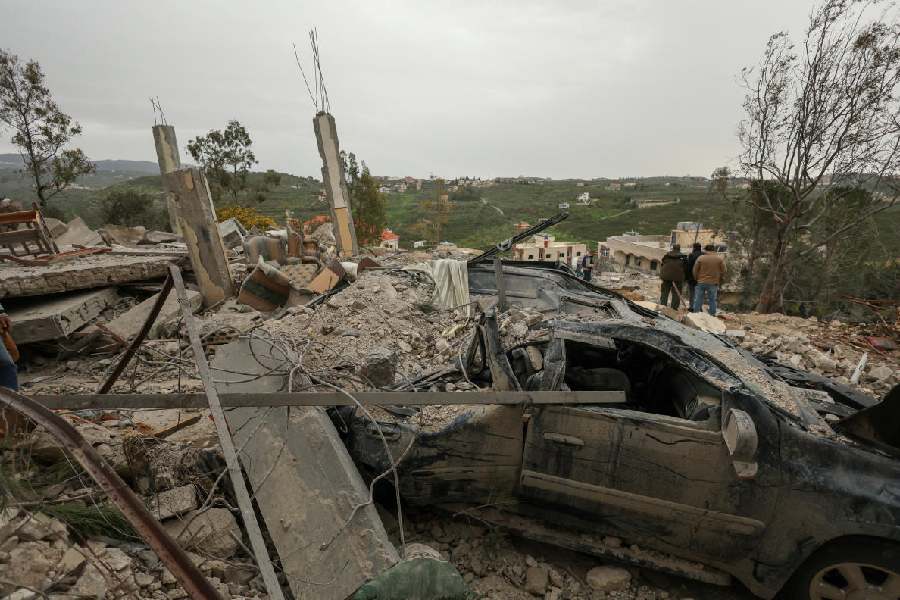
An Israeli airstrike destroyed a home in Houmine El Tahta, southern Lebanon, killing a couple and their two daughters.
Iran warned NATO ally Bulgaria to deny US airport access
Iranian authorities warned NATO member Bulgaria last month not to let the U.S. use its airports for planes participating in military operations in Iran, the foreign ministry said on Wednesday. Earlier on Wednesday, Stanislav Balabanov, a deputy with the "There is Such People" party, showed a note from March 18 in which the Iranian government protested against U.S. military refuelling planes parked at Bulgaria's Vasil Levski airport.
In the note, Iran said it "reserves the right to take all necessary measures to protect its sovereignty, security and national interests in accordance with international law." Later on Wednesday, in a statement to reporters, Deputy Foreign Minister Marin Raikov confirmed the note and said: "Bulgaria is not at war."
"No combat aircraft are being loaded over Bulgaria to participate in military operations," he told reporters. "We maintain intact diplomatic relations with the Iranian side."
In late February, Bulgarian media reported that several U.S. military planes landed at the Sofia Vasil Levski civilian airport, and authorities have said they were part of the NATO forward deployment which Raikov confirmed on Wednesday.
"Our parliament has not approved decisions to support relevant military actions in the Strait of Hormuz region," he said. Some European countries, concerned over the war with Iran, have pushed back on U.S. military operations.
Spain closed its airspace and denied base access, Italy rejected a stopover at Sigonella base, and France blocked overflight of U.S.–Israel weapons flights.
Airstrike claims two lives in southern Lebanon’s Mansouri
An airstrike struck a motorcycle earlier today in the southern Lebanese town of Mansouri, killing at least two people, according to Lebanon’s National News Agency.
NATO ensures security of Euro-Atlantic not 'carry out operations in Hormuz'
NATO is a military alliance that ensures the security of the Euro-atlantic area and is not designed to carry out operations in the Strait of Hormuz that would breach international law, France's junior army minister said on Wednesday.
"Let me remind you what NATO is. It is a military alliance concerned with the security of the Euro-Atlantic region. It is not designed to carry out operations in the Strait of Hormuz, which would be a breach of international law," Alice Rufo said at the War & Peace conference in Paris.
U.S. President Donald Trump said he was strongly considering pulling the United States out of NATO after allies failed to back U.S. military action against Iran, according to an interview with Britain's Daily Telegraph.
Iran’s Khamenei praises Hezbollah for fighting the 'worst enemies of the Islamic world'
According to Al Jazeera reports, Iran’s new Supreme Leader Mojtaba Khamenei has sent a message of gratitude to Hezbollah’s chief Naim Qassem.
In a written statement circulated by Iran’s state-linked ISNA news agency, Khamenei wrote that Hezbollah’s leaders represented “uprightness, steadfastness and patience” against “the worst enemies of the Islamic world”.
Iran agrees to allow safe passage of six fuel carrying ships to Bangladesh
Iran on Wednesday said its Security Council has approved safe passage to Bangladesh's six fuel-carrying ships waiting to cross the Strait of Hormuz amid continued war in West Asia.
As petroleum reserves continue to dwindle in Bangladesh, heavily dependent on imported fuel, five LNG shipments from Qatar and one crude oil cargo from Saudi Arabia, carrying nearly 5 lakh tonnes of LNG and around 79,000 tonnes of crude oil are waiting to cross the Strait of Hormuz.
"Iran does not want Bangladeshis to face any hardships and will provide all necessary assistance for transporting fuel through Hormuz," Iranian Ambassador in Dhaka Jalil Rahimi Jahanabadi told a press conference here.
Bangladesh had earlier requested Iran to allow the vessels to pass through the strait following the February 28 attacks by the United States and Israel on Iran and the retaliation by the Islamic nation.
The ambassador, however, expressed disappointment over Bangladesh's official reaction to the Israeli-US attacks on his country, which failed to condemn the aggression violating the UN Charter and the international law.
"Bangladesh has expressed concerns, but we would have been happy to see Bangladesh condemning the aggression on Iran," he said.
Jahanabadi said the previous US administration avoided falling into what he called an "Israeli trap" but claimed that President Donald Trump had done so under Israeli influence and instigation bringing the "entire region into war."
The envoy's comments came as officials concerned said Bangladesh currently had less than a month's of fuel reserves while Energy Division officials said they are yet to receive an official letter from Iran but noted that developments are moving in a positive direction.
Jahanabadi said the embassy in Dhaka has sent information and photographs to Tehran highlighting the difficulties faced by Bangladeshis amid the ongoing war.
The energy division last week provided the foreign ministry with a detailed list of six Bangladesh-bound vessels, including five LNG shipments from Qatar and one crude oil cargo from Saudi Arabia, carrying nearly 5 lakh tonnes of LNG and around 79,000 tonnes of crude oil.
"Initially, there were no specific details of the ships. After we informed Bangladesh, they shared the specific information last week," the envoy said.
Bangladesh depends heavily on imports for energy, with nearly a quarter of its natural gas demands and nearly all crude/refined oil imported, leading to high-risk energy security.
Starting February 28, the US and Israel have launched a massive joint attack on Iran and with Iran's retaliation, it has extended to the entire Gulf region.
Iranian strikes in Hormuz have affected maritime traffic in the strait, which is crucial for global supply chains for crude and oil.
The strait, a narrow shipping lane that connects the Persian Gulf with the Indian Ocean, remains effectively closed, bringing to a near halt the transit of hundreds of vessels per day, including container, dry bulk and liquid cargo ships.