A dessert without wine is like a day without sunshine.”
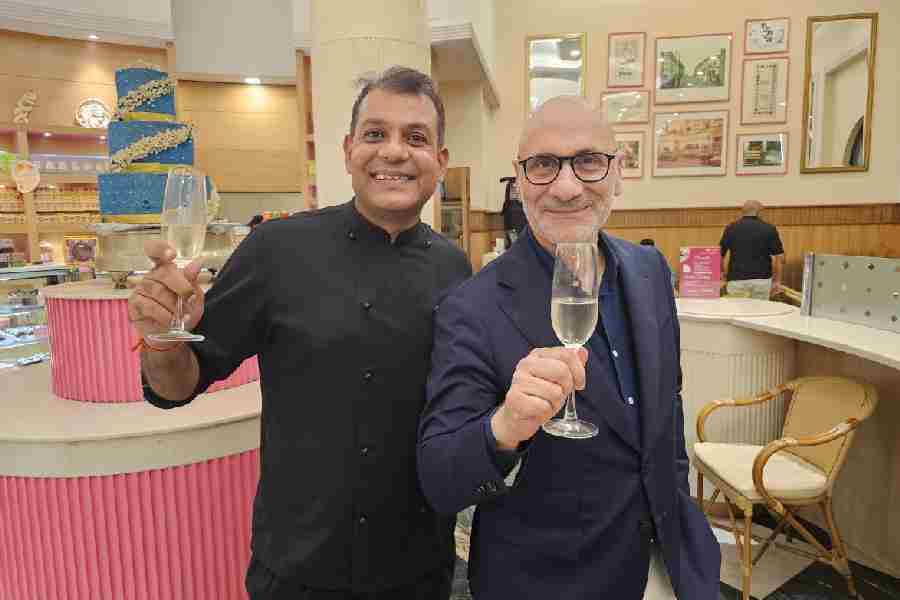
With that playful twist on a line commonly attributed to Jean Anthelme Brillat-Savarin, the author of Physiologie du Goût (1825), Olivier Thiénot, a distinguished French wine educator and sommelier, opened a wine-pairing session at Flurys.
The guests, invited by Alliance Française du Bengale, had gathered for an unusual gastronomic experience — pairing wine not with cheese or meat, but with desserts.
Each participant received a booklet titled My Tasting Notes, complete with tables to record the wine’s region, grape variety, vintage, price and personal impressions of the pairing.
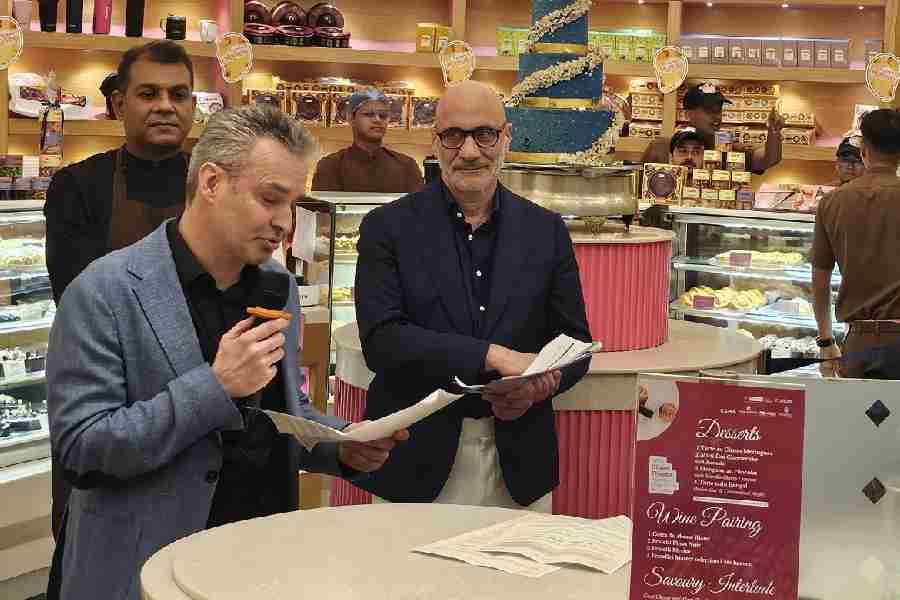
Alliance Francaise du Bengale director Marc Boudin addresses guests as Olivier Thiénot and Vikas Kumar look on
Thiénot first directed guests to the booklet’s opening pages: a world map highlighting major wine-producing nations and a map of France marked with its key wine regions. “As a broad rule, the cooler north of France is associated with white and sparkling wines, while the sunnier south is better known for robust reds,” he explained.
The sommelier then introduced the guiding principle behind the evening’s pairings. “When you are looking to do a pairing, it is not the flavours but the weight of the dish and the wine that you have to keep in mind, in addition to texture,” he said. Sugar levels in the dessert, he added, were equally important in determining the choice of wine.
Four desserts, each matched with a carefully selected wine, were to be served over the course of the session.
“We start with a white wine,” he announced as waiters placed glasses of Côtes du Rhône Blanc on each table. Describing it as a dry, crisp and aromatic white from France’s southern Rhône Valley, he invited guests to locate the region on the map. The wine was paired with a lemon meringue tart, its citrus and floral notes complementing the dessert’s tangy sweetness.
Next came Pinot Noir, a light-to-medium-bodied red celebrated for its high acidity, smooth tannins and elegant complexity. “Among reds, Pinot Noir has less body. It is a charming grape from Burgundy, in central France,” Thiénot said of the variety, notorious for being difficult to cultivate but capable of producing some of the world’s most sought-after wines.
It accompanied an inventive fusion dessert — Mishti Doi Cheesecake with Rasmalai — that married two Bengali milk-based favourites with a Western classic. The modern cheesecake, perfected in the US after the advent of cream cheese in the late 19th century, is prized for its soft texture and balanced flavour.
“Anything too sweet would attack the cheesecake. So we chose to go with a local touch. Mishti doi provided a slightly tangy note while rasmalai added earthy flavours,” he explained.
The third pairing featured Merlot, a full-bodied red, alongside Marquise au Chocolat with Morello Cherry Compote, a dessert designed for serious chocolate lovers. “The strength of the chocolate requires a wine with more volume, which is powerful on the mouth,” the Frenchman said.
The final course was Tarte Tatin Bengal. The classic French upside-down apple tart, named after the Tatin sisters and believed to have originated from a kitchen mishap at their inn, traditionally involves apples caramelised in butter and sugar before baking. At Flurys, however, nolen gur replaced conventional sugar.
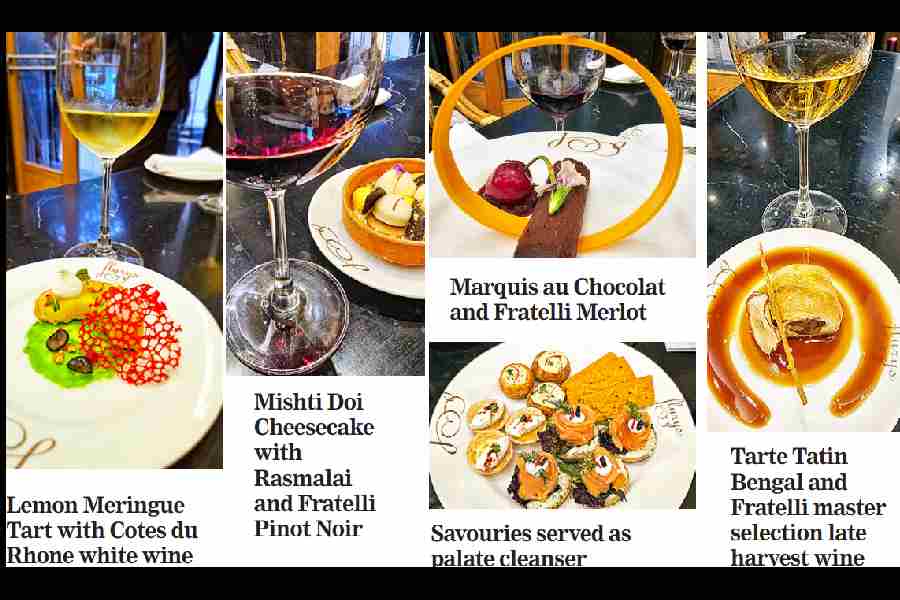
“It is very difficult to match the smoky notes of caramelised apple,” Thiénot said. “So we decided to go with a late-harvest wine.” Such wines are produced from grapes left on the vine well beyond the normal harvest period, allowing them to dehydrate naturally and concentrate their sugars and flavours, resulting in a richer and sweeter wine.
“We are pairing food with wine all the time. Why not have wine with dessert? is the challenge we put to ourselves,” said Vikas Kumar, director, food productions, Flurys.
“We have created a menu that is a dialogue between French wine culture and Calcutta’s celebrated gastronomic traditions, bringing together cheesecake and mishti doi, dark chocolate and nolen gur. To be working with a sommelier of M. Olivier’s standing — combining his deep mastery of French wines with our own legacy of dessert craftsmanship — is a privilege. We see this not as a one-off event but as the beginning of a continuing programme of curated sensory experiences at Flurys,” he added.
Marc Boudin, director of Alliance Française du Bengale, described the event as part of the institution’s efforts to create cultural exchanges between France and India. “At Alliance Française du Bengale, we believe culture is best experienced through meaningful encounters between French excellence and Indian audiences. Our collaboration with Flurys and the Apeejay Group reflects a long-standing relationship built on shared values of excellence, heritage and openness. Following the success of our February programme with Gaël Clavière, pastry chef to the prime minister of France, we were delighted to welcome one of France’s finest sommeliers, Olivier Thiénot, for his inaugural engagement at the iconic Flurys.”
Guests also took part in a light-hearted quiz and sampled palate-cleansing savouries — featuring Goat Cheese and Herb Tartlets, Smoked Salmon Blinis, Parmesan sablés, and Comté gougères — between courses.