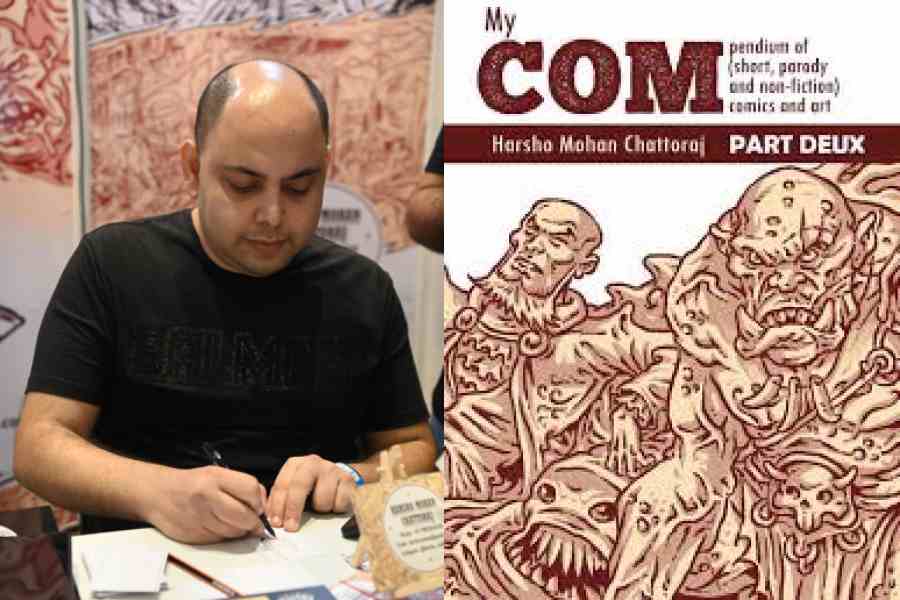
At a time when India’s comics ecosystem is negotiating the disparity between print nostalgia and digital immediacy, creators like Harsho Mohan Chattoraj find themselves at the centre of an evolving landscape, one that is expanding in reach, if not always in visibility. Speaking to t2 on the sidelines of Kolkata Comic Con 2026, Chattoraj reflected on how engagement with comics in Calcutta — and indeed across India — has transformed over the years, shaped as much by technology as by changing reading habits.
“There is definitely more recognition for creators now,” he observed, pointing to the rise of web comics as a crucial turning point. Where once comics were confined to print runs and occasional newspaper features, today they exist across platforms; shared, scrolled, and discovered on mobile screens. “We are publishing in print as well as on the web. New media has come up, which is a very good thing,” he said. Chattoraj also noted that while traditional coverage in newspapers has declined, digital platforms have opened up newer, more democratic spaces for visibility.
This progression, he explained, has lowered barriers for emerging creators. Artists from various cities are now able to showcase their work without relying solely on established publishing structures, creating what he described as a “new ground” for expression. Events like Comic Con, which began in Delhi over a decade ago and has since expanded across cities, along with initiatives such as Indie Comix Fest, have played a pivotal role in nurturing this ecosystem. Calcutta, in particular, stands out for its curious and receptive audience. “If people here like something, they will try it,” he said, highlighting the city’s willingness to explore beyond familiar genres.
At the same time, Chattoraj acknowledged that the form of the comic itself is undergoing a significant transformation. The traditional comic-book page, often dense with panels and text, can be intimidating for first-time readers, especially in an age dominated by quick, screen-friendly content. Web comics, with their one-panel-per-screen format, offer a more accessible entry point. “One mobile screen, one page, one panel — it’s a good process,” he told us, suggesting that digital formats are not replacing print so much as reshaping how stories are first encountered. Increasingly, creators are experimenting with a hybrid model by launching stories online before bringing them into print.
Looking back, Chattoraj admitted there was a period between 2000 and 2010 when the future of Indian comics seemed uncertain, with audiences gravitating heavily towards DC Comics and Marvel Comics. Even now, global influences such as manga continue to dominate certain segments of readership. Yet, Chattoraj remains optimistic about the gradual rise of Indian narratives. “If Indian content is appreciated little by little, people will enjoy it,” he said, emphasising the importance of building a distinct voice rather than competing directly with international giants.
He also pointed to untapped possibilities within the industry, particularly the adaptation of films and other popular media into comics, a practice more common in the West but still emerging in India. Such cross-medium storytelling, he suggested, could significantly expand the audience base and deepen engagement with the form.
For Chattoraj, the evolution of comics in India is less about replacement and more about the expansion of formats, platforms, and audiences. And while the journey is still in progress, the direction, he believes, is encouraging. “We have to explore everything,” he said, echoing a sentiment that captures both the uncertainty and the promise of comics in contemporary India.