Technology is increasingly becoming a lifestyle category, with average spends of ₹60,000 or more per visit on high-end gadgets, and two in five ultra elite consumers treat technology as a luxury purchase.
India’s affluent economy is undergoing a quiet but profound transformation. A new whitepaper — ‘Visa Consulting and Analytics (VCA) Whitepaper: India’s Affluent Economy 2025-2026’ from Visa, a global leader in digital payments — is putting hard data behind what many of us have been sensing anecdotally. To help us unpack what this all means — for businesses, for brands, and for the broader Indian economy — we got in touch with Sushmit Nath, head of Visa Consulting & Analytics (VCA), India & South Asia, Visa.
Goldman Sachs projects 100 million affluent consumers by 2027. How prepared are Indian brands, banks, and platforms?
What’s encouraging is that preparedness is no longer theoretical, it’s already visible in how the ecosystem is evolving. Our whitepaper shows that affluence in India is becoming behaviourally visible much earlier than traditional income classifications would suggest. Discretionary spending is no longer episodic; it’s becoming routine and experience-led.
That said, there is still a critical transition underway. Serving this cohort well is less about adding premium products and more about building coherent lifestyle ecosystems across travel, dining, wellness and payments. The institutions that will win are those that move from transactional thinking to access-led and experience-led propositions, where convenience, trust and consistency matter as much as rewards.
From Visa’s perspective, our role is to enable this readiness through global acceptance, secure infrastructure, and insights that help partners design propositions that align with how affluent Indians actually live and spend today.
Retail drops while travel climbs to 58 per cent for ultra elite. What does this mean for credit card reward programmes?
It signals a very clear reprioritisation. Among ultra elite consumers, the wallet has decisively tilted from goods to experiences, with travel now accounting for 58 per cent of discretionary card spend. That fundamentally changes how reward programmes need to be designed. Traditional earn-and-burn models centred on merchandise are no longer sufficient. Affluent consumers now value time saved, friction removed and access unlocked whether that’s priority travel services, curated dining, or concierge-led experiences. Rewards need to feel embedded into the journey, not redeemed after it.
What we’re seeing is a move toward experience amplification rather than points accumulation, and cards increasingly act as gateways into premium ecosystems rather than just payment instruments.
Non-metro cities are mirroring metro behaviour. What gaps still need to be closed?
Behaviourally, the convergence is already happening. Cities like Ahmedabad, Surat, Jaipur and Lucknow are showing consumption patterns that increasingly mirror metros, particularly in premium dining, travel and discretionary retail.
Where gaps still exist is largely on the supply-side of experience consistent premium merchant acceptance, curated global brand presence, and service depth. Many of these markets have the spending power, but not always the same breadth of choice or seamlessness that metro consumers take for granted. Importantly, this isn’t a demand problem; it’s a scaling opportunity. The next phase of growth will come from extending metro-quality experiences into these cities, anchored locally but benchmarked globally. Brands that establish presence early will benefit disproportionately as these markets mature.
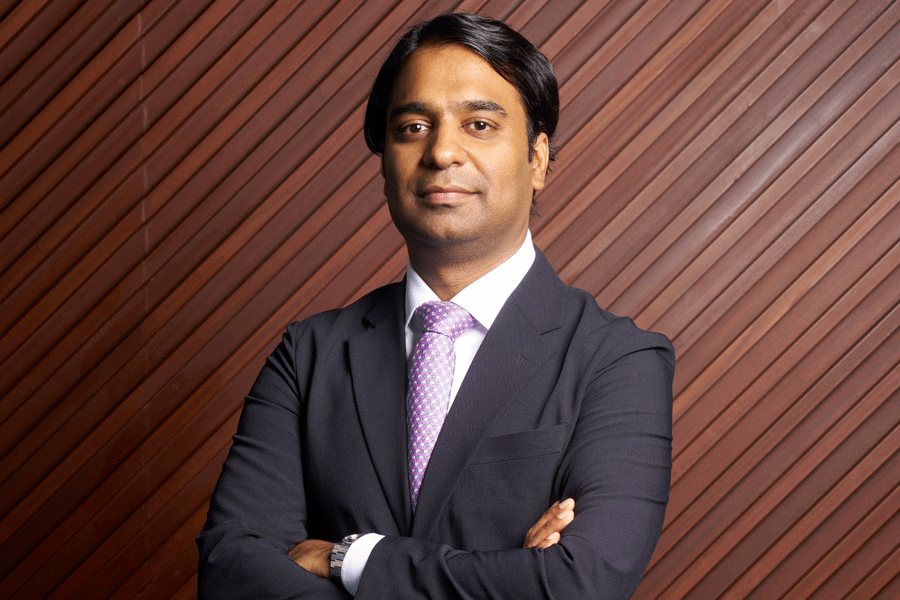
Sushmit Nath, head of Visa Consulting & Analytics (VCA), India & South Asia, Visa.
Is the ethical consumption trend real or still aspirational?
Visa data indicates that ethical considerations are increasingly influencing choice, particularly in experience-led categories. Among affluent diners, nine in 10 look for ingredient transparency, while seven in 10 say sustainability is very important, a notably high threshold by global standards.
That said, as with most markets, there can be a gap between stated intent and uniform behaviour. Where this intent translates most consistently today is in experiences such as premium dining, wellness-led travel and curated stays, where sustainability is embedded into the overall offering rather than positioned as a paid add-on. For brands, the takeaway is clear: sustainability resonates most when it functions as quiet infrastructure, not headline messaging. When it enhances authenticity, quality and experience, affluent consumers respond organically and reward it over time.
Are ₹20,000–₹50,000 dining benchmarks sustainable for hospitality businesses?
These numbers are striking, but they’re also demand-led. Our data shows an annual dining spend of around ₹2 lakh, with ₹20,000 emerging as a new spend floor for premium experiences and ₹50,000 as a benchmark for truly curated occasions. What makes these price points sustainable is that affluent dining today is highly intentional. These consumers dine out less randomly and more deliberately for curated menus, chef-led concepts, provenance, and exclusivity.
For hospitality operators, the implication isn’t higher pricing alone. It’s about consistency of experience. When the experience delivers in service, storytelling and quality affluent consumers justify the spend and return.