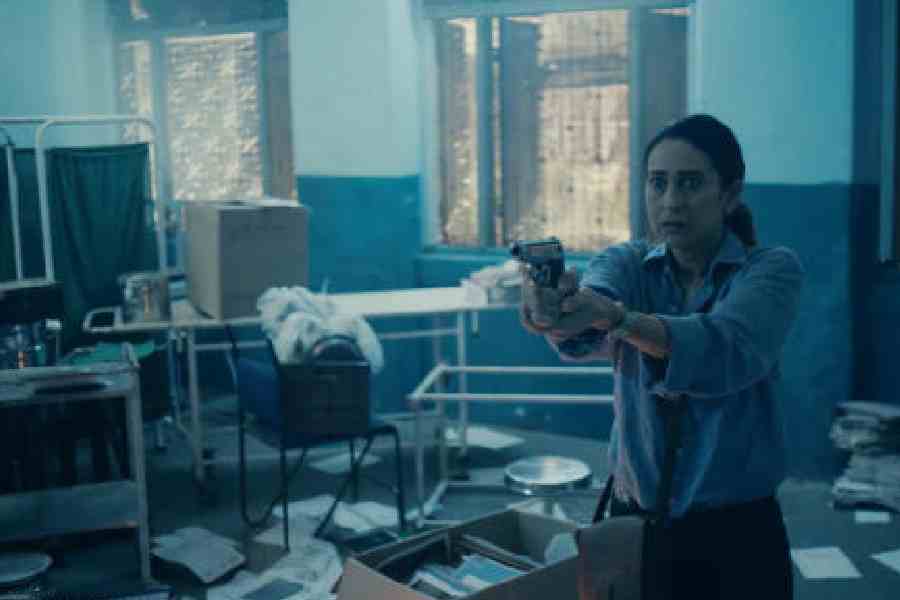
Karisma Kapoor is very sure about being unsure when she will come on screen again. “I may want to act again, I may not want to; I don’t know,” she shrugs when t2 mentions the long gaps between her recent projects. In fact, she had initially refused even this Zee5 neo-noir crime thriller, Brown, as it entailed a two-month stay in Calcutta. But that was till she learnt about the deliciously layered character that Rita Brown, the protagonist investigating the crime, is.
In which season did you shoot Brown in Calcutta?
In the peak heat of May and June in your lovely city. Even though it was so hot, we decided that we should use the sweat and the heat as part of my character. So if you see Rita Brown, you will see that she’s quite sweaty in all the scenes, because genuinely it was so hot, and we were shooting in so many real locations. It was very difficult to handle the heat, but I think we incorporated it within her character, within her role, which was really interesting.
Yeah, you were tying up your hair in a casual bun as you were entering every other scene…
I think the beauty of Rita Brown — she is a very human character. She is not just a cop with a past or a trauma. Even I have a habit of opening my hair, tying it up, so it’s like a reflex action for Rita Brown.
Abhinay Deo, the director, was here in Calcutta yesterday and he said you had initially said ‘no’ to the project.
You know, I don’t like to do much work. I’m very happy not being in the spotlight. I do work but not in the constant rat race. So, yes, I turned it down initially. It’s a big time commitment — going to Calcutta for 50-60 days — and I was like, no way, I can’t do this. But the team of Zee Studios actually refused to leave my set — I was shooting at Mehboob Studios for an ad. They said: “We are not leaving till you give us some time and hear us out.” So after a few days, I met Abhinay and the team, and when I heard about the character of Rita Brown and how different this show was going to be, I was like, okay, chalo, now I have to go to Calcutta, and I have to play Rita Brown. It was a very enriching experience.
Did you read City of Death (by Abheek Barua), on which the series is based?
Yes, I did, though there are some changes from the book. I also read about the Anglo-Indian community in Calcutta. There was a lot of detailing that went into building the story and her character before we went on the set, and I found that very interesting and intriguing as an actor.
In the book, the character was called Sohini Sen, a Bengali. Has making her an Anglo-Indian added another shade to the character?
Definitely. I think Abhinay’s idea was to have all the communities of people who live in Calcutta. So there are Bengalis, Marwaris, Gujaratis, Anglo-Indians — bringing everyone and the entire essence and flavour of Calcutta into the show. To play this very broken woman, who is so human… and you’re seeing this woman in a very raw state. I think that was very interesting for me.
Since Rita Brown is an Anglo-Indian, you didn’t have to speak much Bengali, right?
Yes. So she doesn’t speak much Bangla, and neither does she speak with a Bengali accent. She’s Anglo-Indian, so she talks with her own accent. While the Bengali characters are saying ‘Shoikat’, I say ‘Saicut’. When she talks to her driver or Subhendu Babu, she does speak a little bit of Bengali, but with her own accent.
Is this the first time you have worn a police officer’s uniform? You did do a 1992 film called Police Officer, but it was Jackie Shroff who played the cop.
Yes. Interestingly, somebody pointed out to me, while the promotions were on, that I wore a police uniform in Judwaa for one scene, but that was a comedy scene. Actually, I had even forgotten about that scene. But wearing the police uniform was a matter of honour and pride, and the feeling that you get and the responsibility that you feel are unimaginable. Even though I wore it only once in the entire show, that day we had a wonderful lady inspector who was there to guide me about my body language and everything.
Did the Calcutta gang in the cast introduce you to any snacks?
Honestly, I’m a big foodie, so I love eating. Of course, we had your prawns, the chingri malai, and machher jhol, and all the desserts. I don’t know which ones I should mention, but I must say that Bengali food was a big part of my stay there.
You worked with Jisshu (Sengupta) for the first time.
Yes, it was a wonderful experience. He’s such a fantastic artiste, and of course, such a big star in Bengal, but he was so humble, and it was very interesting that he’s such a hardworking actor. He rehearsed a lot with me, and I think it was remarkable that he put in so much effort. It was a great working experience.
You balanced David Dhawan with Shyam Benegal at the peak of your career. Was that a conscious choice?
I think it was. Back then, it was not the norm, you know. But at the end of the day, I am an actor. There is a difference between being a star and being an actor, and I love acting, and I wanted to grow, so I think it was a conscious decision. I remember when I met Shyamji for the first time, he asked: “Are you going to do my film?” I said: “Yes, sir, absolutely.” He was like: “But you are at the top of your game; you’re doing so many commercial films.” I said: “Sir, that doesn’t matter. I want to work with you.” And, of course, Zubeidaa was such a beloved movie and character. So, yes, I would be going from the Shyam Benegal set to the Biwi No. 1 set, and I think I was lucky enough at that time to have been able to do that.
Is there something that today’s generation of actors has that you didn’t?
A very big difference is that we worked on passion and instinct, and the direction of the director’s instincts. We never had a bound script. There was an idea, a narration, maybe a couple of narrations, and we would just go on the set, and that morning we would get the scenes, or maybe going on the set we would get the scenes, but I think that was a unique learning experience because it was not overly thought out. So that was a beautiful time, and we learnt from each movie. Today, of course, all of us get a bound script. There are so many workshops, which is a totally different way of working, which is also really good. So, I think I’ve been lucky to have seen that era and also work with today’s generation and witness the streamlining.
After three decades in the industry, if you could give one piece of advice to young Karisma Kapoor entering the industry, what would it be?
I’d say change nothing because I think I went in with a love of cinema. I wanted to prove myself, to add something to my family legacy, and I went with that determination, and with blinkers on, focused on my work. And I think that was a good thing. I’d ask today’s generation to do the same. I don’t think there’s any substitute for hard work and dedication in whichever field you’re working in, not just acting. If you are focused and work hard and you’re honest and sincere, anything is possible.
My favourite Karisma Kapoor film is... Tell t2@abp.in