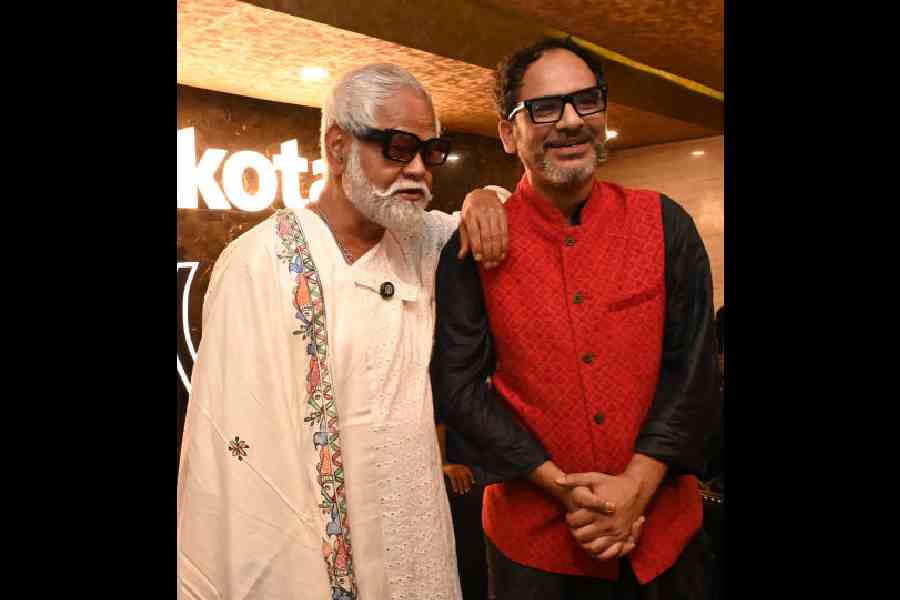
The premiere of Phera was recently held at PVR-INOX (South City). The arrival of cast and crew members and friends from the industry created an atmosphere of warmth and camaraderie. Seven years after Mukherjee Dar Bou, director Pritha Chakraborty returns with a heartfelt exploration of human relationships and social realities in Phera, which is running in theatres now. Incidentally, this film also marks Sanjay Mishra’s debut in Bengali cinema. Pritha has a talent for weaving stories that reflect societal issues while delving deep into the complexities of human interactions. This time, her film is elevated by the stellar performances of Ritwick Chakraborty and Mishra, whose mastery of their craft guides the narrative through poignant moments of emotional resonance and stark reality.
Mishra’s character, Pannalal, is a retired man passionate about football and father to Palash, portrayed by Ritwick Chakraborty. Palash is a single man approaching his 40s, embodying the struggles of countless individuals shackled by the weight of ambition. Having left his suburban origins, he navigates the chaotic urban landscape of living on rent and grappling with corporate politics while contemplating the allure of a bigger life beyond his current circumstances.
In contrast, Pannalal beautifully embodies the essence of a slow-paced Bengali life as a senior who stays away from his son. He leads a life filled with both simple pleasures and profound loneliness — living in a dilapidated home, forming bonds with neighbourhood strays, sharing uneventful evenings with an old friend while watching television, and passionately engaging as the secretary of a local football club — a position that brings him into conflict with local politicians, who seek to exploit the ambitions of young talent for profit.
The film not only explores the father-son dynamic but also highlights the friendship between Pannalal and his childhood companion, brought to life by veteran actor Pradip Bhattacharya, and the sweet bond between Pannalal and Palash’s landlord, portrayed by Sohini Sarkar with emotional depth and humour. Subrat Dutta’s character, who resists the relentless ambition that threatens to lift him away from his roots, and Priyanka Sarkar, who portrays a modern woman confidently navigating her corporate life on her own terms, also add significantly to the narrative.
Caught in a corporate whirlwind that often distances individuals from life’s simple joys — like spending quality time with family or cherishing memories of childhood — Palash, like many, struggles to make time for his father’s calls or to return to the neglected state of their family home. Instead, he finds solace in dining out with friends and colleagues, who encourage him to keep striving for greater success and dreaming of better opportunities in larger cities. As Pannalal hopes for his son to invest in his passion for football and their suburban roots, he decides to move into Palash’s rented apartment, transporting the audience into an acting masterclass through the father-son dynamics that follow.
Mishra aces the moments as Pritha opens a window into the urban Calcutta of the abandoned aged. As the narrative captures the everyday struggles of ageing parents who cling to the hope of rising above their circumstances and find a place in the lives of their ambition-driven children charting paths in cities away from home, the unique adda culture at Bengali tea stalls, and the generational tensions that exist between fathers and sons, Mishra manages to weave in his signature humour primarily through his mannerisms.
Pannalal stands out in both suburban and urban drudgery as a man who dances to his own beat. Ritwick complements this by effortlessly depicting a son that his father’s generation often misunderstands.
Pritha explores a range of deeply resonant themes, including displacement from one’s roots, nostalgia, memory, relentless ambition, corporate burnout, the plight of the elderly, and the chaotic, often directionless nature of contemporary urban life. Blending moments of genuine emotion with a deft touch of humour, the film gently poses a question: in our relentless pursuit of an idealised life — driven by numbing ambition and consumed by the demands of a corporate existence that often distances us not only from our roots but from our true selves — what happens when we finally pause and return home? What do we discover in the people and places that have been waiting for us — sometimes unchanged, often transformed, but always carrying a part of who we once were?