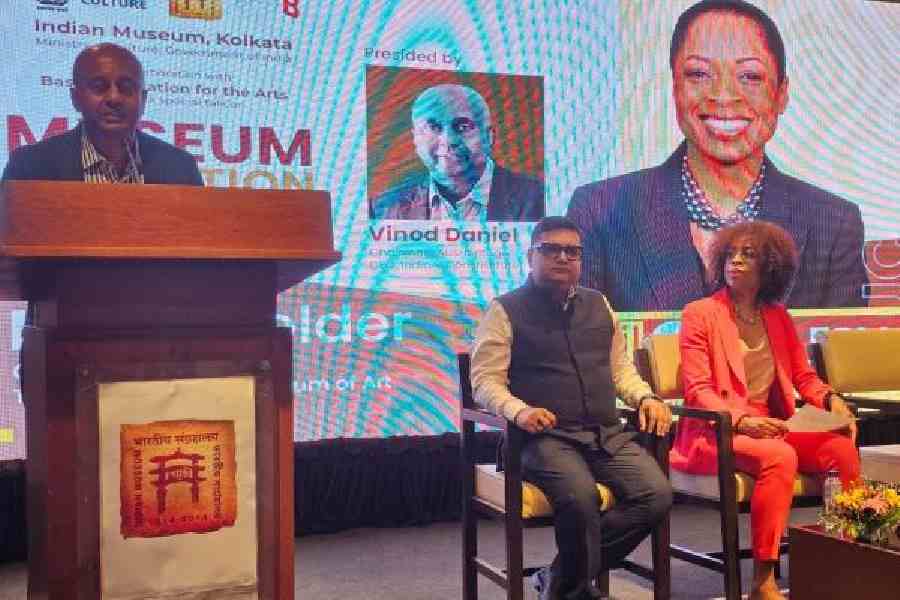
The dearth of trained conservators in India for cultural heritage conservation was a key concern that led to a two-day symposium held in the city titled ‘Shared Knowledge, Shared Collections: Strengthening Conservation in India’. Jointly organised by the Kolkata Centre for Creativity’s KCC Conservation Lab and The Metropolitan Museum of Art, the event hosted conservation professionals from across the country and The Met at the KCC.
“India needs about 10,000 more conservators,” Vinod Daniel, chairman of AusHeritage and CEO, India Vision Institute, told t2 on the sidelines of the symposium. And even that is a conservative estimate.
Explaining how he arrived at the figure, the honorary adviser to KCCCL said: “If you look at a country like the US, they have 5,000-6,000 trained conservators. We have more collections. Consider the human resource requirements at museums, and I’d assume you need at least 10,000 now.”
He pointed out that because of the varied skill sets needed in a conservator — be it conservation or curation or collection management — the job is not a generic role. “Those skill sets are substantially lacking in the museum sector right now. A lot of private investment is going into new galleries and museums, but we don’t have the human resources. So we can’t continue that momentum. There are fewer than 300 who are trained through degree programmes. There are about 700 others who have acquired domain knowledge through mentorships or on-the-job training,” Daniel said.
There are two sides to a conservator’s job — preventive and restorative, he pointed out. “Some agents cause exhibits to degrade, like light for textiles and humidity and temperature for musical instruments like drums. Also, unless you understand how to clean an object, you may end up damaging it.” The conservator’s job gets even more challenging in the face of natural disasters or in war zones, he added.
The solution, in his view, is to encourage more universities to set up degree programmes in conservation or museology, on the lines of that offered at the National Museum Institute of History of Art, Conservation and Museology. “Every state should have at least one degree-level conservation programme to cover the needs within that state,” he said.
The other initiative in this regard is the Indian Conservation Fellowship Program, which is supported by the ministry of culture, the Andrew W. Mellon Foundation, and partner institutions, including The Met, SRAL in the Netherlands, and the Smithsonian, to broaden the expertise of conservators in India. “The fellowship was started in 2010 and about 55 conservators from India have spent three to six months getting trained in places like The Met or SRAL. Once a year, we invite the fellows to meet at one of the country’s conservation labs,” said Daniel, a former deputy director at the Australian Museum in Sydney. Over 20 ICFP fellows attended the Calcutta symposium.
“India is home to an extraordinary range of cultural materials — archaeological artefacts, manuscripts, paintings, textiles, sculptures, and living traditions. At the same time, we continue to face challenges in terms of conservation infrastructure, training opportunities, and professional networks. It is within this context that gatherings such as this become especially meaningful,” said Ushmita Sahu, director and head curator of Emami Art.