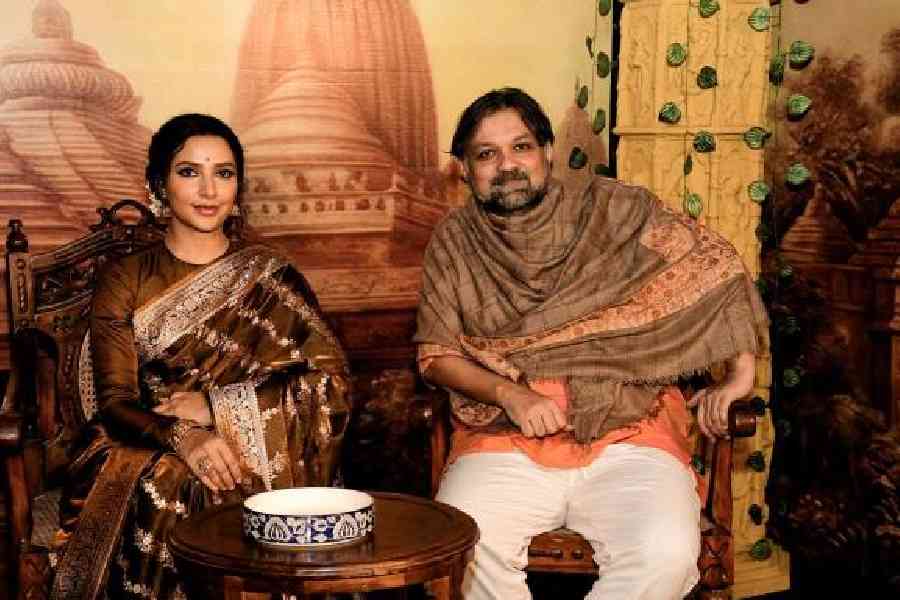
December light has a way of softening Calcutta. It turns afternoons honeyed, unhurried. At the DAG Creative Media office, the warmth came not just from the lamps arranged around the Lawho Gouranger Naam Rey decor, but from the people sitting beneath them. Post-lunch calm, winter settling into bones, a room dressed for a film that refuses to remain merely a film. Subhashree Ganguly arrived like a still frame from another century. An olive sari, silver zari catching the light, gajras tucked into her hair, jewellery worn with restraint and reverence. Across from her, Srijit Mukherji, in an orange kurta, white pyjama, shawl casually draped, looked every bit the storyteller who has spent a lifetime excavating history and unsettling certainties. We sat between them, notebooks open, aware that this conversation had already begun before the first question was asked. Indian classical music hummed faintly somewhere, like a benediction.
More Than Cinema
“What drew you to Binodini?” we asked Subhashree, easing into the question carefully. “Considering the historical, cultural, even religious context.” She smiled, reflective, unhurried. “What I heard first was that this was one of the best-written scripts,” she said. “So getting associated with this film was a big deal. And of course, I always wanted to work with Srijitda. But this wasn’t just about working with him. It meant much more. It meant something in our lives.” Srijit leaned in, picking up the thought almost mid-sentence. “This film will remain as a lived experience. I can’t even find the right words to explain it yet. Because yes, it is a film at the end of the day. After this, we will all work again, we will collaborate again. That’s a promise I’ve given myself,” he said, turning towards Subhashree. “Because she is an absolute delight to work with. One of the best actresses I’ve ever worked with.”
“Top five?” we asked. “Top three,” he said without pause. “Definitely top three.” Srijit was already elsewhere. “What sets it apart is that it transcends being shot, directed, acted. It becomes a life experience. Both in the present and through a lived memory of the past.”
Footnotes of Faith
He traced how the film gathered its spiritual weight. Of Rana Sarkar, who drove the project from day one, a devotee of Lord Jagannath and Chaitanya Dev. Of his own long-standing interest in Chaitanya Mahaprabhu as a political and social force. “I was always intrigued by the historical and political aspect of Chaitanya,” he said. “How he spoke of equality, how he spoke against untouchability. And before he became a social messiah, there was also the question of disappearance.” Subhashree listened as he spoke of her devotion. “She is a Jagannath devotee,” he said. “From childhood.” That spiritual inclination, Srijit felt, altered the experience entirely. “In the 15th century, there was no cinema. Documentation happened through oratory, singing, kirtan, sankirtan. Word travelled from mouth to mouth. Those who documented later also became part of history.” He paused. “We are also like that. Footnotes. Somewhere, years after we are gone, it will be said that in 2025, a group of people propagated his name and his words through cinema. The medium has changed. The hunger to spread love, fraternity, peace remains.” “History,” we said quietly. “Yes,” he nodded. “A footnote in history.”
Becoming Binodini
Pressure was inevitable. Subhashree acknowledged it openly. “Because this story is not only about Binodini. It’s about Binodini performing Chaitanya Mahaprabhu on stage. I had to be Subhashree becoming Binodini, and then Binodini becoming Chaitanya. Two characters at once. It was very difficult,” she said. “And theatre itself is different. Nineteenth-century theatre is nothing like today. I’ve performed on stage as a dancer, but acting is different. Theatre acting has its own structure, its own discipline.”
She spoke of forgetting the camera entirely. “It had to be believable. Because it’s Binodini on stage, not me.” “And as an actor,” she added, “I always want characters that take away my sleep. This one did. I heard the script in January, and from then on, I couldn’t come out of it.” She didn’t soften her conviction. “For me, this is Srijit Mukherji’s best writing.” “For you,” he smiled. “For me,” she repeated.
The Zone
Her process, she explained, begins with surrendering to the director. “It’s his world. I have to enter his psychology.” She laughed about relentlessly calling him during rehearsals. “There were days he didn’t even pick up my calls.” Srijit smiled, remembering the set. “But once we were rolling, it was seamless. She was always in the zone. In a trance. Not for the camera. Not for the paparazzi. A genuine trance. And what she brought with her was calm. The entire set would quieten.”
He paused. “To take up this responsibility as a filmmaker is like taking up arms in many sectors. But I tell stories that provoke, that resonate. If it hits you, you cannot remain unaffected.” He now sees the film as part of an unintended trilogy. “Three disappearances Bengal has discussed for ages.” “And you’re not answering the questions?” we asked. “A film cannot,” he said firmly. “The moment it starts answering, it becomes a problem. Craft lies in writing between the lines.”
Casting the Cosmos
Casting, Srijit said, was never about assembling stars but about building a universe that could breathe on its own. “This film needed actors who understand silence as much as dialogue,” he said. “Because this is not a loud film. It is a contemplative one.” Subhashree, he reiterated, was always Binodini. “She was there in my mind from the beginning. Life happened, pregnancy happened, time passed. And then one day she sent me a photograph. I looked at it and said, ‘Yes’, this is her. This is my Binodini.”
The world around her needed equal care. Ishaa Saha came in as someone he described as “emotionally translucent”, someone who could hold fragility without ornamentation. “She plays me in a way, the curious filmmaker.” Dibyojyoti Dutta, he said, brought a quiet intellectual weight, a sense of inner conflict that did not need exposition. “I told him I wanted to see him as Chaitanya Mahaprabhu but he had to lose 25 kilos in six months or he would lose the part. He did it! It is the softness in his eyes, the love, and not the romantic kind that made me cast him as Mahaprabhu.” “It is also Aratrika’s debut... my first film with Susmita Chatterjee too. Susmita forms the third leg in the Indraneil-Ishaa triangle. Each of them represents a different relationship with faith, art, or power,” Srijit said. “None of them is ornamental. Remove one, and the balance collapses.”
Jisshu Sengupta’s casting, he explained, was instinctive.
“He understands restraint. He knows when not to perform. That’s very important in a film like this.” Sujan Mukherjee and Surajit Banerjee, he noted, brought with them decades of theatrical memory. Ananya Banerjee’s presence, he said, was about moral gravity. And then there was Bratya Basu as Girish Ghosh. “That relationship between Girish and Binodini is not linear,” Srijit said. “It’s parental, it’s mentoring, it’s possessive, it’s liberating, and sometimes it’s cruel. Bratya understands Girish because he understands theatre, power, and ego. Without Girish Ghosh, Binodini cannot exist as we know her. And without Binodini, Girish is incomplete.” Subhashree nodded as he spoke. “Every actor here knows why they are here,” she said. “No one is just passing through the film.” Srijit smiled. “That’s the cosmos. Everyone has an orbit. Everyone affects everyone else.”
Winter Grammar
As the conversation softened, winter crept in naturally. “My winter non-negotiables?” Subhashree smiled. “From December 25 to January 2, I’m not working. It’s children’s time,” she said simply. “Being with them. Doing nothing fancy. That’s my winter.” Srijit added, “It is me and my lep (thick blanket), I cannot do without it!” Talking about shooting in winter, he said, “I prefer shooting in winter. Everyone does. Visually, winter gives you a grammar. The light is softer. Shadows behave. Faces open up.”
Then, inevitably, reality. “But also because we are a resource-trapped industry. In summer, at 40 degrees, I’m fighting for a make-up van, fighting for basic comfort, negotiating toilets for women technicians. Winter makes survival easier. Production becomes humane.” He paused, reflective. “Cinema is also about logistics. Winter helps us remember that.”
After the Light
Reflecting on 2025, Subhashree remained grounded. “I’m grateful. Scripts come, work happens. Whether people love it or not is beyond me.” “You’ve overtaken our screens,” we teased. “My characters will stay,” she said softly. “Indubala will stay. Mehul will stay. Binodini will stay.” Srijit added, “She will reign supreme in the audience’s hearts, and that is what matters.”
Outside, Calcutta moved on. The lazy cacophony in the afternoon forced to lower towards dusk. Inside, Lawho Gouranger Naam Rey lingered, no longer just a film waiting for its December 25 release, but a shared surrender to faith, labour, history and the quiet discipline of storytelling. More than cinema. A footnote, waiting to be read.