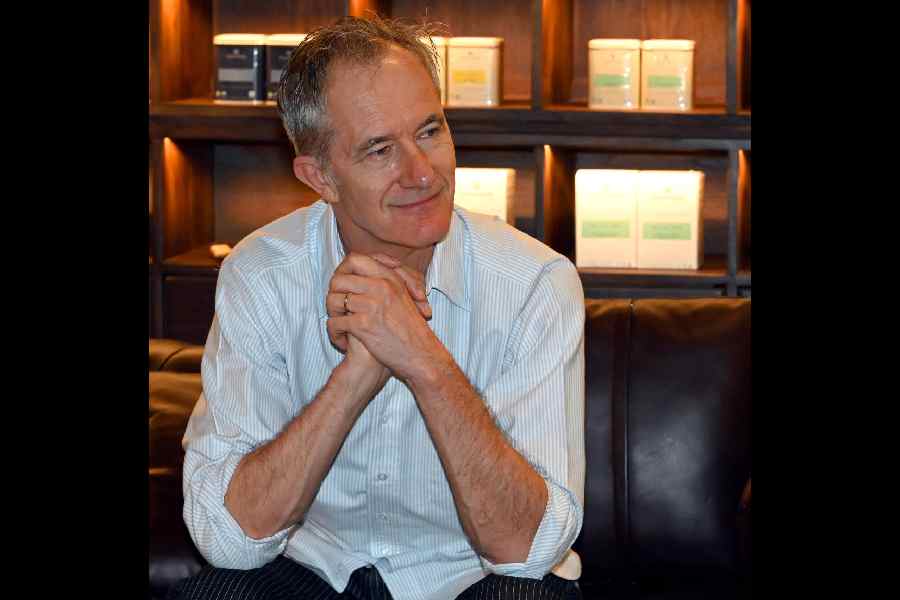
When we met Geoff Dyer at the Jaipur Literature Festival earlier this year and asked him about his impression of Calcutta, his next stop while he was in India, he responded with a quiet sense of fondness. “I’ve been there once before, and I got the sense that it’s one of the real great intellectual literary centres of Indian life,” said Dyer, who was born in Cheltenham, England, in 1958, and currently lives in Los Angeles.
Dyer, who has won multiple awards including GQ’s Writer of the Year, National Book Critics Circle Award, and the American Academy of Arts and Letters’s E.M. Forster Award, has authored four novels and two collections of essays, among other literary works. His oeuvre includes titles like Paris Trance, The Search and The Colour of Memory, The Last Days of Roger Federer, and the latest one — Homework: A Memoir.
Venice and Varanasi
It is his Jeff in Venice, Death in Varanasi, which he calls “half a book on India”, that kicked off our conversation in Jaipur. “Varanasi was such an intense experience for me,” shared Dyer, who went to the city with his wife and soaked in the spirit for a few months. The visuals and the entire experience were so overwhelming for him that he never wants to go back. “There’s no point going back because what would I be doing? I’d just be seeing stuff I’d already processed,” reasoned Dyer, who found similarities between Varanasi and Venice when he visited the holy place.
“As soon as we got there, I saw how similar Varanasi was to Venice. There are these crumbling palaces next to a big body of water. In the case of Venice, the canals and in the case of Varanasi, the Ganges. And they’ve both been in their different ways pilgrimage spots for a long time,” shared Dyer, almost reliving his visit to the ghats, which had a profound effect on him. It’s so intensely beautiful. It’s so intensely horrible. It is flickering back and forth.”
“The fact that Hinduism had been practised there (in Varanasi) for so long means that even if you’re a total atheist like me, the religious power of the place overwhelms you. If there was a scientific instrument, it would register that it has a special power; a place of extraordinary power that is not like anywhere else on Earth,” shared Dyer, who tried to decipher the power he had experienced in Varanasi in the book.
New Journey at 40
Dyer completes four decades in the literary world, and we ask him a reflective question. He goes back to his book Ways of Telling: The Work of John Berger. A candid Dyer shares: “When I published my first novel in 1989, I remember thinking, oh, this is so great, now I’m a proper writer, and I have done something. And then I found that, in no time at all, I had something else to say.” Written words soon became the medium for Dyer to understand, interpret and share. “The great thing about the writing life is that it really does keep you thoroughly engaged with the world. So, it’s a wonderful life, being a writer. It’s also a constant test of your ability to do it. I’ve not had an orthodox career as a writer, but I’ve certainly had a great life from this course of life.”

Geoff Dyer with Debanjan Chakrabarti, director of East and Northeast, British Council India, at a special conversation at Makaibari Bungalow in Taj Bengal.
Ways of Telling the Work of John Berger was a critical study of John Berger, an English art critic, novelist, painter and poet, who won the 1972 Booker Prize. Dyer calls it “a very boring book”. From Berger, we came to Federer (The Last Days of Roger Federer: And Other Endings, 2022). While it may seem that his pen gravitates towards writing on other people’s lives, Dyer says it is the contrary. Explaining, he said, “I hardly mention Federer in the book. Rather, it is about the stage in various writers’ lives when they’re doing their late works or their last works. I think I wrote that in my early 60s, in the sort of twilight of my productive life, and I was thinking about what happens when you feel that you’re approaching the end of your creative life. And then much more interestingly, what happens after the end of your creative life.” Continuing and talking about his experience, he adds: “It’s always a way of engaging with something that is not a million miles away from my own experience. As I got older, it was interesting to me to look at how other artists, writers, thinkers, musicians had addressed this same situation; how they responded to this phase of their life.”
In the book, he wrote about popular people like Friedrich Nietzsche, Bob Dylan, J.M.W. Turner, John Coltrane, Bjorn Borg, and Beethoven. Writing about them at a particular juncture became a mirror of self-reflection to him. As he shares: “One of the interesting things is that by looking outwards, by looking at and through a window, and I mean the artists like Beethoven, Turner, Nietzsche, and others, it’s like when you’re on a train, that landscape that you’re seeing also contains a reflection of your face. That is to say, the window is also a mirror. So I was very conscious when I was discussing writers at a late stage of their career, and that I was also maybe coming up with a sort of vicarious self-portrait as well.” Explaining the effect of writing The Last Days of Roger Federer: And Other Endings, he added, “I felt I’m writing better than ever. However, I was aware that maybe I was exhibiting some of these pathological symptoms in others.”
Home Bound
It could be that those lives in The Last Days of Roger Federer: And Other Endings ultimately led to Dyer’s latest book, Homework: A Memoir, in which Dyer reflects on his childhood and what it means to come of age in England in the 60s and 70s, in a country shaped by the aftermath of World War II. Talking about the genesis of the book, he said, “I was in my mid-60s when both of my parents were dead, and I realised that I was the sole custodian of a certain sort of memories and knowledge about them. I also felt that my story contained a larger history of Britain during that period, from the late 50s through the 1960s up to the late 1970s. And that was a very interesting period of social history.”
There are a lot of books talking about the country in the cusp of change during that period, and Dyer brings a very unique insight with Homework. As we zero in on his intentions with the memoir, he talks about being a reliable witness to history. “I try to be a reliable witness, but at the same time, under cross-examination, it would probably reveal in a court of law that actually there were a number of inconsistencies or inaccuracies. The very act of writing is a way of tampering with the evidence because it’s got fingerprints all over it,” Dyer tells us, as the time for his session nears.
Before our tete-a-tete ended, we asked him to throw some light on the title as homework reminded us of school. “It’s called Homework partly because it’s about this thing that I had of growing up in a house with no books, and having to do all that homework for school and this kind of stuff. But it’s also about home. It’s a work about my home, the houses that I grew up in, and also the hometown I grew up in,” signed off Dyer, promising to meet us in Calcutta.