
Apple’s long-awaited overhaul of its voice assistant Siri has arrived — and this is AI with purpose, not AI for the sake of having AI. It is not a cut-and-paste job of Gemini.
“Today, many AI providers talk about privacy, but by default, most of them retain your personal interactions, leaving the onus on you to defend your privacy,” Craig Federighi, Apple’s software engineering chief, told a small group of media representatives after the main presentation at WWDC concluded on Monday at Apple Park.
He spoke to a room that had in the audience both outgoing CEO Tim Cook and the man set to succeed him, John Ternus.
“Of course, we don’t have the Gemini app as our app. In fact, none of that client code is part of how we run on iOS. For these models, we use none of the models that Google deploys to their customers, nor do we use the infrastructure and means by which they deploy models to their customers. And then, when it comes to the knowledge base, we, of course, don’t use Google Search or anything like that as the foundation of our system. So I hope that’s clear. The amount of the Google Assistant we use is none,” Federighi said.
Apple representatives — Amar Subramanya (vice-president of AI), Mike Rockwell (Siri lead), and Sebastien Marineau-Mes (software vice-president) — joined Federighi to showcase how Siri AI works. They emphasised the assistant’s ability to tap into a user’s personal information whilst maintaining privacy, which they said would differentiate Siri from competitors.
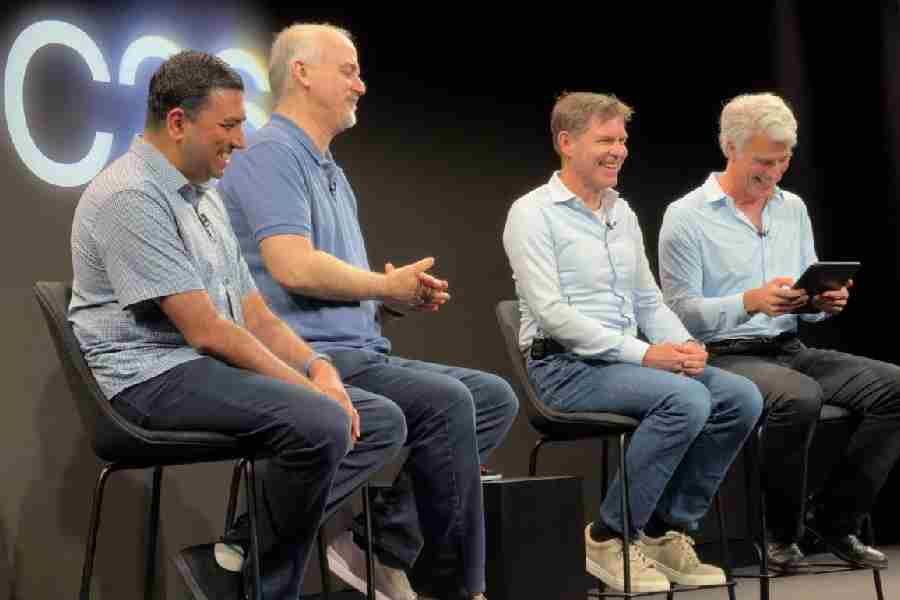
Left to right: Amar Subramanya (vice-president of AI), Mike Rockwell (Siri lead), Sebastien Marineau-Mes (software VP), Craig Federighi, Apple’s senior vice-president of software engineering. Mathures Paul
Built from the ground up
The next generation of Apple Intelligence is “centred around our users, integrated deeply into our operating systems”. At the heart of the architecture is the company’s third generation of Apple Foundation Models (AFM) — a family of five foundation models custom-built in collaboration with Google. These span from on-device models to server-based models running on Private Cloud Compute.
The Foundation Models can “unlock a wide range of helpful experiences for our users”, including an entirely new Siri and intelligent tools that make everyday apps smarter and more useful.
This family of models includes two on-device models: AFM 3 Core (the next generation of Apple’s 3-billion-parameter dense model that delivers a step up in quality) and AFM 3 Core Advanced (the company’s most powerful on-device model). The latter is natively multimodal, enabling features such as expressive voices and higher-accuracy dictation. The 20-billion-parameter model uses a sparse architecture, “activating just 1 to 4 billion parameters at a time depending on the request”.
Then there are three server-based models running on Private Cloud Compute, which ensures that user data is never stored or shared with anyone, including Apple. These are: AFM 3 Cloud (optimised for speed, efficiency, and performance), ADM 3 Cloud (Image), and AFM 3 Cloud Pro (the server-based model that powers the most demanding use cases, such as agentic tool use and complex reasoning).
AFM 3 Core, AFM 3 Core Advanced, AFM 3 Cloud, and ADM 3 Cloud are all purpose-built for Apple silicon.
The team demonstrated the new Siri responding to queries in a manner similar to its rivals, whilst also reading what is happening on screen and interacting with apps. It will be available in beta next month before launching in the autumn.
“Some appear to be racing forward, seemingly pursuing AI for the sake of AI without clear regard for the people — all of us — that it’s meant to serve,” said Federighi.
Privacy at the core
Federighi was quick to address privacy-related concerns arising from Apple’s involvement with Google. Customers need not worry that “all my data is going to Google, and Google has access to it”, he told reporters, adding that all personal data would be immediately destroyed after being sent to the cloud to process individual requests. “You’re not going to see an ad from us coming based on: ‘Hey, we noticed you like Thai food, like, here’s some Thai food,’” he said.
Crucial to the Siri revamp is Mike Rockwell, who was put in charge of the voice assistant last year. Siri AI can now easily pull up photos and personal contact details, or come up with a dinner menu based on iMessage chats. A dedicated Siri app will save prior conversations and images.
Apple’s own “world knowledge” database is being used by Siri to fetch live information. When a user makes a request involving current events or other elements of world knowledge, responses are “grounded by accessing Apple’s World Knowledge Service”. “This is something that we’ve built over many years and provides a great source of information to satisfy your request,” Federighi said.
Apple had revealed a new AI-capable Siri assistant — able to understand personal context and take action across apps — in 2024, but the rollout was delayed. The turnaround has been swift. “Across all of this family of models, our goal is to match every user request to the model which provides the best response at the lowest latency. Together, we’re super excited about this next generation of models and the amazing features it enables us to build on top of them, including the new Siri AI experience and all of the intelligent experiences across the OS,” said Subramanya.
Apple said in a statement that for AFM 3 Cloud Pro, it has worked with Google and NVIDIA to extend Private Cloud Compute to NVIDIA GPUs in Google Cloud, whilst maintaining the same guarantees to protect user privacy.
To train its foundation models, Apple uses a mixture of data that includes publicly available information, data licensed or purchased from third parties, open-sourced data, data obtained through dedicated studies, and synthetic data. “We do not use our users’ private personal data or user interactions when training our foundation models. We also respect the rights of web publishers to opt out of foundation model training,” the company said.
The new Siri AI will not be available in the EU or China initially, owing to regulatory constraints. It will launch in English, with new languages to be added quickly, and will only work on iPhones released after 2023. Apple noted that the EU’s Digital Markets Act has made it difficult for Siri AI to launch immediately in the bloc.
Siri AI, currently available to developers, has been redesigned. It is becoming part of the iPhone’s Dynamic Island interface and now features both a dedicated app and a chatbot-style experience.
Beyond Siri, Apple introduced a collection of new AI-powered capabilities, including upgrades to photo editing, writing assistance, and its Visual Intelligence feature. The offerings run on next-generation Apple Foundation Models. The upgraded Siri interface and underlying AI technology will be crucial to Apple’s next generation of products.