You feel the violence in Raakh before you see it. It is present right from the first few moments, in something as innocuous as two teenage siblings excitedly getting ready for a much-awaited evening out, the good-natured bickering between them and their lively banter with their mother. But you, as the viewer, find your nerves on edge, holding back a threatening lump in your throat. For you know that once they walk out of that door, the Arora siblings will never come back home again.
The year is 1978. The series is Raakh, Prime Video’s eight-episode watch, streaming now, which is, without a doubt, inspired by the Sanjay and Geeta Chopra double murders. Taking place in the capital, the heinous crime shocked the country, elicited a nationwide manhunt and ultimately resulted in the death sentence for perpetrators Billa and Ranga. The case shaped India’s capital punishment jurisprudence, fundamentally altered children’s safety policies, and set landmark media rights precedents. Since then, it has been touched upon on screen, with varying degrees of fact and fiction, quite a few times, with the most recent example being the Netflix winner Black Warrant.
In Raakh, there is no official acknowledgment of the case, but its shadow looms large over it. Directed by Paatal Lok maker Prosit Roy and anchored by Ali Fazal, Raakh is a primal, gut-wrenching and evocative story of deviance and depravity. Even as it looks at the loss of humanity, it mourns the untimely, brutal death of two young lives. It unfolds as a police procedural but doesn’t limit its storytelling to the mechanical. It captures both the visceral and the vulnerable, giving us a watch that lingers long after the screen goes blank.
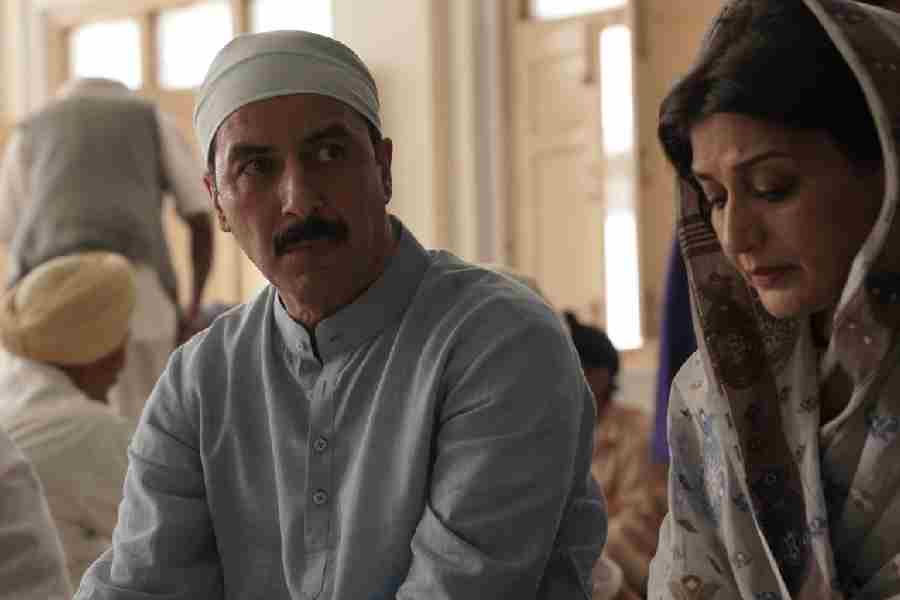
Aamir Bashir and Sonali Bendre in the series, streaming on Prime Video
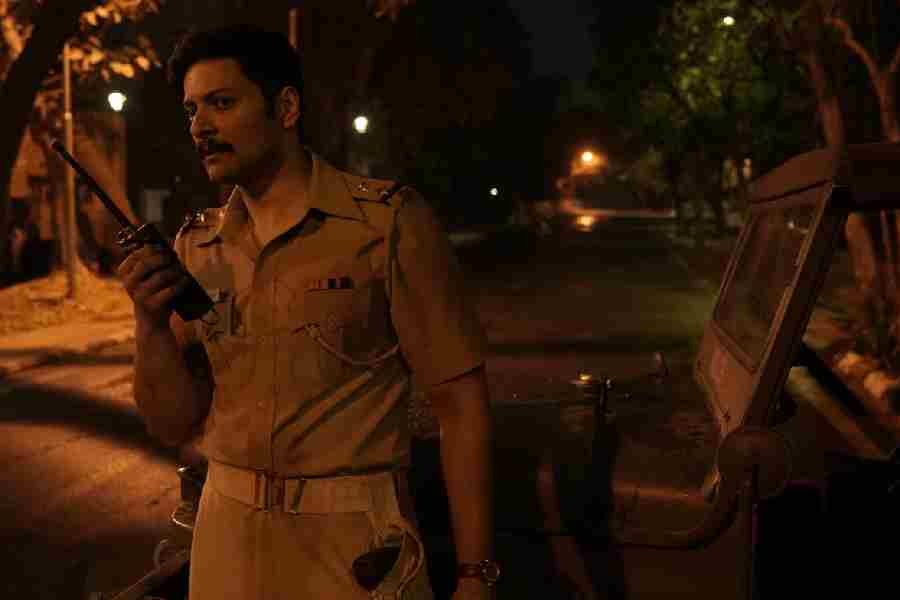
Created and written by Anusha Nandakumar and Sandeep Saket, with dialogues by Ayush Trivedi, Raakh hits the ground running, adopting a narrative technique that oscillates between the aftermath of the crime and the days that led up to it. Siblings Suman and Sahil Arora (played by Divya Sharma and Vivaan Sharma) hitch a ride on their way to the local radio station — where Suman is slated to perform that evening — but never make it. Their parents — former Armyman Ashok (Aamir Bashir) and schoolteacher Mona (Sonali Bendre) wait for their children to come home, with the sense of calm within the Arora household descending into chaos within minutes. The cops — led by sub-inspector Jayprakash Jatav (Ali Fazal) — come into the picture. Everything from kidnapping to a runaway rebellion is looked at, but the conjecture is cut short quickly. In what is undoubtedly one of the most heart-rending moments in a series which has many such instances in its runtime, Suman and Sahil are found brutally violated and killed, with Jayprakash having to painstakingly piece together the harrowing facts of the case, one that not only tests his mettle as a professional but fundamentally changes him as a person.
The primary win of Raakh lies in the fact that it manages to remain consistently engaging, even though one is aware of how the series will eventually play out. That credit largely goes to its form. Raakh — as already mentioned — doesn’t just opt for a present day and immediate past structure, it also traces and retraces its steps to not only show how the crime came to be committed, but also how the criminals — Babu (Akash Makhija) and Rajjo (Ramandeep Yadav) — arrived at the crime, one reprehensible act at a time.
A father in grief, a mother in denial and a cop on a time-bound mission form the core of Raakh. Also in focus are the two delinquents, with bloodthirsty Babu’s guiltless Machiavellian descent being juxtaposed against Rajjo, forever ridiculed by society for his effeminacy, reluctantly aiding him on this gory trail. The homoerotic undertones in their equation — perhaps largely orchestrated by Babu to ensure Rajjo remains an accomplice — isn’t allowed to tip over into over-the-top territory, with the makers succeeding in sticking to the eye-on-the-fish-eye DNA of the series.
Leading the way and with a screen time that is easily the longest among his co-actors is Ali as Jayprakash. Inexperienced but industrious and struggling to grapple with his own suppressed emotions even as he investigates the case, Jayprakash also has his Dalit identity to contend with in his workplace. The son of a former havildar — Rakesh Bedi is in sublime form as Jayprakash’s call to conscience, sounding board and his punching bag, besides his enviable mutton cooking skills — the young cop plunges into the case with all he has, with the professional quickly turning personal for him. Ali is the right pick for the role, his face effectively reflecting the contrasting emotional twists and turns and the inner turmoil he undergoes as he sinks deeper.
Some of Raakh’s most unsettling scenes belong to Aamir Bashir and Sonali Bendre. Though their screen time isn’t as long as one would expect, the duo is superlative, especially in that one scene on a stormy night when Mona finally accepts the fate of her children — and the fact that her family will never be the same again. The breakdown moment as they hug tightly, clutching to the last remnants of Suman and Sahil, is enough to tease a tear out of even the most strong-hearted. The other impactful acts are from the two antagonists, with Akash and Ramandeep going above and beyond the memo. Are these born criminals or one shaped by a savage society? The jury will always be out on that one.
The rest of the ensemble cast — especially Dibyendu Bhattacharya as Jayprakash’s boss and Anshul Chauhan as an intrepid journalist — are top notch.
Raakh progresses at a gripping pace, though it does tether on the edge of streaming bloat midway. The last episode, however, is a punch to the gut. It narrows itself down to the beginning, laying bare the barbarity of what has been largely implied in the preceding few hours. It ends with a “what if” question. What if Suman and Sahil hadn’t hitched a ride that day? What if someone else had picked them up? What if they had walked to the radio station even in the rain? The answer is an ache in your heart.
I liked/ didn’t like Raakh because... Tell t2@abp.in