I have had the chance to attend different film festivals since 2018, the year I started making films. But until this year, Cannes was something I had only heard of. As planned, I went to the Cannes Marche du Film with our new film Rango Bibaaho. Even before going to Cannes, I knew I would hardly get time to watch films between my pre-fixed meetings. Besides, a separate registration is usually required to attend festival screenings, and I did not have one. But two days before arriving in Cannes, I received an email informing me that my Marche du Film accreditation would also allow me to watch films at the festival. That email made me unexpectedly happy.
I arrived in Cannes on May 11. For the first four days, I barely had time to enter a cinema hall. But there was already a much larger film unfolding all around us — and all of us were simultaneously its actors and audience. How does an entire city transform itself so completely for just two weeks of cinema?
I have seen the madness around film festivals in Calcutta and Kerala. But Cannes felt different. There, during the festival, the hotels, cafés, streets — everything seems to live and breathe cinema. From morning till late at night, people everywhere were talking about films — in cafés, on pavements, outside theatres. People from different countries, strangers to one another, all walking in the same direction.
There is a glamorous side to Cannes — red carpets, flashing cameras, fashion and celebrities. But once you go there, you realise how small a part of Cannes that really is.
What surprised me even more was that all these people who spend the whole day talking endlessly about cinema become completely silent inside the theatre hall. No one speaks. No phones ring. For those few hours, everyone surrenders themselves entirely to the screen.
I first took the initiative to watch a film on May 15, four days after arriving in Cannes. After cancelling a 9am meeting, I went and stood in a queue outside the theatre. There were not many people waiting, and that filled me with excitement. I immediately called my friend, actress Amrita Mukhopadhyay, and told her that my dream was finally about to come true — I was going to watch a film in Cannes, and that too Pawlikowski’s Fatherland. His film Cold War remains one of my favourites. I still remember rushing one afternoon during the Kolkata International Film Festival in 2018, travelling from Nandan to Hatibagan just to catch a screening of it.
Just when it was my turn to enter the hall, an official stopped me and said I could not go in because the tickets had to be pre-booked online. I had no idea. I checked immediately, but everything was sold out. It was heartbreaking. Then, unexpectedly, she mentioned there was a last-minute queue. If there were any empty seats left after entry, there was still a chance.
That was where I met a French musician. We spoke for a while as we waited. In the end, both of us got to get into the hall. He left the back seat for me and took a seat in the front row himself. I suppose I made a friend that evening.
The film began, and I soon realised that the subtitles were in French, not English. I do not understand French. Still, the history the film was speaking of was not entirely unfamiliar to me. Post-World War II Germany had been divided into East and West. Thomas Mann and his daughter return to Germany, and both governments want to honour him.
It is a Germany emerging from war, from concentration camps. A Germany where people look at one another with suspicion, as if everyone is trying to discover the fascist hidden inside someone else. Into such a land, Thomas Mann and his daughter return after years of exile. Yet beneath the speeches, the press conferences and the awards, he seems to be searching for something else entirely — perhaps a lost childhood, perhaps a simpler life, or perhaps a world, much like the life of the old doctor in Bergman’s Wild Strawberries.
Even though I could not understand the dialogues, the black-and-white compositions, the acting and the sound slowly pulled me into that claustrophobic world — a world where people do not speak their hearts; they just observe each other in silence.
Pawlikowski’s Cold War searched for the wounds left on the soul through the union and separations of a man and a woman after the war. That emotional search feels absent in Fatherland. In its place, there is exhaustion and surprise. Throughout the film, Thomas Mann’s eyes seem to search endlessly for an answer to a single question — how did his fatherland become this?
That evening itself, I had the chance to watch Asghar Farhadi’s Parallel Tales. This time, there were no problems entering the hall. I arrived on time and found a good seat. Like Farhadi’s earlier films such as A Separation and The Salesman, this film also has a few dramatic elements. His films generally begin with a crisis and slowly draw us into a world that lingers long after it is over — disturbing us, troubling us. Farhadi’s moral questions are never complicated, but they are deeply unsettling.
In this film, he also pays tribute to Kielowski. An ageing writer, now in her 60s, decides to revisit her difficult childhood and youth while writing a new novel. But in doing so, she begins altering not merely the novel, but her own memories. Like the characters of Rear Window or A Short Film About Love, she watches three neighbours in a distant apartment through binoculars. She writes about them, imagines them, and reshapes their reality through her novel. After all, that is also a writer’s responsibility — or perhaps temptation.
The complexity deepens when the young domestic helper in the writer’s house begins interfering with the lives of those three neighbours in reality, attempting to alter their destinies himself. To some extent, he succeeds. This new Farhadi no longer asks the simple moral questions. Instead, he places the responsibility of understanding upon the audience — the writer’s fractured memories, the helper’s inner life, the emotional entanglements of the characters of the neighbours.
There were moments in Parallel Tales that felt good. But the film itself did not walk out of the theatre with me. That night, I wandered alone through the streets of Cannes. It was almost 11. The cafés were still alive, crowded with conversations and laughter. Perhaps people were discussing the films they had watched that evening, speaking about what stayed with them and what did not. I say “perhaps” because I do not know French. It is equally possible that perhaps the girl sitting at the next table was herself one of those three neighbours, whose life someone, somewhere, was trying to rewrite.
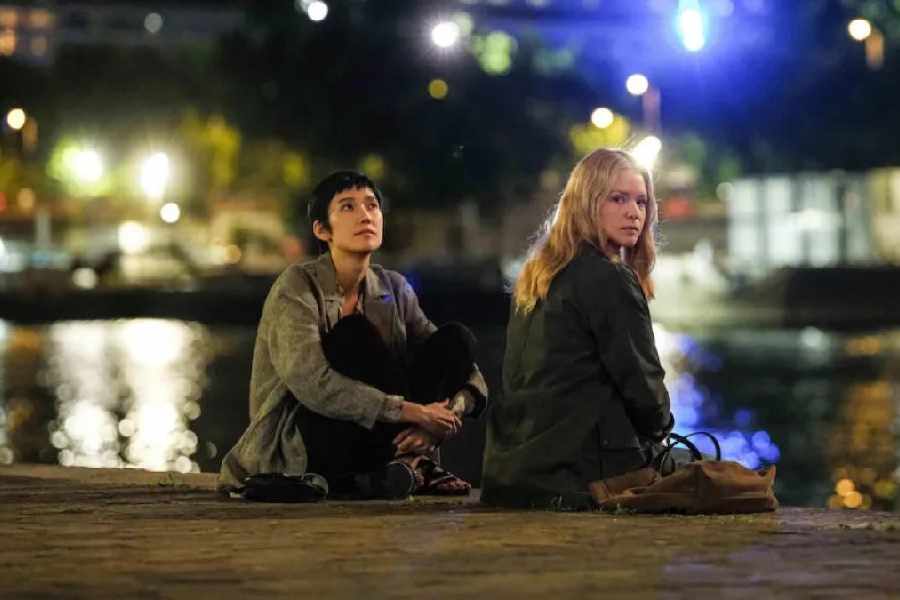
The third and final film I watched at the Cannes Film Festival was Hamaguchi’s All of a Sudden. Before this film, time itself comes to a halt. Even writing about it feels scattered. Cinema has always had filmmakers who experimented with the language of time. But what is time? Does time exist beyond our calculations? Kiarostami searched for this time in Five, dedicated to Ozu. All of a Sudden seems to search for a different kind of time altogether. It is difficult to write about a three-hour film built almost entirely on conversation. The characters keep talking, repeating, circling back to the same thoughts. At one point, nearly 20 minutes are spent explaining, even through diagrams on a whiteboard, how capitalism pushes people toward loneliness in old age.
A French doctor who runs a caregiving centre for dementia patients is searching for more humane ways to treat them. She meets a Japanese theatre director suffering from fourth-stage breast cancer. From there, the film unfolds like a diary — mostly in Paris, with some parts in Japan.
Everything that mainstream cinema and many critics would call “non-cinematic” or destructive to audience engagement is embraced in this film. The film becomes an act of resistance against the speed of reels and streaming content. Perhaps the filmmaker is not truly searching for time at all, but for people. I say perhaps because, just like French, I do not fully understand this language of cinema either.