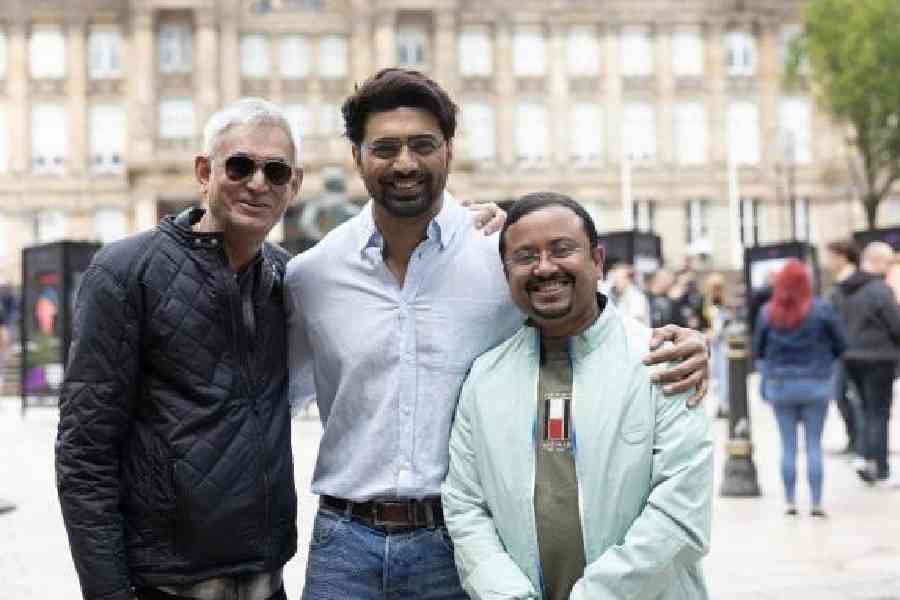
Shooting Projapati 2 in London felt less like a film schedule and more like an extended, laughter-filled family holiday — except that, every now and then, a camera would wander between us to remind us we were actually there for work. Before we flew out, everyone back home in Calcutta seemed endlessly fascinated by one question: “So how is this Dev versus Mithun pair going to play out abroad?”
A lot of people love viewing them through the inevitable prism of political difference. But the moment we stepped onto the cobbled, postcard-perfect lanes of Stratford-upon-Avon, politics dissolved like mist in a warm sun. What remained was something beautifully uncomplicated: two remarkable men who share a bond so warm, so instinctive, so quietly protective that even real fathers and sons might envy it.
If you ask me what my abiding visual of that trip is, it’s Dev — megastar, youth sensation — hovering around Mithun-da like a permanently curious kid who refuses to leave his favourite elder’s side. Dev teased him, joked with him, shadowed him through every rehearsal and meal. And Mithun-da, with that signature combination of dry humour, lightning-sharp wit and the occasional playful scolding, absorbed it all with infinite indulgence. Watching the two of them together every day, I often felt I was witnessing not a co-star equation but a relationship that had deepened over the years into genuine affection.
Stratford Days and Clear Skies
We stayed at the Leonardo Hotel in Stratford, and if you’ve never experienced an English summer, here’s the secret: the sun refuses to set. Daylight stretches till 9.30pm, sometimes even 10pm, which is deeply confusing for Bengalis who rely on a clear distinction between “evening adda” and “night adda”.
Our schedule went like this: shoot till late evening, drive back to the hotel under a still-bright sky, sit down with dinner, and before we knew it, we would slip into our nightly adda — our sanctuary. The group hardly changed: Dev, Mithun-da, Avijit, and I. And every night, without fail, our adda ran till 12:30am, sometimes later.
What still amazes me is Mithun-da’s discipline. He sat with us past midnight, laughing away, narrating stories, enjoying the warmth of our company — yet he was always up and ready by 6am, fresh, composed, and set for another packed day.
These late-night gatherings — more than the shooting days, more than the scenic beauty — are what return to me most vividly now: the jokes, the unending cups of tea, the feeling of being part of a small but fiercely connected tribe. And then there was the weather. London, famous for sulking skies and sudden showers, was in an inexplicably generous mood. Sunshine welcomed us every morning. Clear skies followed us everywhere. Honestly, we had so much good weather that at one point the team began joking that perhaps Dev and Mithun-da’s combined star power had convinced the sun to work overtime for the schedule.
Waiting for the Ducks to Act
If someone ever writes a quirky behind-the-scenes book on Projapati 2, one entire chapter should be dedicated to the ducks of Stratford-upon-Avon. One of my favourite memories is from a park overlooking the River Avon, where we were scheduled to shoot a few crucial sequences. Dev, in his full comic glory, kept teasing Avijit: “Whatever happens to the film, you’re definitely winning an Oscar for this shot!” Why? Because Avijit point-blank refused to take a shot unless ducks ambled into the frame at exactly the right distance and formation. So imagine this: our entire team sitting by the riverbank — actors, DOP, assistants, crew — waiting patiently for ducks. And the ducks, sensing their newfound importance, decided to play hard-to-get.
We finally resorted to bribery. Two team members were dispatched to buy duck food and lure them to us. The ducks arrived, waddled around with great enthusiasm… and still Avijit said, “No, no, let’s just wait for a better composition.” It was chaos. Chaos with laughter. And that kind of chaos is what makes a schedule unforgettable. Similarly, we had to arrange a last-minute replacement of a violin player as the earlier one had cancelled without notice, and Avijit just wanted the perfection of that scene to remain undeterred, so we all jumped into the scene looking for another alternative.
Around the same time, we experienced the now-legendary 5am fire alarm at our hotel. A harmless outsider’s cigarette smoke triggered the alarm, and suddenly the entire unit was racing down the stairs half-asleep, half-dressed, fully irritated. Nothing bonds a film crew like the shared indignity of standing in a cold lobby at dawn in pyjamas.
There was a special moment while we were shooting in Birmingham. India won the second test match, and we saw the team come back to the hotel by bus but there were none to cheer them up while they were getting down. This will forever remain etched in my memory that I took the members from the shoot team, and we all cheered for the team that brought us the victory. Such a golden moment from the shoot.
A Scene Close To Heart
There is a father–son scene in the film — some of you may have glimpsed a fraction of it in the teaser. For me, it is one of the emotional anchors of Projapati 2. After decades in filmmaking, you reach a stage where very little on set can surprise you emotionally. But that day, something unexpected happened. The simplicity of the moment, the quietness of the setting, the tenderness of the writing — all of it aligned like planets falling into place. Dev delivered something luminous, something both aching and effortless. And the way his performance sat against Mithun-da’s seasoned, dignified presence created an energy I can only describe as cinematic magic. I felt my chest tighten — not in that overtly sentimental, over-the-top way, but in a quiet, introspective way. You’ll know what I mean when you watch the film.
And Then Came Anumegha
Perhaps the most delightful surprise of Projapati 2 is the little girl who has already won our hearts: Anumegha. She isn’t unknown — she has acted in television and films — but her presence in Projapati 2 feels utterly fresh, almost like discovering a rare stone that has somehow remained unpolished until now. I genuinely believe she will grow into one of the most precious additions to Bengali cinema in the coming years.
And the way we found her was pure destiny. We were shooting Dance Bangla Dance at the time, and she was anchoring the show. I remember watching her on the monitor and turning instantly to Avijit: “This is the girl.” We were scheduled to audition four or five others that day. All of that was cancelled. When instinct speaks that clearly, you listen. Her slight British accent in the film is entirely authentic — crafted out of sheer hard work. She underwent a proper workshop, absorbed everything with remarkable focus, and delivered it with a maturity far beyond her six or seven years. Watching her perform was like watching a small comet discovering its own sparkle. She is, without exaggeration, God-gifted.
The Pickpocket Incident
Not all memories from a shoot become adorable anecdotes. Some become cautionary tales. One afternoon, we were shooting near Scotland Yard. A group of officers approached us politely and told us to be careful about pickpockets in the area. We thanked them, reassured ourselves that nothing would happen, and continued our shoot. At wrap time, as we were congratulating ourselves for a smooth, uneventful day, news arrived that Dev’s hairdresser couldn’t find his bag. It was gone — lifted cleanly, expertly, invisibly.
London gave us clean frames, golden sunsets, and eventually even cooperative ducks. But more than anything, it gave us something we rarely get in the middle of busy schedules: time— to sit together, to laugh, to rediscover not just cinema but the joy of the people who make cinema with you. As Projapati 2 arrives this Christmas, I carry those memories with me — not as a presenter, not as a film professional, but as someone who lived a rare and precious chapter of friendship and storytelling. And that, truly, is my greatest reward.