The genesis of Adamya can be traced back to a moment so simple that it seems almost mythical now: a young boy standing under the glare of tube lights on a school stage, reciting Sukanta Bhattacharya’s iconic poem Deshlai Kathi for the first time. The poem — spare, fiery, and prophetic — struck something raw in him.
Filmmaker Ranjan Ghosh recounts, “That poem lodged itself in my bloodstream. I didn’t understand everything then, but its fire stayed.” Even as he grew up, sailed across oceans, made films, that fire never really went out. By 2015–16, the lingering spark finally took shape. Ranjan began imagining a single-character survival thriller — stripped of any kind of glamour and distraction — that mirrored the poem’s uncompromising spirit. Solitary, ascetic, almost monk-like in its narrative demands. “It was a story that refused crowding. It required just one soul, alone.”
Ranjan went on to make three more films by 2022. In 2023, he was invited to Pondicherry University as Filmmaker-in-Residence. The vibrant yet idyllic campus created a contemplative space for him to expand the script. There, with longtime collaborator Aryuun Ghosh, he reworked the narrative. “As we wrote, the story began shifting,” he recalls. “Suddenly Bhagat Singh started entering my dreams — not as a historical figure, but as a presence. His defiance, his clarity, his unyielding idealism… it all began colouring the way I saw the protagonist.” The more he wrote, the more he realised he was shaping something closer to a political meditation.
“It was as if Sukanta Bhattacharya and Bhagat Singh — who never met in real life but shared an ideological wavelength — were speaking to each other through the film,” says Ranjan. During writing sessions, Aryuun suggested bringing in well-known young actors to make the film more appealing to producers. It was a practical suggestion. But the story seemed to resist practicality. Ranjan smiles when he recalls it, “Some films choose their own path. This one was choosing the harder one.”
Back in Calcutta, he began approaching producers. Meetings were polite, conversations were encouraging, but when it came to investment, the responses became hesitant. A single-character film? With a newcomer? Shot in the Sundarbans? “It was as if they were saying, ‘Don’t make this,’” he says.
The message hit him harder than he expected. “Should I not make the film then? How can external agencies decide our fate?” But what troubled him even more was the ideological contradiction — “It went against Kabi Sukanta’s and Bhagat Singh’s grain. Against everything they stood for.”
He sensed that the film’s intensity — its political sharpness, its emotional ferocity, its refusal to dilute — unsettled people. “Perhaps they feared the story was too volatile,” he says. But abandoning it felt like betrayal. “If I abandoned it, I would be betraying Sukanta, Bhagat Singh — and my own conscience.” And so came the decision that shaped the rest of the journey: “I would make it independently. There was no other way.”
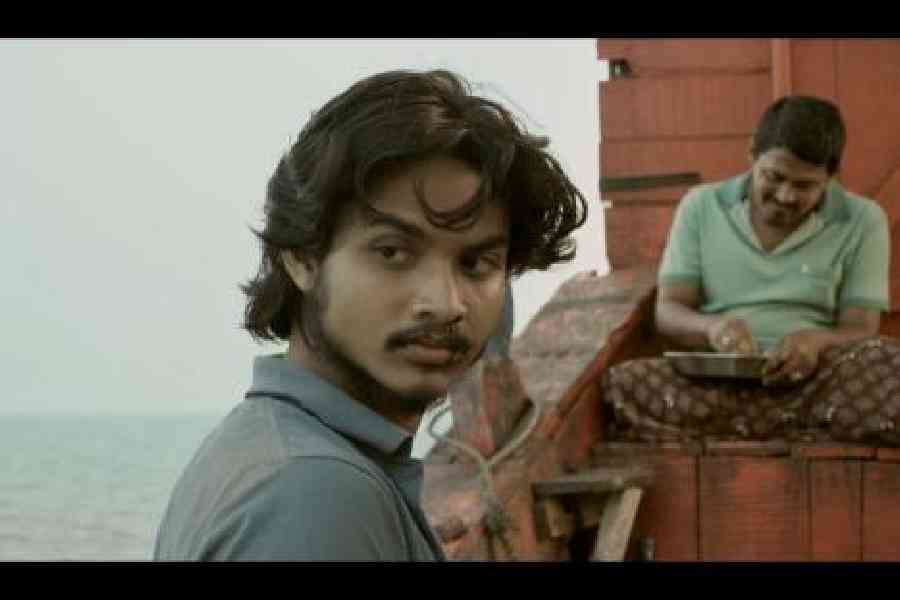
He cast Aryuun as the sole protagonist. With Arjo, a close friend of Aryuun, the trio ventured deep into the Sundarbans to scout locations. As they travelled further away from urban roads, they realised they were entering a world seldom seen by film crews. “There was no infrastructure. Nothing. The villages were six to seven hours past Kakdwip. After that — only boats, engine vans. No cars. No buses.”
The remoteness, instead of discouraging Ranjan, strengthened his belief that this was the right landscape for the film. The Sundarbans — with its perpetual battle between land and water, human and tiger, state and nature — became not just a location but a metaphor for the protagonist’s inner world.
Ranjan assembled a team of absolute newcomers: Arkaprabha, a still photographer, Sourya, a young theatre actor, Arjo, the local boy from the village, Shubham, whose youthful energy with a toothy smile was infectious and Pushpak, a film school graduate who joined later. Except for Aryuun and Pushpak, none had formal behind-the-camera experience. And their equipment was comically minimal. “We had a tiny Sony A7Riii. That’s it. And we just went. No big plan. I felt we should jump into the unknown and let the film reveal itself.”
For four months, the team lived in Arjo’s modest home amidst the warm chaos of village life. “It grounded us,” Ranjan says. “Our city arrogance dissolved.” They bathed in ponds, used the community tubewell, ate on mud floors, slept on mats rolled out beside each other. Days were physically gruelling but spiritually electric. “It was basic, but the warmth! The life! It was like being reborn.”
The filming process became an exercise in audacity. With no artificial lights, they shot entirely in natural light. Night scenes were filmed day-for-night. They didn’t even have a tripod. “Our tripod,” he laughs, “was a wooden stool from Arjo’s house!” Indoors, they used two small battery-powered lamps. A theatre friend had shown them rudimentary make-up techniques; after that, Ranjan and Aryuun improvised daily. Transport was equally improvised — a trusty toto driven by Arjo’s friend, and a half-broken bike borrowed by a neighbour.
They shot guerrilla-style. No call sheets, no fixed schedules. “Every morning, we freshened up, stuffed our faces, discussed, debated, argued — and then went where the light took us.” What could have been a limitation became the heartbeat of the film — a raw, instinctive cinematic language shaped by necessity and courage.
Above all, the village embraced them. “Their support was overwhelming,” Ranjan says. “You can’t manufacture that kind of love.” When they needed a trawler for a couple of crucial sequences, village elders called a meeting, spoke to the fishermen, and arranged one. Arjo’s family, too, offered unconditional support — shelter, food, emotional grounding. “They were the backbone of the film,” he says. “Shooting in the Sundarbans was magical.”
Ranjan showed the finished film to veteran filmmaker Aparna Sen. “I was nervous,” he admits. “She had a different glow on her face after the film ended. When I asked if she would consider presenting it, she gently said she would love to. She had never presented a film before. That was a huge validation.” The film, set against the landscape of the Sundarbans, explores the fine line between revolution and extremism. “Is he an extremist or a revolutionary? An anti-national or a patriot? The film asks the audience to decide,” says Ranjan.
And why tell this story now? Ranjan’s answer seems urgent: “Look at whatever is happening all around us… I feel… what if Bhagat Singh and Kabi Sukanta were reborn today? I wanted to explore that possibility. I made Adamya for our own people. If it resonates with them, that is all I could ever ask for.”