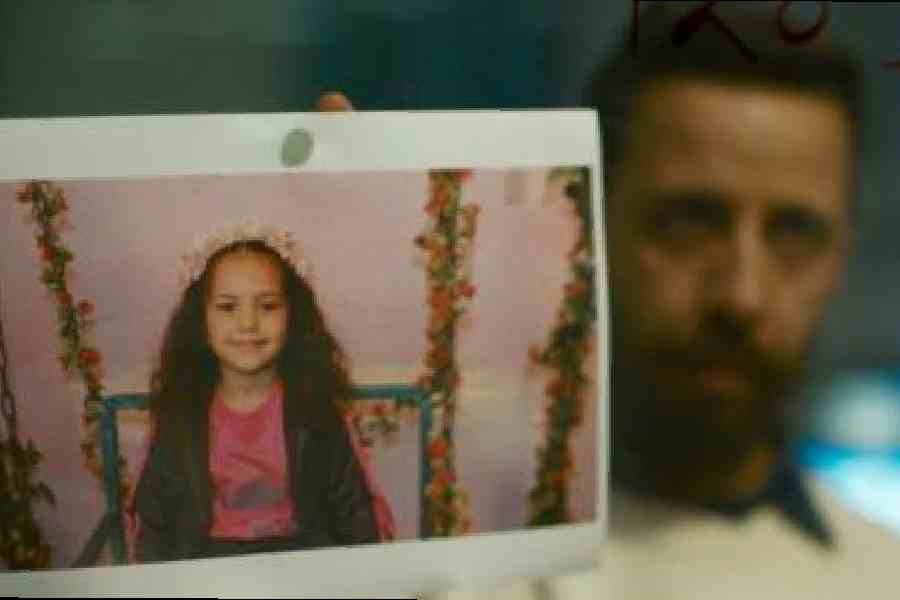
The Voice of Hind Rajab follows the real-life story of a five-year-old Palestinian braveheart holding out on her own and pleading for help to the Palestine Red Crescent Society responders after the car she was in was attacked.
Hind Rajab was killed by Israeli defense forces during the invasion of the Gaza Strip in 2024, but her voice now reverberates across the world, with the film, directed by Kaouther Ben Hania, capturing the real voice of the young girl as she called for help, with the Red Crescent Society responders being played by actors.
After winning the Silver Lion Grand Jury Prize at the Venice International Film Festival, where it got a 23-minute standing ovation (the longest in the festival’s history) and being feted across the world, The Voice of Hind Rajab is eyeing an Oscar for Best International Feature this month. Over a recent video call, t2 chatted with Kaouther Ben Hania on her film that has touched hearts globally.
You first heard the voice of Hind Rajab pleading to be rescued while you were in the middle of a busy Los Angeles airport. What were the emotions you felt at that time and do you still feel them after making this film on her?
The emotions I had are what the audience feels when they first watch the film. It is a mixture of sadness, anger, helplessness and grief.
Now that you have managed to make her voice heard to the world, do you feel a little less helpless?
That is a good question. The movie still moves me. I made it, I know it by heart, shot by shot... it is often said that fabrication makes things less emotional. But that has not been the case here. I still get very emotional when I hear her voice. And yes, I feel a little less helpless because I gave voice to this little girl. That has helped me.
Was the idea always to place The Voice of Hind Rajab in the borderland between documentary and drama?
When I started thinking what was the best form to tell this story, the first thing that came to me as a filmmaker was that this had to be a documentary. Since it is a real event and I had a body of investigative work with ample proof of what happened that day, I automatically thought about a documentary. But we quickly understood that the format wasn’t enough to convey the kind of emotions that were needed. You can explain things in a documentary, but you can’t make people feel. It can’t take you and put you in the moment when she was alive.
I realised that this may be an event that has already occurred, but I needed the present tense for its dramatisation. I signed on actors to play the parts of members of the Red Crescent Society but I also needed the audience to clearly know that they were actors, and not the real remembers of the Red Crescent who spoke to Hind Rajab. But the impact of this story is such that the actors stopped acting after a while... it became too real for everyone involved in this film.
Was retaining the original voice of Hind Rajab non-negotiable for you?
Everything started with that emotion I felt after hearing her voice... it is the focal point of this story. Her voice is at the centre of everything. The idea of bringing a child actor and doing the mise-en-scene of the death of Hind Rajab was never on my mind... it would be equal to silencing this young girl again. The film would have no meaning then.
I know that her voice is not comfortable to hear, it is very painful... but that is what the point is — the last few hours of her life were far from comfortable. So why should I take care of the comfort of the audience? Her voice is real, her voice exists, her voice is a document, her voice will live on almost like the diary of Anne Frank.
What part of this story impacted you the most?
It is a shocking story from the beginning to the end. The fact that the Israeli army shot a family car, that they didn’t only shoot it once or twice but several times... it was all done on purpose. There was an ambulance just eight minutes away but they couldn’t send it because of the Israeli army. The most shocking thing was that when they did send the ambulance after having the approval of the Israeli army, the Israeli forces themselves bombarded the ambulance and killed the rescuers. This is a war crime in all aspects.
Though you did have Hind Rajab’s mother’s go-ahead to make the film, were there any ethical or moral dilemmas you grappled with?
In the initial stages, there were some people financing the film who insisted that the camera should be in the car also. That was out of question because I couldn’t do the mise-en-scene of such a horrible situation. Her voice was already impactful, I felt we didn’t need anything else, and that has been proved right. I was not interested in showing any kind of graphic violence. I wanted to show systemic violence, which is why I stayed in the offices to explain why they couldn’t send an ambulance eight minutes away to save a child for several hours.
The film premiered to a 23-minute standing ovation at Venice, you have won several awards and also have a shot at winning an Oscar this month. What do awards mean to you, particularly for this film?
All these awards and this spotlight is because of her voice. This is definitely not the feel-good movie of the year, it is an uncomfortable watch. But all over the world, people have taken to the film and made it seen and heard. This is an important film about an important story that should be told. All these awards help to make people aware about the film. A lot of people have told me that this film has changed their life.
The most emotional reactions to the film have come from those who have young children. The plight of that five-year-old brave girl calling out for help resonates the most with them. It makes them very, very emotional. The main reaction is crying, but also a lot of people have asked: “What can we do?” They have experienced the film like a call for action. They are asking if they can donate to the Red Crescent. The feeling of helplessness that viewers have felt while watching the film is making them want to fight against the system by doing something within their means.
In the past, you have said: “We are numb, but cinema, literature and art can change things.” Is that something that is becoming increasingly difficult in the world that we live in or as a filmmaker do you still hold on to hope?
We all know that cinema can change us, or at least can change the way we look at the world. I have met some people who had a lot of cliches in their minds about the Palestinians, mainly because of mainstream media. But this film has allowed them to put themselves in the place of Palestinians and has elicited feelings of connection, empathy and identification. This is what cinema can do.
We are also trying to do a lot of screenings for decision makers. So far, we have done two screenings for Congressmen, one for the European Parliament, for the Council of Europe, for the UK Parliament.... There are quite a few partnerships with international organisations like Oxfam, Red Cross and Amnesty International who are almost using the film as a pedagogical tool.
Big names like Brad Pitt, Rooney Mara, Joaquin Phoenix, Alfonso Cuaron and Jonathan Glazer are attached to the project as executive producers and presenters. What does that mean for the film?
When we finished editing the film, we were hit by the thought that this film will not travel wide and will only stay among a niche number of people. We realised that we needed a celebrity name to be attached to the project. We contacted all of them, hoping maybe to have one ‘yes’, but all of them loved the film and wanted to come on board as executive producers!
You recently refused the “Most Valuable Film” award for The Voice of Hind Rajab at the Berlin International Film Festival because a former Israeli general was also being honoured on the same podium. Why was it important for you to do that?
Maybe they wanted to be balanced, but my question is, how can one be balanced when it comes to genocide? I don’t want me or my film to be in a scenario where peace is only a PR word. That is why I didn’t feel comfortable about receiving this award. Real peace comes with accountability and it is time for people to be held accountable.
What kind of cinema did you grow up watching?
I grew up in Tunisia in the ’90s. The town I lived in had no cinema but we had a VHS club. There I watched only Indian films, particularly those starring Amitabh Bachchan... classics like Sholay were a favourite. The Hollywood film I remember watching very early was Brian de Palma’s Carrie.
Do you still watch Indian films?
Yes. I really liked the documentary All That Breathes, that was nominated for an Oscar. The last Indian film I watched was Homebound.