When Apple co-founder Steve Jobs visited India in 1974, the country had the second-largest population in the world at around 600 million people. He and his college friend Daniel Kottke had made the journey to meet Neem Karoli Baba, only to find that he had died months earlier. What remained with Jobs was a quest for self-discovery that ultimately led to the formation of Apple on April 1, 1976, alongside Steve Wozniak.
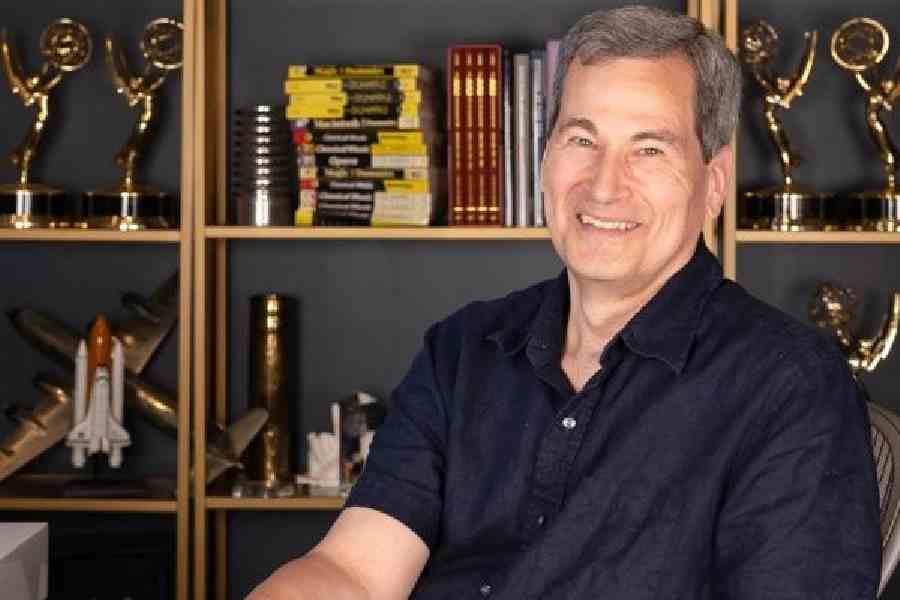
Today, with nearly 1.5 billion people and an economy growing at more than six per cent, India is key to the success of Apple over the coming decades. The half-century spanning those two eras is defined by a series of significant milestones and curveballs. Capturing this entire journey is a new book by American technology and science writer David Pogue.
In the pages of Apple: The First 50 Years, published by Simon & Schuster, Pogue offers an exhaustive account of the company’s evolution, packed with facts from the Apple orchard and interspersed with fascinating anecdotes.
To mark the 50th anniversary of the tech giant, we spoke with Pogue via email to discuss Apple’s legacy and the road ahead. He is a seven-time Emmy winner for his stories on CBS Sunday Morning and has written or cowritten more than 120 books. Here are excerpts from the conversation.
How long did you work on the book, and what was the starting point for the project?
It took just under two years. In February 2024, the Computer History Museum (Mountain View, California) invited me to host a special event, celebrating the 40th anniversary of the Macintosh. They invited all these famous former Apple engineers to the stage. It was a night of storytelling, humour, and PTSD.
Shortly thereafter, my wife woke up in the middle of the night from a dream. “David, wake up! Wake up! I have the best idea for a book!”
I told her that that date had already passed, and suggested that she go back to sleep!
But I was wrong! I looked it up in the morning. Apple’s actual 50th birthday was two years away — just enough time to write a 600-page book, if you’re crazy.
There will always be several types of readers for your book: techies who want in-depth details; casual readers who want something dramatic; and Apple-haters who want you to be as unbiased as possible. How much of a challenge was this balancing act whilst writing the book?
It was a tremendous challenge. With every story, every paragraph, I was aware of different constituencies who’d be judging the prose.
First, there were the 150 people I interviewed. Their interest was getting the story right, and, often, in getting their own credit where it was due.
Then, as you say, there were the techies. There were the fanboys. The haters. Students of business. Everyday citizens whose lives Apple has touched. Everyone, I worried, would want something different out of the book.
So for me, it was like threading a needle inside of a needle. I had to be extremely careful and extremely accurate.
Fortunately, so far, all of those audiences seem happy with the result!
Apple is betting big on India, both in terms of its retail and manufacturing strategies. At the same time, India remains a price-sensitive market. What is your take on how they are handling their expansion into the country, and how important will India be for the company over the next five or 10 years? Furthermore, what did Steve Jobs think of India as a market for his company?
We seem to be stuck on the subject of his visit to India in the 1970s.
For Tim Cook, it’s a huge priority to lessen his dependence on China for manufacturing. That’s the heart of his India factory strategy.
On the retail side, Apple knows that it can’t approach India the same way it did with the US or even China. Apple won’t try to win by selling massive numbers of devices. Instead, it will proceed patiently: opening more stores, online sales, financing offers, and trade-ins. The company seems to want to pursue the premium consumer market, whose middle-class keeps expanding.
When Steve Jobs returned to Apple, his focus was on the consumer business rather than the enterprise. Over the decades, Apple has made computers accessible to the general consumer. What is it going to take to make AI accessible to the public at large, and what role will Apple play in this?
Apple seems to have been caught unprepared for the AI revolution, and is scrambling to catch up. Initially, Apple said that it won’t create a chatbot (like Gemini or ChatGPT); instead, it would rather scatter AI features across the operating system, so that they pop up exactly where they’ll be most useful. According to the latest rumours, that stance may be changing; Apple will make some announcements in June about this.
The most exciting prospect is AI-based Siri, which will know everything in your email, texts, and files, while still maintaining strict privacy. You’ll say to Siri, for example, “When is my mom’s flight landing?” And Siri will know (from your email) that your mom is coming for a visit, will know (from your texts) the flight details, will check the flight’s progress on a flight-tracking website, and display her updated landing time, all in the blink of an eye.
Apple is also being careful to deliver AI features without AI’s worst aspects. For example, Apple doesn’t want to encourage students (or anyone else) to use AI for cheating. So Apple Intelligence can summarise or rewrite blocks of text, but won’t write first drafts for you.
Similarly, Apple’s image-generation tools can produce only cartoon-styled images, so that people can’t create deepfakes. And they don’t respond to requests for pictures that include weapons, blood, or full-body shots of people.
After writing the book, what are your main takeaways regarding what made Apple so successful, and what are the headwinds they are currently facing?
Most of the throughlines behind Apple’s success have to do with Steve Jobs’s own beliefs.
For example, incredible focus. Even to this day, everything Apple sells would fit on a boardroom table. Contrast with, say, Sony or Samsung, which make thousands of products.
There’s also a devout belief in simplicity, beauty, and secrecy. Teams working in isolation.
The headwind threats are domestic (the threat of huge tariffs that would send the prices of Apple products soaring), global (a dangerous reliance on China), and technological (missing the AI boat).
Fifty years on and we are still fascinated by Apple. Why do we have this continuing fascination with the brand?
In the beginning, Apple was the underdog. For years, the Mac had market share under two per cent — and yet it was clearly better and more beautiful than its competitors! So Apple fans became a self-identified tribe. They congratulated themselves for their good taste and aesthetic principles, and vowed to fight against the corporate mediocrity of Windows.
What’s weird is that the Apple army still feels some of that tribal pride, even when Apple is now the corporate giant!
But even more important, it’s been Apple’s incessant parade of breakthroughs. Apple, after all, introduced the public to the mouse, windows, and the graphic interface; laser printing and desktop publishing; the CD-ROM; the digital camera; Wi-Fi (yes, really); and, of course, multitouch phones and tablets.
It’s great tech, designed with astonishing care, that’s joyous to use and beautiful. Apple stuff has the luster of luxury goods, crafted with attention and magic that other companies can’t (or don’t bother to) replicate.
Do you want to share “one more thing” about Apple? Perhaps something you found particularly interesting whilst researching the book?
Here’s my biggest takeaway from the 150 interviews I conducted for the book: Every company claims to strive for excellence. But within Apple, the striving is extreme. I heard one story after another of ridiculously over-the-top efforts to get a feature right, to make a product polished, to work out the kinks.
Just one example: When the FaceID team was perfecting the iPhone’s facial-recognition system, they held regular “test fests” in the auditorium, where employees on their lunch hours stepped up to a line of phones, trying to fool the system. On Makeup Mondays, employees were asked to show up in various make-up and costume styles.
The sensors team persuaded volunteers to grow a beard for six months, then shave it off, so that they could capture data from all stages of the process. They attended a motorcycle rally with a mobile data-capture rig, hoping to find a lot of guys with creative facial hair. (They did.) They took their measuring equipment to a twins conference. To rule out the possibility that a mask could fool the sensor, Apple commissioned Hollywood effects artists to create realistic human masks.
Apple has lovers and haters, but one thing seems indisputable: A true, intense, deeply ingrained standard of excellence and beauty truly does pervade this company.