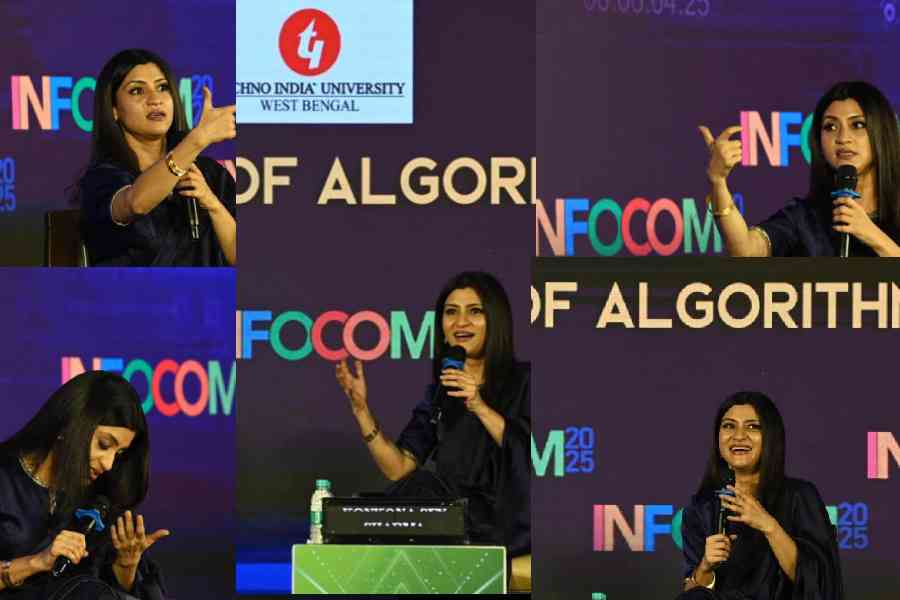
Known for her honest and authentic portrayals in both art-house and commercial films, Konkona Sen Sharma is also a filmmaker of repute, and is known for her nuanced and realistic storytelling. Her work has mostly dealt with social and feminist themes with a focus on relationships, identity, displacement and the life of marginalised communities. Her latest role in the web series Search: The Naina Murder Case, though that of a homicide investigator, explores themes that touch upon the pressures faced by women to balance the needs of their career and family. At present, she is co-directing a comedy series for OTT, which marks a significant shift in her style and embraces humour and romance to offer a completely different approach to storytelling. As someone with a deep knowledge, experience and understanding of the audio-visual narrative art form, Konkona is perhaps also one of the best among the contemporary crop of film personalities to offer a true perspective on the challenges that cinema as a medium is facing in the fast-changing, technology-driven entertainment landscape of today.
Excerpts from a fireside chat between Konkona Sen Sharma and model-actress Ushoshi Sengupta on ‘Art in the Age of Algorithms’, the concluding session of the three-day technology conclave Infocom 2025: An ABP Initiative, held at Hyatt Regency Kolkata last month.
QThe times are changing and there is so much technology in all we do. The way we are consuming films and watching content is also changing at a very fast pace. So do you think the audience’s perception and of understanding cinema is changing as well? Has it changed for you?
I think to a certain extent it has changed. In fact it has changed across audiences. You see I am a proud Gen X-er. We had a shared childhood, we watched Doordarshan in the age of pre-liberalisation. We watched all the ads, and those national integration videos with the Ek chidiya song, and the moment I mention them, people my age know what I am talking about. I wonder if there is that shared pop culture heritage today, except for of course some highlights, whether from abroad or from here. There are only some viral videos and those are very ephemeral. They are so short-lived that I don’t know if it has that kind of significance the way it had for us. So I do think that audiences are changing.
They are also exposed to a lot more content from all over the world — all kinds of content, whether it’s Reels and Shorts, or whether it is like short films, feature films and so on. Plus, people are always on their phones watching “content” on their smartphone screens. It is so odd, because everybody is holding a phone in their hand or holding them up (to record). It is as though without our phones what meaning does life have?!
QDo you think that the excessive screen-time that everybody is spending now is responsible for a gap or a loss of depth between what creators and makers want to show and what the audiences perceive, or, what filmmakers are creating as works of art just end up being “content” on viewers’ screens?
Well, it depends. Because I wouldn’t say that all the mainstream Hindi or Bengali films in the ’80s and ’90s were works of art! Actually, so much depends on your intention. You see, films, or anything that requires money to make, must think about recovering that money. But hopefully artistes should also be interested in expressing themselves and driving home their artistic agenda. So I think this is a very old problem. Nowadays there are streaming platforms, previously there were studios. They had the masses as audience, while now there are subscribers, but they both want the same things, they both want their content to be popular. So what matters is the intent of the person who looks at the work of art as his business. But if you only look at it as a business it never works. So you have to temper it with some artistic intention or at least some meaningful entertainment.
QSince we are talking today about technology as the way to go “future forward”, how much do you think tech is influencing storytelling, with platforms changing and audiences shifting?
Firstly, people have always been wary of technology, and by no means has it stabilised today. In 10 years’ time there will be so much more tech in our lives. What has remained the same are human emotions. Human beings have been feeling love, loss, betrayal, sorrow, anger, regardless of technology. Whatever form technology may take, it doesn’t really influence emotions. What it does influence is plot. When I was directing A Death in the Gunj, there were no phones, and it was very convenient for the plot. So now there are phones, where previously there were only radios. So one has to accommodate to the level to where technology has reached.
A lot of storytelling is about emotion and it’s difficult to change people’s minds without an element of storytelling, or without an element of emotion. So technology is just the tool. People were similarly apprehensive of television when it first arrived. They were similarly apprehensive of the telephone and found it disruptive. So I think that it is normal for human beings to feel apprehension about technology, specially when it’s progressing at such a fast rate. Though I wish there was more responsible corporate or government policy to stabilise some things to make them last for at least a few years before something new came along.
I also don’t think it is always very advantageous. You see, I don’t own any music anymore. I used to own cassettes, and I used to own CDs and now, I own a subscription. None of the music belongs to me. I can’t even access it the way I like. I can download it but if something gets taken off the streaming platform I lose all access to it.
QIn a world where AI is also moving so fast, and AI plug-ins are being widely used by creators everywhere, has the digital ecosystem changed your perspective as an actor or as a filmmaker?
I don’t know. I don’t think so. I am very tired of constantly trying to make out if something is a product of AI or not. You know, now they should be teaching it in schools — how to tell if its done by AI. As soon as you know it’s AI, don’t you lose a little interest? I think you do, because the moment you know it’s AI generated you know that what you see is not a real person or animal. I see that in many Reels they are trying to grab eyeballs by showing you what’s popular — baby and animal videos.
QRecently I heard that they changed the climax of a film through AI and there was obviously a lot of buzz around it, with mixed responses. Do you think that technology might have a role to play in influencing artistic expression in filmmaking in the future?
Probably, yes. Ideally not, but you see what is right and what is fair and what is just doesn’t have anything to do with laws or policy or economics. See, if you’re going to change an actor’s face that copyright should be with them. But it’s not. Even now, without AI, when you have to sign contracts, it’s heavily skewed in favour of the producers and the studios. These are things that one has very little control over. Yes, they have changed the ending. And apparently they won’t need actors down the line. But I am happy to stay away from this kind of fear-mongering. I don’t think it is useful. We don’t know whether this is going to happen. Every time there has been a technological advancement or development people have worried for the worst. I mean, people may lose interest. If AI actors or AI artistes take over, I personally wouldn’t like to watch it. For instance, when I watch those baby and animal videos and then can tell that some of them are AI, I feel so cheated. It’s fun only if they are real.
QYour family has had a huge influence over your life and career. You directedA Death in the Gunj, which is a story written by your father. In a world defined by so much content, what inspired you to pick up this story?
You see, I never did want to become an actor and I didn’t ever want to become a director. So clearly I shouldn’t be listening to myself. But I liked that story very much because it is a story that actually happened to my parents. Back in the late 1970s they had visited McCluskieganj and there was an incident like this. I just took the seed of that idea and developed it and made it into a feature-length film.
My parents are really wonderful storytellers; they can tell really funny stories and spooky stories and I was a child who would ask for stories on repeat. It was as though my brain was trying to make sense of it. I found that story about a planchette gone wrong very fascinating and would ask my father to tell it again and again. And when a loved one tells a story repeatedly, it’s imbued with a certain emotion and it becomes heavy with a sense of the time of that world. I wanted to make it into a film because it says so much about the audience also. It’s in the way we are trained to view things — if there is a certain kind of music, we perceive the image differently, if the music is different, then we perceive it in another way. Even the preceding and subsequent image influence the image one is watching. It is fun to manipulate those things. The same scene someone will interpret as paranormal, while others will interpret as psychological — so I think it is very revealing of the audience.
QHas motherhood changed the way you work as a filmmaker or as an actor? Do you find it challenging?
I do find it challenging and rewarding. More than anything else, I think it ultimately lends itself to meaning. As a great man once said, happiness is a by-product if you work towards meaning. And sometimes we don’t make the meaning in the moment. Future forward as a concept is very good, especially for people who are studying technology and science, but for artistes, introspection and reflection are also important. Why I said this is that more and more we find that women who are very literate and very educated have fewer and fewer children. In some countries it is also becoming a problem with birth rate. In my workplace, the women I work with don’t have children. It’s very difficult for women to hold positions of power in their reproductive and child-bearing years. And that’s because we don’t have joint families or a community support system in its place. I wish instead of focusing so much on AI, we could focus on how technology could help mothers like us counter some of these problems.
QAll the content we see online these days is algorithm-driven. Does it impact the way you choose your characters?
I don’t think my algorithm has anything to do with how I choose my characters. I think we are giving too much importance to the algo. Firstly, you can make the algorithm work for you, and I think I have reached a very sweet spot at the moment with my algorithm because it’s showing me some great content that I want to watch. So I feel that is so much a tool that we can use. I don’t think that it itself need to have much meaning beyond the fact that corporate greed will probably spend billions on research, so they can have more “users”.
But it obviously can’t have anything to do with the way I choose my films, because the way I choose my films is a reflection of my personality. The algorithm is just a reflection of what I have clicked recently, and that also keeps changing. Also, I have not taken help from AI for my work yet, but if I need to I won’t be reluctant. As you know, filmmaking is a very technology-heavy medium and that’s perfectly fine. I use a lot of tech in my everyday life and it has its space. It is just that we don’t need to deify it and give it a lot more importance than it deserves.
Choosing a character is an artistic expression and that is built from the way I live my life and the way I choose to spend my time. It’s just not about content only; it’s about the interactions and connections I have with people, the books I read.
QWe live in a world where being “viral” is such a big thing. Does that put pressure on the creator?
I don’t think that you can actually plan for becoming “viral”. If it happens, great. What you actually try is to create something that rings true for you and therefore for someone else. With my kind of work for instance, the goal is not to be most popular, because what is popular is not necessarily good.
QYou have the image of a public figure with a very private life. How do your social media pages help you stay connected?
I put things on social media as it suits me and my mood. There are times when I want to share, there are times when I don’t. I don’t want to feel obliged to put out something every day or risk losing followers. There are times when I feel very inspired and I want to share a thought or an idea. One of the few things I use my Instagram for is for book recommendations. I have a highlight on books, so that anybody who is looking for suggestions on books to read can also look there.
QIs there any story that you want to tell but haven’t been able to transfer on celluloid?
There is a story that I have been wanting to write for the last two years where I want to couple the themes of motherhood and horror. I am excited to do that and have been trying but not yet quite managed to.
QThis year’s Infocom is anchored on the theme, ‘Technology — Future Forward’. So what does “future forward” mean to you?
I wonder if future forward is more to do with tech because I am very much a person who lives in the moment. I am lucky also to be able to do that. The idea of future forward is great but I feel that without an understanding of the past, that future will not be of any value. Instead of only having great ideas and visions for the future, if one studies the past, whether it is your own personal history, of your nation, your community or even a friendship, there is a lot to learn there and you get an understanding of why things happened the way they did. So along with future forward, you need to look back too as only then will you be able to break patterns.
QIf you have to give one piece of advice to the young generation of filmmakers and actors, what would it be?
Young people these days are very smart and I am sure they will be able to figure it out on their own. But maybe I will tell them to have or build a rich inner world; that is helpful. And not to have one source of happiness but to identify a few things that will create a deep and meaningful inner world such as travel, experiences, relationships.