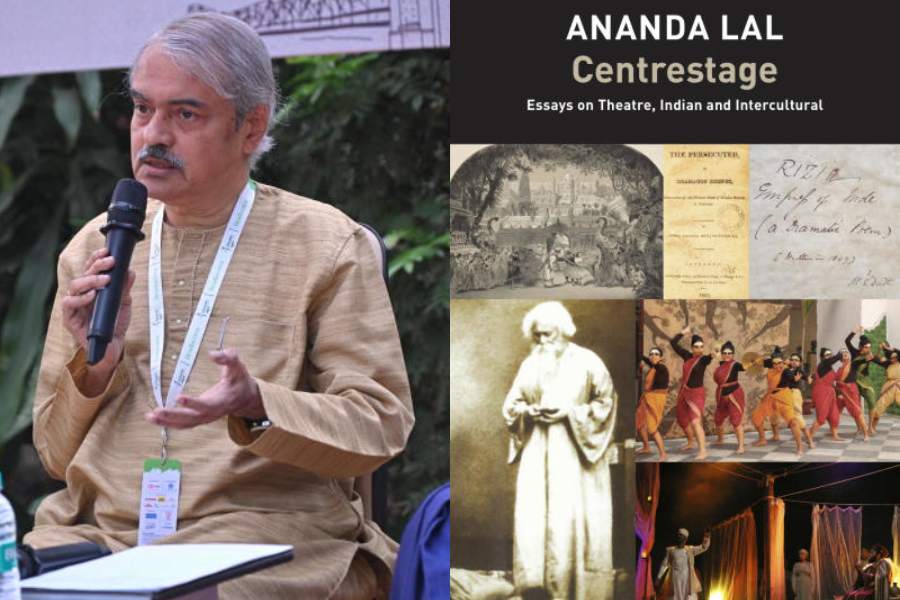
One of Calcutta’s most revered and loved academics, Ananda Lal had a charmed upbringing as the son of the Calcutta intellectuals Professor P. Lal and Shyamasree Lal, and grew his own perspective on Indian theatre. Ananda’s new book, Centrestage: Essays on Theatre, Indian and Intercultural, is a collection of his writings on theatre over a period of four decades. It is a seminal contribution to the study of theatre in India.
Ananda was two years my senior, and because his father Purshottam Lal had a very vibrant following among all of Ananda’s friends, I got to know of his passion for theatre since we were in college. He always stood out as a serious, insightful, and perceptive youngster who imbibed much of his father’s craft and his mother’s art through his youth. Kind, sharp, and a public intellectual who speaks with delightfully correct diction and never disappoints, Ananda, married to educationist Swati, and father of theatre personality, Shuktara, is now putting his own spotlight on the stage. Ananda retired as professor of English, Jadavpur University, and is the publisher of Writers Workshop. Excerpts from a chat:
Ananda, could you speak about growing up surrounded by the effulgence of intellectuals such as Professor P. Lal, and Shyamasree Lal. You are considered one of the leading specialists on Indian theatre. How much of your childhood and youth was influenced by your parents creating such an environment?
Julie, you knew my parents well! Many children of famous parents want to make their own mark by moving out from the shade of their parental canopy. So did I. While I imbibed the home ambience of modern Indian literature in English and translation into English, I found myself drawn to theatre after finishing school. Both my parents were quite dramatic personalities, but didn’t have any deep theatrical connect. If my father was the visionary of Writers Workshop (WW), my mother was his shakti and support, without whom WW could not have endured. She was a devout Rabindrik and a pioneering translator from Bangla to English.
In world theatre that you have encountered, which three performances will always stand out for you as exceptional, and why?
The word “encountered” narrows the field considerably to only those I have seen. All three that I mention here demolished what we, and I, knew as conventional proscenium theatre. My first eye-opening performance was Badal Sircar’s Spartacus performed immersively in the top room of the Academy of Fine Arts when I was in college. The second, Peter Brook’s Mahabharata, showed how someone could transform an Indian story into a universal human experience for a worldwide audience. The third, Tim Supple’s Midsummer Night’s Dream, worked in reverse, presenting Shakespeare multilingually in South Asian languages for an equally human international impact. I have written about the last two in my book.
It is a formidable book based on meticulously researched articles that you have written over the last four decades, spanning drama from the 1830s to the 1950s, key plays of the 1970s, and Calcutta theatre in the 21st Century. What did you keep in, and what did you throw out, and why?
It happened organically, not to a premeditated plan. Collecting my essays, I realised that they covered a 200-year history of modern Indian theatre, as well as intercultural theatre that became a trend in contemporary times. Thus the book fell naturally into these two parts. I have kept those that speak to the present reader, and updated them. I omitted several articles that dealt with productions that I myself directed, or on specific plays that I felt may not reach out to an external readership today, or on my guru Tagore, because my writings on his theatre are readily accessible elsewhere.
I am sure haphazard archives and missing volumes must have been a frustrating enterprise at times, with ellipses, lapses, and gaps, and the writing of the authentic “history” of trailblazing of the 19th Century which does not exist in our libraries, posed as big challenges. How did you ensure authenticity and fill in the lacunae?
You’ve hit the nail on its head regarding the difficulties. But a dedicated researcher must try to locate every possible source, even if he doesn’t succeed in unearthing some, and then verifying every bit of factual information, even if one has to search for residents’ names in old street directories or track a gravestone in a cemetery! You have to scour foreign libraries if ours draw a blank, as I did with the play Kaminee, finally discovered in the British Library (London) but vanished from India. Sometimes glorious serendipity occurs like when my student Pramantha Mohan Tagore gave me his invaluable family possession of Michael Madhusudan’s manuscript of Rizia, which nobody even knew existed. The minute it landed in my hands, I realised that I had to transcribe and publish it for the benefit of posterity. Few literary scholars get such an opportunity in their lifetimes.
You have corrected many inaccuracies about Indian theatre in English that scholars had accepted. For example, claims that the first Indian play in English was Michael Madhusudan Dutt’s Is This Called Civilization (1871). Please explain how you corrected this inaccuracy.
Actually, though most histories continue to perpetuate this error (Michael didn’t author it; and a certain D.N. Banerjee translated it from Michael’s original Bangla), some discerning scholars had identified, rightly, that Krishna Mohana Banerjea wrote the first such play, The Persecuted, in 1831, based on his own ostracisation or infamy, as Bengalis termed it at that time. What they did not point out is that The Persecuted wasn’t merely the first Indian play in English, but the first original Indian play in any modern Indian language. Not even Bangla had come up with an original drama in 1831. Meanwhile, I continue my hunt for Is This Called Civilisation, a 42-page book that nobody has set their eyes on and which doesn’t seem to exist in any library. Even the copy in the British Library has been misplaced! Somebody obviously spotted it, and possibly purloined it.
It seems one of the first fathers of Parsi theatre in Mumbai, Cooverji Sorabjee Nazir, had composed in English in 1866 The First Parsee Baronet, but there were plays going back even earlier.
As I’ve explained in my book, that was a biography, not a play. If Nazir did write a play with the same title, he never printed it. Before him and after Banerjea there appeared a tragedy, Kishun Koovur, published in Trivandrum in 1840. This has recently been edited in a modernised version as Krishna Kumari, although I cannot understand, why modernise it. But, trust me, there was no English play by an Indian before 1831. Until some other discovery proves all of us wrong.
Looking at Chapter 3, Utpal Dutt’s Barricade was considered most staggering, a huge shadow of Hitler gesticulating is a scene none of us could forget. Major trigger for Barricade was that under President’s rule the entire Left was crumbling. Why do you think Utpal Dutt made such a mark with both the Communist wannabes in colleges and universities, both English language and vernacular, in Calcutta?
Dutt was a theatre genius, and any such personality is bound to attract an ardent following regardless of time or place. The Seventies was also a decade of dissent and student activism, which dovetailed with Dutt’s avowed “revolutionary theatre”. By the way, “the entire Left” didn’t crumble. If it had, then it could not have come to power afterwards.
What was the secret of the global outreach of Peter Brook’s Mahabharata? Was it his diverse, yet magisterial casting to use African, Asian, and White actors?
There's no single answer. Let’s face it, he had huge financial resources backing him. With that kind of funding, you can tour globally, which obviously helps. But let’s not forget that his vision, intellect, methodology, and artistry made him one of the most iconic directors of the previous century. Multiracial casting, which he had already introduced in previous productions, was only one element of it. A major aspect was his presentation of it as a trilogy in three parts that had to be viewed separately, the total duration spanning nine hours. Above all, he communicated the Mahabharata as a work for all humanity. If I may return to my father (whom he met on his recce trip to India), Brook seems to have accepted P. Lal’s interpretation of it as “the doomsday epic”. That certainly resonated with his audiences worldwide.
Julie Banerjee Mehta is the author of Dance of Life, and co-author of the bestselling biography Strongman: The Extraordinary Life of Hun Sen. She has a PhD in English and South Asian Studies from the University of Toronto, where she taught World Literature and Postcolonial Literature for many years. She currently teaches Masters English at Loreto College. She curates and anchors the Rising Asia Literary Circle