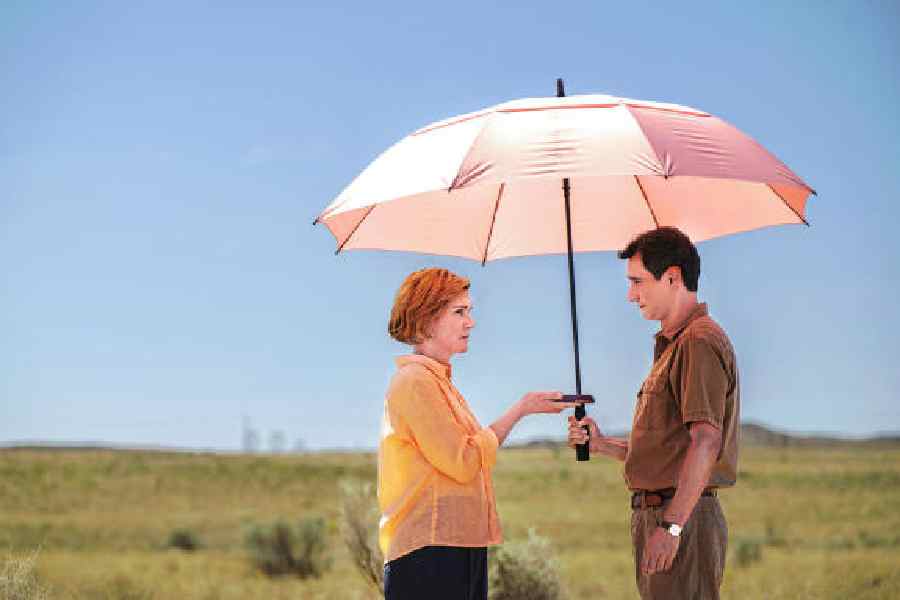
What if…” — two words, endless possibilities. The beginning and the sum of all stories worth being told. They can turn a simple life, or the most mundane world, into a topsy-turvy space where metaphors and analogies start melting into each other — just as they do in the case of the shows covered in this edition. Both look at humanity through a lens of humour, albeit a translucent lens given how dark the humour gets at times, founded firmly on the strength of these two words. Of course, the scales and magnitudes vary vastly.
THE CHAIR COMPANY
Tim Robinson stars in and co-creates (along with Zach Kanin) this show about how one man’s relentless need to vent, combined with an obsessive quest for his humiliation to be validated, leads him down a rabbit hole that presents more questions and mysteries than the number of explanations it offers. On one of the most important days of his professional life, William Ronald Trosper suffers a terrible fall when the chair he was sitting on collapses — it happens in full view of his bosses, colleagues and co-workers. While he escapes any serious injury, his pride and his ego are severely bruised. Imagine his horror — the speech he was to make at the event, the one that he had been losing sleep and his peace of mind over, goes surprisingly well. Bosses impressed, co-workers cheering, he is pleased.
Relaxed, he takes a seat and just then, doom city! Ron needs answers, at the very least — an apology. Instead of coming back in the next day and putting the entire episode behind him, he starts a quest to track down the people responsible for the faulty manufacturing of the chair. What Ron could not have anticipated is that his attempts to trace the people running the chair company would inadvertently expose him to several conspiracies and mysteries that involve a giant red ball, assassination attempts and international drug trafficking along with just about everything in between.
The premise of the show is absurd and silly, but it never fails to entertain. There will be times one might feel extremely tempted to dismiss it outright but the writing and weaving of the mystery is so good that dismissal becomes impossible.
Robinson’s own performance is one of the biggest strengths of the show. He plays out the idiosyncrasies of the protagonist so deliciously well that you do laugh at his silliness, root for him when you realise that he is way out of his depths while simultaneously being convinced that he is just a simple man in extraordinary circumstances and in that respect, this could just as well have happened to you. The beauty of it though, lies in the realisation that the chair company Ron has taken on could well be a metaphor for any government in the world while the faulty chair could be just about any aspect of our failing systems or societal structures – that is when the empathy truly hits you.
Other noteworthy performances on the show come from the likes of Joseph Tudisco, Sophia Lillis and Lake Bell. While Tudisco plays Santini, the unlikely sidekick to Ron on his quest and a man with several secrets of his own, Lillis and Bell play Ron’s long-suffering daughter and wife respectively – the ones who ground the otherwise hyper-reactive elements of the show with a sense of real-world pragmatism. It is also through them that we first realise that Ron himself may just be much more complex as a human being than initially suggested.
The Chair Company has been called one of the best shows of the year by multiple prestigious institutions and rightly so. Most shows or films that suck the audience into their absurd narratives often lose the emotional connection, but that is not the case when it comes to this show. Let me reiterate – despite the show needing uncompromised suspension of disbelief, despite it being absurd, wacky, silly and hilarious, there is something wonderfully human about Ron and his story. That is where the show’s directors Andrew DeYoung and Aaron Schimberg truly flaunt their victories.
Platform: JioHotstar
PLURIBUS
“The last man on Earth sat alone in his room… There was a knock on his door!” Almost all of us are familiar with this Fredric Brown short story; why it is relevant in this context is something I am about to explain. Imagine being Carol Sturka, a successful author specialising in niche genres, the last person on Earth. Well, not exactly, but close enough. A mysterious alien signal causes our species to stumble upon utopia – a society where the well-being of all and the well-being of one are in fact one and the same. Individual agency has ceased to exist; humans now thrive as a species with a hive mind. No conflicts, no killings (not even livestock or plants), no dissent, no arguments — peace on Earth.
Of the eight billion people who inhabit the planet, only 13 or 14 are immune. Even for the ones who are immune, the world is now truly paradise. The entire species is seemingly at their service and they are all milking the situation. All except one that is – Carol. She is the only one who doesn’t interpret these circumstances as a form of utopia; if anything, she sees a world where the needs and wants of the individual hold no value as a form of dystopia. Add to that the fact that this changeover, what the species has come to call The Joining, cost her the love of her life.
The beauty of Vince Gilligan’s world-building has always been that he has mastered the art of creating heroes who are deeply flawed and as malevolent as they are benevolent, a trait that we all applauded when he created Breaking Bad — his crown jewel. Pluribus carries forward that legacy. Carol’s reluctance to acknowledge the new world order as one that is all good and beyond questioning is not misplaced, but the show pits her attempts at uncovering the truth of the matter at any cost against the brainwashed population’s inability to cause harm so effectively, that at times Carol does come across as selfish, apathetic and downright antagonistic. That is by design, not coincidence. In fact, the show explores both sides of the argument so effectively that as a viewer, one might be forgiven for constantly shifting loyalties.
Yet another Gilligan trademark is the patient world-building that the show employs. It is never in a hurry to jump from one beat to the next. This is also the area where the show really flaunts its technical proficiency, especially the mastery of Marshal Adams and Paul Donachie behind the camera. When the show leaves Carol alone and on her own in vast expanses, it is almost an open invitation to step into her solitude.
Rhea Seehorn is absolutely, strikingly and undoubtedly brilliant as Carol Sturka. She hits every note so precisely that it becomes impossible for us to disengage. Needless to say, she has been asked to take on a titanic task — carry a show alone while functioning as the audience’s anchor to the new reality. A lesser actor would have created a unidimensional heroine. Seehorn, on the other hand, inspires every single human emotion in the viewer. We empathise with Carol’s sense of loss, we get deeply disturbed by the lengths she is willing to go to in order to revolt against the peace that has been forced upon her world, we feel for her and fear how lonely she is, we even root for her when new truths come to light. She is the soul of the show.
Pluribus is high concept and, I won’t lie, it does test your patience. However, the world of Pluribus raises so many deep and disturbing concerns about our own existence that its responsibility towards crafting a tale dutifully taking precedence over its need to entertain makes absolute sense. Besides, when it does shift gears, it makes for a show that is more riveting than anything else on streaming. I highly recommend you visit Gilligan’s island!
Platform: Apple TV+