Viswanathan Anand decided to play in the recently-concluded Tata Steel Chess India Rapid and Blitz tournament only last year after a hiatus of six years. He was out of playing active chess for a long time and was quite unsure of his form, especially in this quicker format.
However, he played in the Jerusalem Masters (where Anand reached the final before losing the blitz tiebreaks to Arjun Erigaisi) and then at the Global Chess League in December 2025, where Anand led the Ganges Grandmasters. He faced top opponents, including Hikaru Nakamura and Dommaraju Gukesh. Both these tournaments helped Anand regain his confidence, and by his admission, “finally in the chess playing zone” before coming to Calcutta.
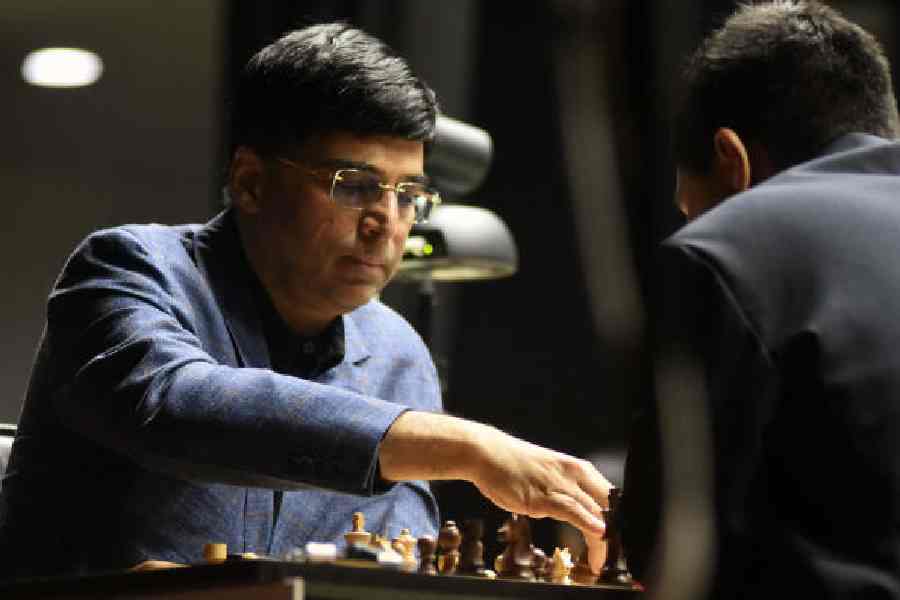
At the post-match discussion after the rapid tournament (Day 3), Anand discussed his brilliance against both Volodar Murzin (Round 9) and Hans Niemann (Round 5) on Day 2 along with the super middle game win against Wesley So (Round 4) where Wesley lost perhaps after Anand’s move 34, with G*F4.
Surprisingly, Anand confessed to his disastrous game against Erigaisi (previous day in Round 3), where he blundered from a winning position (RA5 in the 52nd move & QD6 in the 53rd).
He had a plus 5.61 advantage after his 51st move! This was the same way he lost to Erigaisi at the Jerusalem Open. It was with amazing lucidity, intensity and passion that Anand discussed all three games, and I was amazed at his memory recall.
He knew every single move with clarity at the news conference, and then discussed the logical options available to him at that point in time and the reasons for his decisions.
The board was like a giant LED screen before his translucent eyes! In his earlier years, Anand was called the “Lightning Kid”, and this was really early, after winning the Asian Junior Championship at the tender age of 15 in 1985.
Anand mentioned that he would study all his games once he is back in the hotel, lest he forgets his train of thought at a later date. This shows the seriousness with which he approaches each tournament, even at this stage in his life. Anand ended with 6/9 in the rapid with four wins, four draws and one loss. Very remarkable indeed. He finished in second position after Nihal Sareen (against whom he drew).
So what makes Anand tick after so many years? Is it just his memory, or his sharp tactical thinking, which needs a quick response more than a broad strategy being iterated to greater detail?
Anand confessed he has evolved over the years and is playing “modern chess” which at one level is based upon more information. It’s not that he has abandoned his intrinsic playing strategy or style or changed fundamentally from his tactical or fast iterative thinking process.
He confessed he now needs to constantly keep abreast with all the latest openings, middle games thematically, and this is where he gets help from Sandipan Chanda more as a playing partner.
There is so much of change happening in modern chess which is breaking free from “conventional chess”, especially with newer ideas coming to the fore, also initiated with Fischer Random Chess, as propagated by Magnus Carlson in recent times.
A deeper understanding of positions and counterplay help a modern chess player. This is apart from the basic parameter of quick thinking, based more on intuition and perhaps often at a compromise to astute logic.
It is this balance of intuition and quick immediate response (often based on aggression), often based on instinctive reaction to newer variations in openings and middlegame that make the modern chess player lethal.
Indian chess has these strengths in its youth. Aggressive players are willing to take risks and beat logic with intuitive thinking.
Anand has wound up his clock and is now realising his innate strengths can pass the test of time with this recalibration. This is showing in his results and the best part is he is still enjoying his chess.
Postscript: Aruna, his wife, had nicknamed Anand as “Lord of the Rings” because he kept losing his wedding ring. How could Anand never forget any of his chess games? The mystery remains to date.