 |
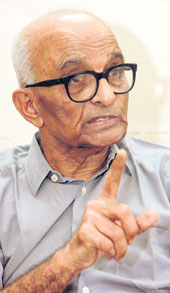
| Madhav Mantri at his residence in Mumbai. Picture by Gajanan Dudhalkar |
Sachin Tendulkar’s run slump has, for long, been either attributed to age or his stiff bottom-hand-batting grip. One man, however, puts forward an interesting point of view: Sachin’s weight!
“Sachin has put on weight, and that has slowed down his reflexes,” he says matter-of-factly, and points out the parallel with a similar slump in Sunil Gavaskar’s career during an Australia tour.
On that tour, when Gavaskar’s runs dried up, a worried Russi Modi wrote to Sir Don Bradman asking him what he thought the problem was. “Bradman wrote back saying ‘it’s simple. Sunny has put on weight, and his reflexes are slower on the fast-paced Australian pitches’. Sachin is a facing the same problem,” he says.
Whether you agree with him or not, when Madhav Mantri opines, one listens.
At 86, Mantri is the oldest living Test cricketer in the country (though K.C. Ibrahim is 88, he now lives in Pakistan). Now, as Indian Test cricket completes 75 years on Monday, the wicket-keeper batsman, who played for India between 1951 and 1955, looks back on his playing days.
Mantri played just four Tests, scoring 67 runs with eight catches and one stumping, but had a decent first-class career. He played 95 matches and scored 4403 runs at an average of 33.86 with seven hundreds, including a top score of 200.
Making his first-class debut for Bombay in February 1941, Mantri set an Indian wicketkeeping record of nine scalps that remained unbroken till 1980 when Mumbai’s Zulfikar Parkar got the perfect 10.
Like all Mumbai cricketers, including Gavaskar and Tendulkar, Mantri’s entry into cricket was through ‘Gully Cricket’. He played in the by-lanes of Hindu Colony in Dadar, getting four annas from his father whenever he took more than five wickets in inter-lane matches.
Mantri’s first big-match experience was historic. He was a 12-year-old boy when his father took him to Bombay Gymkhana for the first-ever Test played on Indian soil in December 1933.
A commemorative plaque with a photograph of England captain Douglas ‘Bodyline’ Jardine and his Indian counterpart C.K. Nayudu adorns Mantri’s drawing room today.
“It was a cricket fortnight with several warm-up games before the historic Test match, and I got to see all of them. Watching stars like C.K. Nayudu, Mushtaq, Lala Amarnath, I had no idea that one day I would play with them,” says Mantri.
“The highlight of the Test match was Lala Amarnath’s century, the first-ever by an Indian cricketer, and that too on debut,” Mantri says, his eyes alight with the memories.
England needed 39 runs to win, and completed the victory against “minnows” India in grand style with Charlie Barnett hitting two towering sixes off fast bowler Mohammed Nissar.
Nearly 20 years later, Mantri bumped into Barnett on his 1952 tour to England, and reminded him about the victory. “Barnett was amazed when I told him that I had watched him hit the two sixes,” he says.
Among the highlights of the 1952 tour was a sparkling 150 by Sir Len Hutton, the England captain.
“Hutton spoke little when he was batting. Early into the innings, he was beaten by a googly by leg-break bowler Sadubhau Shinde. ‘So, that was the wrong ’un,’ Hutton said. Then on, he played the googly well, and without another word scored his ton. I eventually caught him off a Vijay Hazare delivery,” Mantri said.
His best anecdotes are about his nephew, Sunil Gavaskar, who often credits Mantri for inspiring him. Gavaskar stayed every weekend at the second floor Mantri residence in Hindu Colony’s Lane No. 3.
One day while Gavaskar was there, Mantri was preparing for a Sunday match. “Looking at the several caps in my cupboard, Sunny said, ‘Nana Mama, please give me one of those’. I said ‘these caps are not gifts. I have earned each of these. You earn one and wear it’,” Mantri recalls.
Next season, Gavaskar began playing for St Xavier’s School. He was then an opening bowler and a No. 8 batsman, and not until the next season was he made the opening batsman of the school team. “One evening, Sunny came home and ran up to me with a brand new sweater and a cap. ‘Uncle, I have earned mine. We won the shield’,” Mantri said.
Before Gavaskar made his debut for Mumbai, he already had two double hundreds under his belt from his school days — a 246 and a 222 — and was named the best Indian schoolboy cricketer in 1966.
After one of those double hundreds, Gavaskar visited his uncle’s house, and told Mantri that his team score stood at 400/1. “I asked him how he lost his wicket. Sunny shrugged and said that after he scored his 200, he just threw the wicket away. I told him ‘never give your wicket away, let the bowler earn it’.”
He says Gavaskar took the advice, and continued doggedly even after scoring a 300 later in his career. Gavaskar’s first-class top score is 340.
Mantri has also seen the other batting sensation from Mumbai up close. He was the cricket manager when Sachin Tendulkar toured England and scored the first of his 37 hundreds at Old Trafford in 1990.
“After Sachin got out cheaply in the first Test at Leeds, Sunny told him that England pitches were slow and advised him to play a little late to avoid striking the ball on the up. Sachin scored the century that had eluded him in the next Test,” Mantri says.