Tanvir Sheikh and Roshan Agarwal never imagined they would link up at a cricket ground to reignite a friendship that began a decade ago at Columbia University when they were postgraduate students.
One now settled in Canberra and the other in Toronto, they found themselves in Colombo a day before the high-stakes India-Pakistan T20 World Cup encounter, courtesy their common love of cricket.
As at Columbia, so in Colombo: their different nationalities — Indian and Pakistani — never came between them.
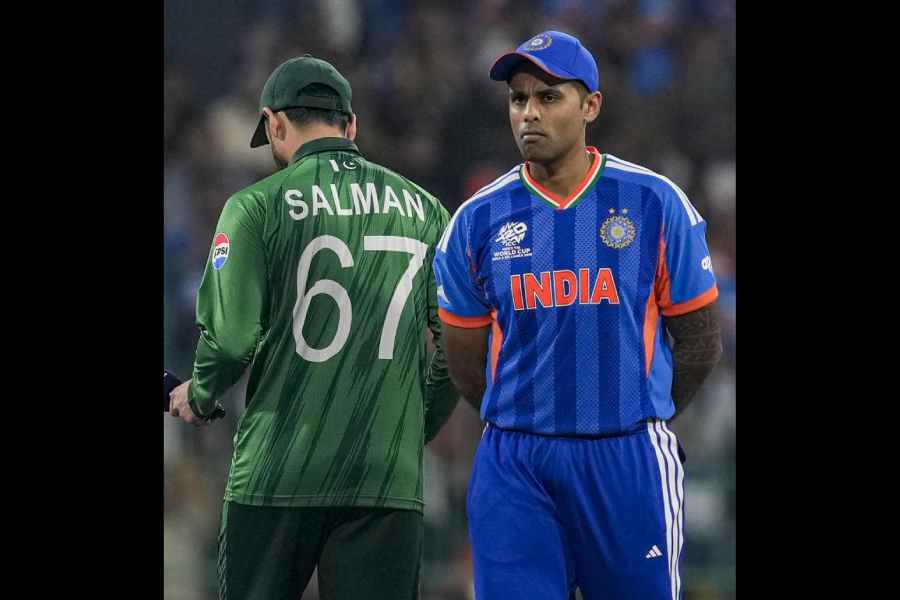
India captain Suryakumar Yadav may have refused to shake his Pakistani counterpart Salman Agha’s hand at the toss on Sunday, but Tanvir and Roshan were among the thousands of cross-border fans who chose to embrace bonhomie in the Premadasa stands.
Surya had refused to reveal his handshake plans on match eve, requesting the media to “wait for 24 hours”.
But long before he had walked out for the toss on Sunday, it was known that the Indians would maintain status quo on their no-handshake policy, effective since Pahalgam and Operation Sindoor.
Surya was aloof towards Agha at the toss. He wore a serious look, barely speaking to anyone. Toss over, he finished his mandatory interaction with the broadcaster before walking off. There was no immediate word on whether the decision to not shake hands had been taken on match day or earlier. What is certain is that the diktat came “from the very top”, as someone in the know underlined.
The frostiness wasn’t confined to the players — cold vibes were exchanged among former cricketers in the broadcasters’ arena.
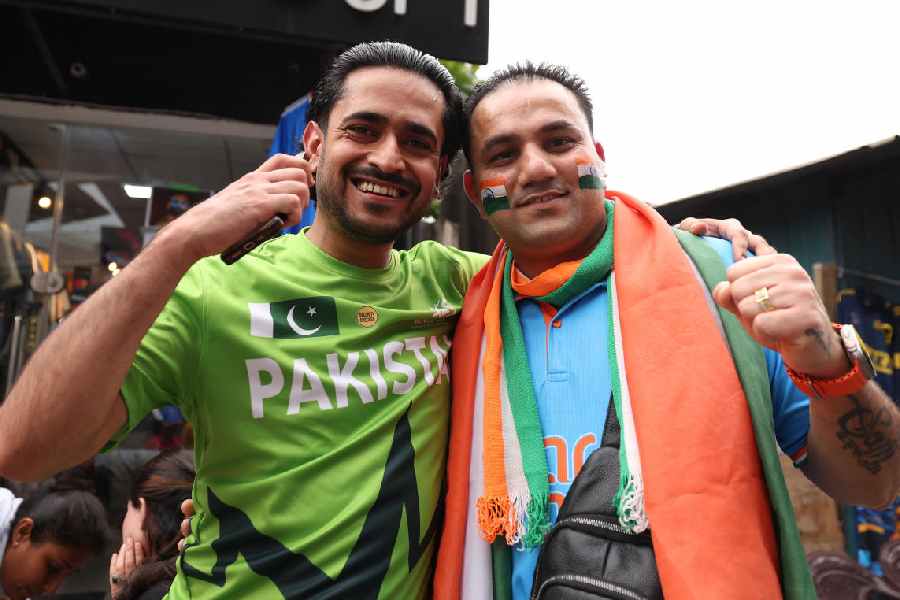
A friendly gesture from rival fans at the R. Premadasa Stadium in Colombo during the India-Pakistan T20 World Cup match on Sunday. Getty Images
Cricket commentator and ex-India player Sanjay Manjrekar called India’s stand “silly”. “This ‘no shaking hands’ is such a silly thing that India has started. It’s unbecoming of a nation like ours. Either play properly within the spirit of the game or don’t play at all,” he posted on X.
Surya’s latest snub to Agha came in the presence of heavyweights from the International Cricket Council (ICC), including its chairman Jay Shah, as well as the cricket boards of India (BCCI) and Pakistan (PCB).
A cavalcade of cars had swept into the Premadasa Stadium a little before the toss, throwing security into a tizzy. Those who got off included Shah, the BCCI brass, including president Mithun Manhas and secretary Devajit Saikia, and former India captain Rohit Sharma. The entourage had arrived on a chartered aircraft from Ahmedabad.
PCB chairman Mohsin Naqvi had made a quiet and contrasting entry much earlier and sat down in the company of Sri Lankan cricket officials. Naqvi had on Saturday night told the Pakistan players to take the field in the “right spirit”.
It is understood that India’s no-handshake policy had become a bone of contention at a tripartite meeting in Lahore between the ICC and the Bangladesh and Pakistan boards. Eventually, the world body got Pakistan to accept India’s stand.
The Indians’ refusal to shake hands with Pakistani players had been a big talking point during last year’s Asia Cup. The Indian team later refused to accept the trophy from Naqvi, the Asian Cricket Council chairman and Pakistan interior minister. The team still hasn’t received the Asia Cup trophy.
The bilateral bitterness has ensured that India-Pakistan matches, which drive the entire cricket ecosystem, are now limited to only ICC tournaments.
At the Premadasa stands, though, the fans didn’t seem bothered.
A carnival atmosphere prevailed, with the two sets of supporters cheering for their own teams side by side, with nary a word seemingly spoken in rancour.