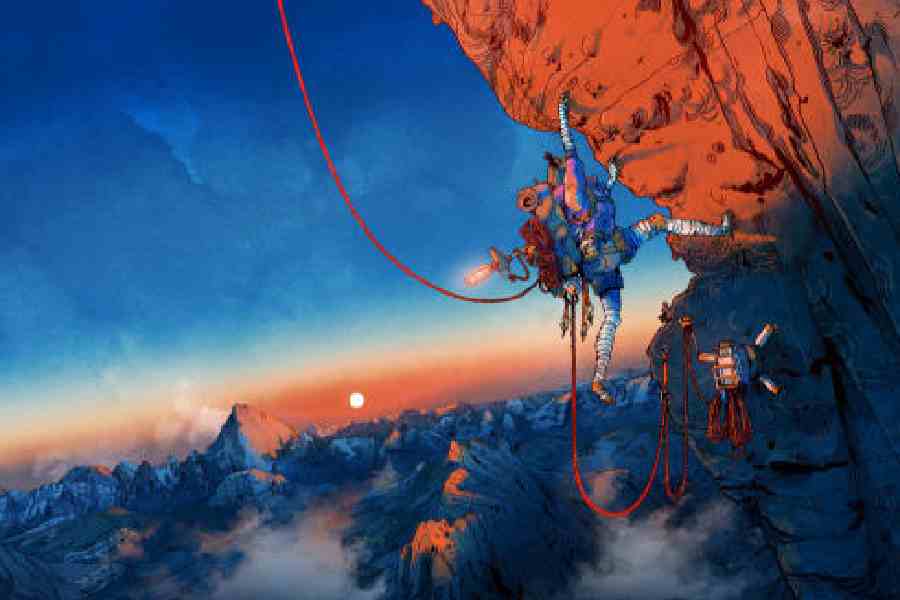
The creative director of Cairn wants players to feel all the tension of climbing while their character clings to a granite-grey mountain face. Toes clench over a slither of rock as hands clasp a protruding crag. Each limb trembles. Listen closely and you can hear the quickening of the mountaineer’s breath.
If a path is beyond the capabilities of Aava, the game’s protagonist, she will tumble down a sheer cliff, battered and bruised as her body hangs from the safety rope. But with each handhold, players can feel the exultations of real-life climbers — white-knuckle anxiety giving way to what the creative director Emeric Thoa calls “huge satisfaction”.
Development of Cairn started in 2020 when few games were dedicated to climbing, which has surged in popularity during the past decade. Now this genre boasts a string of hits: the first-person climbing game Peak blew up last year, selling more than 10 million copies; the Death Stranding franchise sees players scaling massive mountains (and rappelling down them); Jusant offers an achingly poetic take on alpinism; and indie games such as Lorn’s Lure and White Knuckle deliver darker, more experimental angles.
For gamers, there is appeal in pitting oneself against a towering mass of stone. “The mountain offers a literal learning curve, a clear goal and a visual way to track your progress,” said Paolo Pedercini, a professor who teaches game design at Carnegie Mellon University, US.
The challenge is an essential component for this climbing cohort, bucking the safe and predictable scrambling seen in many blockbuster action games. In those titles, players tend to follow a prescribed path highlighted with conspicuous yellow markings.
Not so in Cairn. An avalanche of mathematical calculations feeds the game’s free-form movement system, which is constantly evaluating Aava’s physiological stress and which limb she is likely to move next. The gigantic, fictional Mount Kami was laboriously constructed by level designers and artists who hand-sculpted and hand-placed every rock and ridge.
The lineage of these climbing games is varied. Death Stranding and Baby Steps add greater interactive depth to the walking simulator genre of the late 2000s and early 2010s (pejoratively named because walking is the primary activity). In Jusant, little leaps of faith to reach distant handholds evoke the unforgettable jumps across the backs of steppe-scraping titans in the 2005 classic Shadow of the Colossus.
For the makers of Peak, which can be played cooperatively online, a major inspiration was the groundbreaking open-world adventure The Legend of Zelda: Breath of the Wild. Petter Henriksson, a Stockholm-based designer, said he and his colleagues were influenced by Link’s ability to climb anywhere. The blond hero simply approaches any vertical surface to start climbing, limited only by a slowly decreasing stamina bar and rain that causes him to slide down slippery rocks.
Rain does not halt your progress in Peak but merely slows the ascent. Peak’s multiple summits are not handcrafted; they are procedurally generated, the product of a carefully programmed algorithm. Chief among Henriksson’s considerations for that approach was ensuring that the mountain routes delivered sufficient challenges.
While Cairn evokes the clean nobility of winter mountaineering, Peak evokes four friends going on a breezy afternoon hike, during which a poorly judged leap across a towering ravine can lead to your death.
It is this juxtaposition — between goofing around with friends and what Pedercini describes as the “godless, unforgiving” environments — that elevates the climbing experience in Peak. “You can get lost. You can follow what looks like a trail and end up at a dead end,” he said. “It’s just you and your friends against chaos.”
The sheer hugeness of Mount Kami in Cairn evokes the world’s largest peaks like K2. Even bigger, stranger and more expressive is the world in Lorn’s Lure, where the climbing takes place within a vast subterranean megastructure. The space is unfathomably deep, though Toronto-based designer Radu Nicolae prefers not to reveal its precise dimensions. He merely confirms that it plunges downward for miles and miles, and then keeps going for many more.
Like other climbing games, Lorn’s Lure, released in 2024, delivers the thrill of travelling somewhere rarefied and out of reach while also subverting it; the vistas here are dark and gloomy, more likely to inspire dread than wanderlust.
You do not need to have exceedingly strong fingers or a stomach for heights to enjoy these games. Regardless of setting or style, they suggest that everyone is a climber, seeking to convert the environment before them into a symbolic system of self-expression.
NYTNS