 |
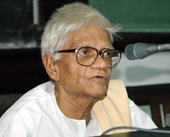
| Reminiscence: Prof. Amal Kumar Raychaudhuri at the meeting |
I t?s not mere hard work. Not sincerity. Not even the depth of knowledge. What made Prof. Shyamal Sengupta a great teacher was his passion for the truth, love for struggle, and his hatred for achieving a goal without an effort. He wasn?t in the least bothered about fame and recognition. The only thing he used to fret about was the wrong attitudes towards science ? both of the students and the teachers. That?s how his colleagues and students at the department of physics, Presidency College, describe Sengupta.
On December 22 the undergraduate laboratory of the college was named after Sengupta, who passed away a year ago. A meeting organised on this occasion attracted a lot of Sengupta?s former students as well as admirers.
Although known for his contribution to nuclear physics and solid state physics, Sengupta was more a teacher than a scientist. He believed that science is a way to teach how something gets known, to what extent it is known, how to handle doubt and uncertainty, and how to go from an observation to a judgement or conclusion.
Sengupta tried to inculcate a spirit of invention and enquiry among the students, always claiming that they were of tremendous value. He framed his lectures in such a way that the students were encouraged to raise questions. ?But very few people welcomed this,? said Prof. Amal Kumar Raychaudhuri, an eminent physicist as well a colleague of Sengupta?s at the Presidency College for decades, who spoke at the meeting marking the naming of the laboratory after Sengupta. ?Most of the people, from his teachers to his research students, often criticised his style.?
In his lecture, Raychaudhuri reminisced about friendship with Sengupta, often going into annecdotes that revealed the latter?s style of incisive thinking.
?In his lectures, he hardly remained confined to the syllabus, or the formal contents of the chapters he was supposed to discuss,? said Prof. A.N. Basu, vice-chancellor, Jadavpur University, and a student of Sengupta?s who also spoke at the meeting. ?To him, physics was simply the study of Nature. And if that be so, there can hardly be boundaries in Nature. There cannot be an undergraduate-level Nature, or, for that matter, a postgraduate-level Nature. Sengupta believed that Nature could be studied at any level.?
According to Basu, this attitude of his teacher did not find many takers. Teaching in the colleges, he often lamented, was solely geared for examinations. ?Thinking is banned here,? Sengupta used to say with sadness, rather than sarcasm. ?But within all the limitations he was successful in making many of his students fall in love with physics,? Basu said, adding that in his writings and lectures, Sengupta offered suggestions about how physics teaching could be made more meaningful. If his suggestions were followed, learning science could made much more meaningful, Basu commented.
The programme was preceded by a video show of an interview of Sengupta taken two years ago. The interviewer took great pains to highlight many facets of his life. In the interview, his beliefs in Gandhian philosophy as well as his participation in the freedom movement came out vividly.
It also showed how his interests in science first took shape. He was sent to the Dum Dum Central Jail after being arrested for taking part in the Quit India movement. It was there that he first came across the works of such great authors as Arthur Eddington, James Jeans and Bertrand Russell. Each of the stalwarts is famous for stylistic writings, but more than that, they took it upon themselves the task of describing how the study of science was linked to human development. Sengupta got hooked to their works during his days in the jail. ?While going through their works I got the idea that understanding science needs a struggle. There?s no easy way out,? he said in the interview.