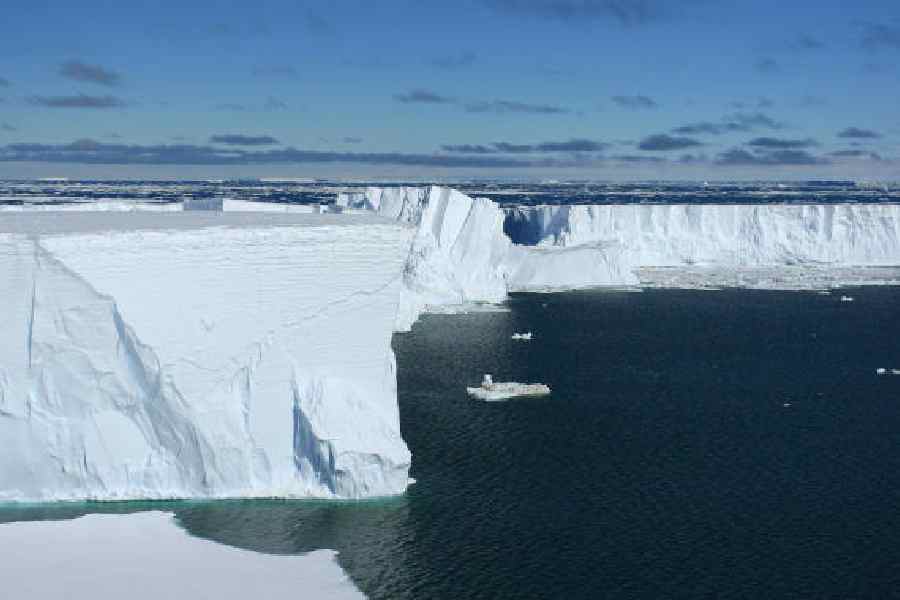
As humans heat the planet by burning fossil fuels, the ice at the bottom of the earth is changing in ways that are anything but slow, with consequences that are anything but distant. Antarctica’s melting glaciers are already pushing up sea levels worldwide, worsening the damage from floods and storm surges. The speed and extent of the melting could determine the fate of coastal communities worldwide, home to hundreds of millions of people.
That’s why a ship carrying researchers from four continents set sail recently. I’m travelling with them.
For all that has changed about the frozen continent, it remains a hard place to work. And yet people are still drawn there. Only now, the attraction of going is not just to prove that we can. It’s to unlock the inner workings of a most unearthly place.
Our destination is a remote bay whose waters wash up against the fastest-melting ice on the continent. The journey by sea is a week and a half each way.
The area’s largest glacier, the Thwaites, is known by an apocalyptic nickname, the “Doomsday Glacier”. Thwaites is the size of the US state of Florida, more than a mile thick in places, and shedding 45 billion tonnes of ice a year. If it melted away entirely, it would raise average sea levels by two feet.
Like a cork in a bottle, Thwaites holds back the vast icy plateau that scientists call the West Antarctic ice sheet. The greater peril would be if Thwaites collapsed and caused the broader ice sheet to melt away, adding another 10 to 15 feet to sea-level rise.
The idea is not far-fetched. Geological evidence tells us it might have happened before, some 1,20,000 years ago. While it would take centuries for all the West Antarctic ice to melt away again, Thwaites is disintegrating fast enough that the next big milestone in its collapse is expected not decades from now, but years.
“Thwaites has really broken up in front of our eyes,” said Doug Benn, a glaciologist at the University of St Andrews in Scotland.
Like all the best adventures, this expedition has goals but no guarantees. One team of scientists, intending to study the warming waters under Thwaites, will attempt to drill through a half-mile of the glacier’s ice and install instruments in the seawater below. Other teams will lower equipment from helicopters into the ice-strewn seas and venture onto ice floes to place buoys. Another group will attach sensors to seals, which can dive and gather data in waters that are inaccessible to ships.
Those are the plans, at least. “There will be a Plan A through F,” said Chris Pierce, a glaciologist at Montana State University in the US whose team hopes to use airborne radar to look inside Thwaites’ fractured ice, like X-ray on a broken arm.
It’s not just bad weather that could spoil things. At the edges of the West Antarctic ice sheet, the glaciers are changing so quickly that what researchers think is important can turn out to be the opposite once they arrive. Or vice versa.
The scientists’ home for the next two months, the Araon, is a 360-foot-long icebreaker operated by the Korea Polar Research Institute. As researchers grew concerned about Thwaites a decade ago, the US and UK mounted a seven-year, $50 million research campaign involving more than 100 researchers. Many of them sailed to Thwaites aboard the Araon or an American icebreaker, the Nathaniel B. Palmer.
This year, though, the Palmer was decommissioned, a victim of President Donald Trump’s budget cuts. The American ship’s retirement will have a “huge impact” on Antarctic research, said Won Sang Lee, a polar scientist with the Korean institute who is leading this season’s expedition.
On this expedition, a team of 10 hopes to camp for weeks on the ice and use hot water to drill the half-mile-deep hole to the ocean underneath. Down this hole will go instruments that sit in the water for one to two years, measuring the warm currents that are melting the glacier from below.
If the scientists succeed, theirs would be the first ocean mooring ever installed under Thwaites’ fast-moving core, said Peter Davis, an oceanographer at the British Antarctic Survey and member of the team. The data collected would provide invaluable visibility into this crucial and all but inaccessible corner of the planet.
One team on this expedition plans to spend several days searching for seals
to tag with sensors. Their preference is for Weddell seals, beloved for their soulful eyes and gentle smile. They might also try tagging southern elephant seals, bellowing behemoths whose males have the lumpy, swollen nose of a boxer.
Once they’ve been tagged, the animals will go on diving and basking and leading normal seal lives, all while capturing measurements of ocean temperature and salinity that will be transmitted by satellite to the scientists.
The data that comes in won’t be as random as you might think, said Lars Boehme, an ecologist at the University of St Andrews. The seals “go where the food is,” he said. “And very often, that’s a place where, in terms of the environment and oceanography, things are happening.”
NYTNS