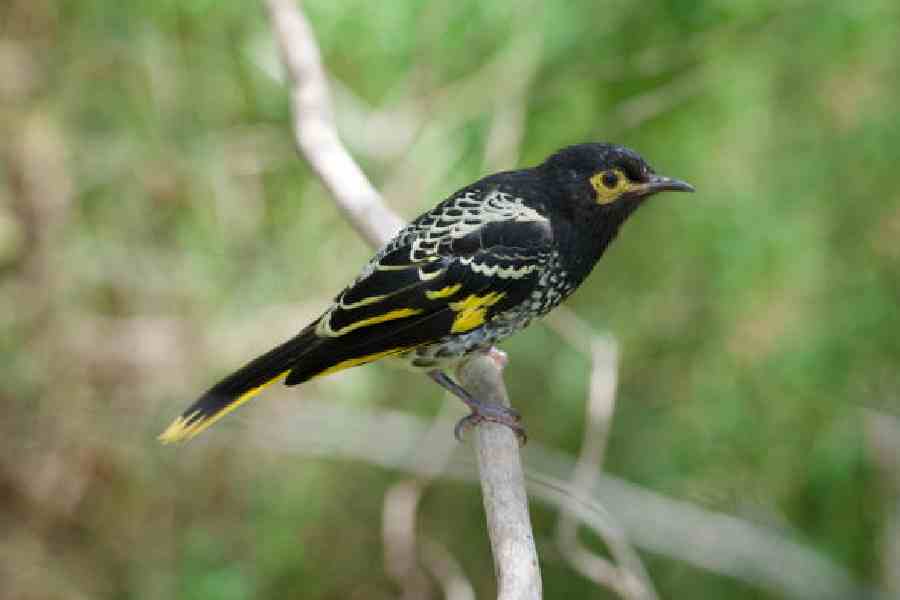
Regent honeyeaters were once abundant in the forests of southeastern Australia, congregating in enormous, eye-catching flocks. Today, the songbirds are critically endangered, with just a few hundred remaining in the wild.
As the birds disappeared, so did their distinctive song — a soft, warbling melody that males use to defend territory and attract mates. Honeyeaters born in zoos, as part of a captive breeding programme, didn’t learn the tune at all.
Now, scientists are restoring the song by deploying skilled honeyeaters to act as tutors. Researchers found that regent honeyeaters that knew the standard song successfully taught it to young, captive-born birds. Some of these avian students even learned the song well enough to teach it to the next generation, the researchers wrote recently in Scientific Reports.
The scientists hope the ongoing tutoring programme might help boost reproductive rates in the wild and, perhaps, get the world’s last remaining honeyeaters all singing the same tune again.
“The traditional song has some sort of intrinsic value to it but it’s also really important for the birds to have a stable song,” said Daniel Appleby, a conservation biologist at Australian National University and an author of the study. “The song is pretty critical to their reproduction.”
The study also reflects a growing understanding of the importance of animal culture — and a recognition that successful conservation programmes may need to find ways to preserve socially learned behaviours like birdsong.
“As captive breeding is increasingly relied upon for the survival of species, we really need to consider culture,” said Appleby, who is part of a research lab named the Difficult Bird Research Group.
The regent honeyeater population dropped sharply over the 20th century, as their woodland habitats were cleared. Today, scientists estimate, roughly 250 wild birds live in the fragmented forests of southeastern Australia, spread across an area about the size of Spain.
This low population density may explain why the honeyeater song began to change. Young birds typically learn the tune by listening to and observing adult males, but fewer birds on the landscape meant fewer learning opportunities.
A parallel problem emerged in the captive breeding programme, where young birds often had little exposure to adult males during their critical song-learning period. When these zoo-born birds were released into the wild, they sang “strange, rudimentary songs”, Appleby said, and relatively few managed to find wild mates.
So Appleby and his colleagues decided to try teaching the wild song to the captive-born birds at the Taronga Zoo in Sydney and Taronga Western Plains Zoo in Dubbo, New South Wales. Over several years, they experimented with a variety of strategies.
They housed some young birds in aviaries with speakers, which played recordings of the wild song. “That just completely failed,” Appleby said.
But other young birds got real-life tutors — two wild-born males who sang the traditional honeyeater song. When the young chicks lived alongside these tutors, they began to sing their tune.
“Three months in, we started hearing our first little renditions of a traditional wild song,” Appleby said.
“Those birds produced very, very good songs — so good that in the following year, those birds became tutors themselves,” Appleby said.
The study demonstrates that it is feasible for captive breeding programmes to take concrete steps to preserve the culture of threatened species, said Peter McGregor, an expert on animal communication and birdsong at ISPA-University Institute in Portugal. McGregor was not involved in the study.
“They’ve done the hard work of actually doing this stuff with captive populations,” he said. “It’s becoming more and more clear that quite a lot of critical aspects of animals’ survival and reproduction is socially learned.”
NYTNS