 |
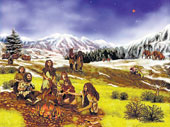
| Artist’s rendition of a Neanderthal family (Courtesy: Nasa) |
It is, by contemporary proportions, a strange looking creature. A robust physique, short legs, a protruding face and large head. Very human, but not quite there. This animal, or quasi-human, was extinct around 30,000 years ago. But Neanderthal Man, as this creature is called, has become one of the most researched and hotly debated topics in paleobiology. The reason: knowing Neanderthal Man throws light on how our own ancestors evolved.
Recent research has thrown up many fascinating questions about our cousins in the evolutionary tree. Last month, scientists at the Max Plank Institute (MPI) in Leipzig, Germany, found in a Neanderthal fossil a variant of a gene responsible for language. If this is a true finding — there are disputes about the purity of the sample — we have generated a mystery: what made humans evolve quickly? Anthropologists believe it was language, but could the Neanderthals also speak? If they did, why did they not evolve further?
The first fossil of this animal was found in 1856 in the Neander Valley in Germany. For a long time, scientists thought that they were part of the main evolutionary path to humans. But it is now clear that they were an offshoot rather than part of the main branch. Most scientists believe that they coexisted with humans but did not interbreed. Yet research continues to throw up more and more human characteristics in the Neanderthal Man. Do we carry genes from this creature?
Let’s take a quick sample of recent research findings. The Neanderthals definitely made innovative tools. They may have ceremoniously buried their dead. They may have cleaned their teeth. There is evidence to show that some of them were redheads, another human characteristic. Many scientists think they were innovative with their tools. But the latest finding, the human variant of the language gene FOXP2, is the most mysterious of all. Did the Neanderthals really have this variant?
The answer to this question is significant. There is widespread belief among scientists that something happened to human beings in Africa around 50,000 years ago. This event happened only in Africa, and allowed human beings to spread all over the world and take over the planet. “Human beings before 50,000 years ago looked like human beings now, but behaved quite differently,” says Richard Klein, anthropologist at the University of Stanford. Klein himself is one of the main proponents of this theory. It is believed that this change was neurological.
When the FOXP2 gene was discovered recently, and was shown to be important in speech, the theory started gaining ground that its acquisition was the change we were talking about. When this gene is transferred to mice, something changes in their brain and they start squeaking differently, but show no other change of behaviour. So it is clearly important in speech, but since there are other genes involved in speech too there is no clear reason to suppose that Neanderthals spoke. Nor is there evidence to suppose that they did not. “Other kinds of evidence like the voice box and nerves that go out are very contentious,” says Svante Paabo, a director at MPI, who sequenced the Neanderthal genome.
Since Neanderthals became extinct long ago, genetic analysis of fossils is difficult; fossil DNA degrades over time, and also becomes contaminated with that of other organisms. However, scientists have made big advances in the sequencing of fossil DNA. Genetic analysis is going to yield more and more clues about their past. And they are supposed to help us answer the big question: what happened 50,000 years ago to humans?
Recent genetic analysis has also shown that human and Neanderthal DNA was 99.5 per cent similar. Scientists also think humans and Neanderthals diverged more than 500,000 years ago. Can they carry strikingly similar genes — speech, red hair, ability to work with stone — from so long ago? Did they interbreed? Or did similar characteristics evolve independently? There is so much attention now on the genetic analysis of Neanderthal and archaic human DNA that the next few years might provide the answers to some of these questions. Or they could lead to more intriguing questions.