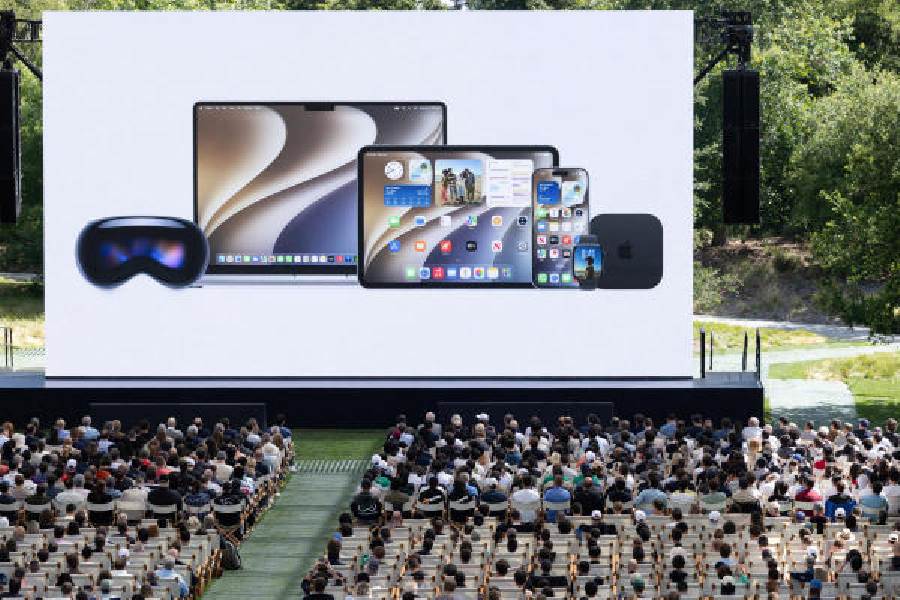
Parents with iPhones want artificial intelligence to pull details from a poorly formatted school notice directly into their calendars or answer questions about what is on the screen. Office-goers with MacBooks want meeting minutes turned into a clear, actionable email with a single click. Families with iPads want to plan a holiday, say to Kerala, with the device consulting the family calendar, suggesting five activities that would keep everyone happy and making notes about what to pack, which restaurants to book and which transport agencies to contact.
These are tasks that Apple users have wanted Siri to perform for years. Making all of it possible is a drastic overhaul of the virtual assistant Apple first introduced in 2011.
Cross-platform play
“The biggest differentiator here is the cross-platform play, backed by a firm promise of privacy. Apple possesses the largest user base poised to benefit from seamless cross-device connectivity and task handovers. If iOS 27 delivers a genuinely conversational Siri, Apple will reset the narrative and enter the
iPhone 18 supercycle with its most compelling upgrade story in years,” Tarun Pathak, research director at Counterpoint Research, tells The Telegraph.
Before this, Siri had remained relatively static while the generative AI revolution raged around it.
After the keynote address at the Worldwide Developers Conference (WWDC) at Cupertino, US, in the second week of June, Apple’s Siri team, led by Craig Federighi — who is senior vice-president of software engineering — addressed a select group of media representatives about the making of Siri AI.
On the question of Google’s involvement, Federighi was unambiguous. “We don’t have the Gemini app as our app. In fact, none of that client code is part of how we run on iOS.”
Apple Frontier Models
Apple built its Apple Frontier Models — AFMs, the AI inside Siri AI — by training them on proprietary data and refining them using outputs from Google’s Gemini frontier models.
AFM is a family of five foundation models custom-built in collaboration with Google.
The two on-device models are AFM 3 Core — a three-billion-parameter dense model capable of handling basic text generation, summaries, conversational replies and everyday tasks — and AFM 3 Core Advanced, a natively multimodal model enabling expressive voices and higher-accuracy dictation.
The three server-based models run on Private Cloud Compute, Apple’s cloud intelligence system designed to keep Apple Intelligence requests secure while ensuring that user data is never stored or shared — including with Apple itself. They are: AFM 3 Cloud, the server-side workhorse; ADM 3 Cloud (Image), for image generation and editing, and AFM 3 Cloud Pro, which powers the most demanding use cases, such as agentic tool use and complex reasoning. For AFM 3 Cloud Pro, Apple worked with Google and Nvidia to extend Private Cloud Compute to Nvidia GPUs in Google Cloud.
Integrated digital partner
What makes Siri AI feel genuinely useful is how deeply embedded it is within the system. Six days of testing it across iPhone, Mac and iPad has speeded up workflows in ways that feel consequential rather than cosmetic.
On first installation, Siri AI indexes everything on the device locally; nothing is pushed to the cloud. That local index becomes the basis for answering surprisingly vague queries. Asked what a contact’s drink order was on a recent evening — with no date specified and no disambiguation of which contact — Siri AI returned the correct answer with a link to the group thread where it found the information. Asked where a lunch meeting was being held, it cross-referenced a calendar event and produced the location.
What makes this more than a sophisticated search function is the way Siri AI triangulates across multiple data sources simultaneously. An email, a calendar entry and a message thread can all inform a single answer.
It can also execute complex, multi-step editing tasks: simultaneously changing a meeting’s title, time and location from a dial-in number to a physical address, for instance. This marks a significant shift from a basic voice tool to an integrated digital partner that takes fluid action across your devices.
Apple’s updated assistant directly rivals standalone platforms such as ChatGPT, Gemini and Claude, taking on everyday consumer requests. By embedding these capabilities within the operating system, it removes the need to switch into external apps for general queries and text generation.
Visual Intelligence, meanwhile, is now baked into the camera itself. Point it at an object and ask what it is. At a café, ask what people recommend and Siri draws on world knowledge to answer in context.
Privacy
Beyond convenience, Apple is placing considerable emphasis on privacy as a core selling point. To handle requests, the assistant uses a hybrid approach, combining on-device processing with cloud-based models. For some requests, models process queries entirely on-device. When the System Orchestrator determines that a more sophisticated response is required, it contacts the models running in Private Cloud Compute. User data is never stored and it is not accessible to anyone, including Apple.
“This app isn’t just reaching out to some model in the cloud,” said Federighi. “It’s built on top of powerful system software in Apple Intelligence. This includes the System Orchestrator, which is key to the privacy architecture of our entire system. It coordinates requests against things like the App Toolbox, which provides access to actions within your apps, the Spotlight Semantic Index to access personal
content and on-screen context to understand what you might be looking at the moment you’re making a request.”
The overall character of Siri AI is worth noting. Where many AI assistants tend towards verbosity or an odd performative enthusiasm, Siri AI behaves like a competent personal assistant: direct, brief without being brusque, focused on the task. It features clear guardrails, shutting down inappropriate prompts with a firm refusal. It handles contextual follow-up requests — recommending a local garden centre based on a user’s home location, for instance — and demonstrates improved multitasking, creating a reminder list, adding checklist items and scheduling a calendar event all from a single prompt.
Notes from WWDC 2026
- Scheduled to arrive on iPhones this September, at the moment Siri AI is available for developer testing through the Apple Developer Programme across the forthcoming iOS 27, iPadOS 27 and macOS 27 on iPhone, iPad and MacBook respectively
- Siri AI will not be available in the EU or China initially, owing to regulatory constraints. It will launch in English, with further languages to follow
- Visually, the new Siri is woven into the iPhone interface. It presents a prominent “search or ask” prompt with a blinking cursor during home-screen searches. It activates from the Dynamic Island rather than as a full-screen border when the wake button is held. The impression is of an assistant that is always within reach

A new Siri option in the camera app can identify objects. Photo by Mathures Paul
- “An AI assistant that understands personal context, works seamlessly across devices and operates within the trust boundaries of the Apple ecosystem has the potential to be far more valuable to mainstream consumers than raw model capability alone. No competitor has yet delivered personalised AI at this depth of platform integration and Apple’s scale. That is a meaningful structural advantage,” Prabhu Ram, who is vice-president of industry research at CyberMedia Research, tells The Telegraph
- Beyond Siri AI, the second most significant highlight from WWDC 2026 has been child privacy. Apple has built multiple guardrails into its platforms, giving parents greater control over what their children can see, access and who they can communicate with, addressing what Tarun Pathak of Counterpoint Research describes as one of the key anxiety points for parents in the age of AI.