 |
| Biogas energy: Starch has more calories than dung |
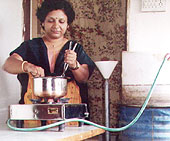
At Pune?s Kimaya restaurant, leftovers don?t join the municipal garbage stream. Two buckets of the leftovers from the plates of chowmein, dosas and pau bhaji from the eatery go into an obnoxiously smelly, underground biogas plant where bacteria digest them to produce methane gas. Restaurant-owner Mahipal Patwardhan, who lives just behind, uses the methane to reduce his domestic cooking gas bills. ?When you eat at my restaurant, I make money. When you leave something in your plate, I get green energy and save money,? says Patwardhan.
The concept of using leftover food for methane generation is part of a portfolio of new technologies and technology promotion practices developed by two non-government organisations in India in their attempts to make biogas and biomass commercially attractive. Their efforts have now received international acclaim ? and funding.
The US Environment Protection Agency (EPA) last week announced grants of $230,000 for the two non-government organisations to promote technologies that will reduce the health risks of indoor air pollution from traditional stoves. The Appropriate Rural Technology Initiative (ARTI) in Pune will use the grant to introduce its biogas plants that use kitchen waste to make methane in 2,000 households across Maharashtra. And Development Alternatives (DA) in New Delhi will scale up biomass cooking to over 15,000 households in 13 districts in the Bundelkhand region of Madhya Pradesh and Uttar Pradesh.
Non-conventional energy experts caution that success will depend on how efficiently people can be convinced to shift from traditional practices to the biogas or biomass technologies. Lack of easy microfinance may also pose a problem for growth. The technologies may demand investments of between Rs 1,000 and 2,000.
Dr Anand Karve, a botanist who now heads ARTI, says traditional attempts at harnessing biogas failed because bacteria were given the wrong food. India currently has less than 2.5 million operating biogas plants which, Karve says, is a ?ridiculously low figure for a country of India?s size?. There are many reasons why the previous attempts to promote biogas technology did not work ? the large size and high cost of the plant, user-unfriendly operations, and low efficiency of methane production.
Dung has a low calorie content available for bacteria. ?The key to improving efficiency lay in finding the right energy-rich food for bacteria,? says Karve.
The compact biogas plant from ARTI is quite different from the traditional underground plants used for decades. A conventional plant typically has a capacity of four cubic metres and costs Rs 15,000 to build. The compact biogas plant developed by ARTI has a capacity of 500 litres, costs Rs 3,000 and occupies the space of a household refrigerator. In traditional plants, a user would handle up to 40 kg of cattle dung each day. But ARTI?s plant needs just two kg of biomass and it can be kitchen waste ? rotten fruits, spoilt milk, potato peels ? or other starch-rich items such as spoilt grain or the cake of non-edible oil seeds. One thousand kg of dung produces 10 kg of methane in 40 days, while 1,000 kg of starch-based waste yields 250 kg of methane within 24 hours.
The ARTI project is focused on the use of starch-rich domestic and agricultural wastes, but the DA programme is aimed at improving biomass-based cooking. The government-funded improved cooking stove programme launched by the department of non-conventional energy sources during the 1980s had little impact on cooking practices. Non-government organisations estimate that 80 per cent of households in India today cook in stoves that use either low-grade coal or raw biomass that emit harmful gases.
Research at DA involved tailoring a combination of stoves and fuels as well as finding ways to transform low-performing biomass fuels into higher-grade fuels. A wild grass called ipomoea, for instance, is first burnt under controlled conditions (charred) and then converted into briquettes ? sausage-shaped chunks of fuel that go into the cooking stoves. In Bundelkhand, this grass is called besharam because no matter how much you cut, it just grows again. ?During controlled burning, volatile gases and tar are removed from the biomass and the briquettes have far lower levels of harmful emissions,? says Shrashtant Patara, manager, technology systems, DA.
?For a technology to be commercially viable, all those in the technology chain should either make money or save money,? says Dr Ashok Khosla, president, DA. In the pilot phase of the programme, supported by the Shell Foundation, DA got local women?s communities to participate in the collection of the wild grass and charring. The briquettes are made by TARA, the production and marketing division of DA. About 1,500 households in Bundelkhand today use this technology. The goal is to get more people to recognise the value of biomass and set up local processing units and earn money.