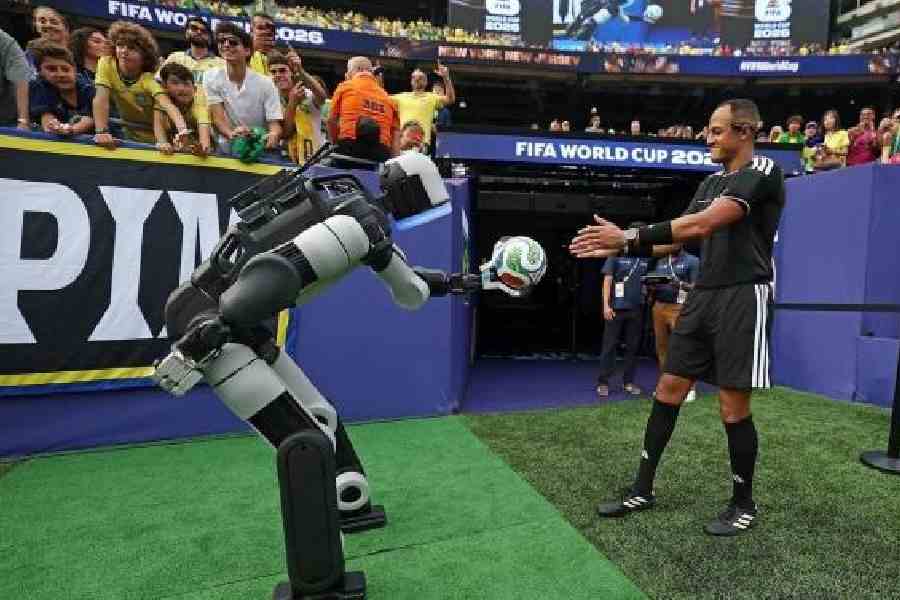
A humanoid robot delivered the match ball at halftime during a FIFA World Cup 2026 fixture between Brazil and Norway, marking what Hyundai Motor Company describes as the first-ever integration of a humanoid robot into a live World Cup match environment.
The robot, named Atlas, was developed by Boston Dynamics, which is owned by Hyundai Motor Group. Before handing the ball to the referee, Atlas emerged from the player tunnel and performed a sequence of goal celebrations associated with prominent footballers, including Matheus Cunha’s surfing celebration, Son Heung-min’s camera gesture and Erling Haaland’s meditation pose. The appearance was the robot’s first public demonstration since its production-ready version was unveiled at CES in January, and it forms the centrepiece of Hyundai’s ‘Next Starts Now’ campaign, building on an earlier video series titled ‘School of Football’.
Alberto Rodriguez, director of robotics behaviour at Boston Dynamics, said the process behind Atlas’s football skills reflects a shift from programming to training. “It used to be programmed,” he said. “Now it’s no longer programmed—it’s learned.” Engineers fed the robot footage of professional footballers alongside motion-capture data, including recordings of Boston Dynamics’ own staff performing the movements, into a physics-based simulation that allowed Atlas to repeat the actions millions of times across cloud computing infrastructure. According to Rodriguez, tasks that might take a human athlete around a year of trial and error to master were worked through by Atlas in roughly 24 hours.
Staging the demonstration outdoors, rather than in a laboratory, introduced fresh engineering challenges. Rodriguez noted that grass “has that interesting property where sometimes you slip, but sometimes your feet can get caught on it,” which required adjustments to how Atlas learns to walk, run and jump. The dense concentration of fans and mobile devices around the pitch also ruled out standard Wi-Fi communication with the robot, prompting engineers to fit Atlas with a radio device instead.
Hyundai Motor Group, which acquired a controlling stake in Boston Dynamics from SoftBank in 2021, has pledged a $26 billion investment in the US over four years, including a robotics manufacturing facility near Savannah, Georgia. The company intends to produce thousands of Atlas units annually from 2028, with an initial focus on automating high-risk and repetitive tasks such as part sequencing at its factories. Sungwon Jee, Hyundai Motor Company’s executive vice-president and global chief marketing officer, said the World Cup appearance represented “the moment Atlas enters public consciousness for the first time”.
The rollout of humanoid robots has raised job security concerns among workers, and Hyundai’s own labour union is reportedly seeking assurances that management will consult employees before deploying humanoids, amid ongoing wage negotiations. Hyundai and BBC StoryWorks Commercial Productions are also set to release a documentary-style feature, The Training Ground, on July 7, chronicling the technical preparation behind Atlas’s World Cup appearance.