When I first visited Ahmedabad a few weeks before the devastating earthquake struck in 2001, it was a bustling city of low-rise buildings that was dusty, but not half so as Bhuj. When I revisited Ahmedabad just about a month ago, I was struck by its transformation into an upwardly-mobile city crammed with high-rise apartment blocks. The ugliest of these high-rises have jharokhas conjoined to their facades. Only the crude and the sensational seem to appeal to our debased Indian sensibilities. These high-rises are cookie-cutter structures that have nudged out the old bungalows. They started mushrooming all over Ahmedabad around 2000 in total disregard of the city's rich architectural heritage. It was in 1411 that its foundation was laid by Sultan Ahmed Shah. And right up to our times, Ahmedabad's enlightened industrialists and city fathers have invited internationally-known architects to design their homes, museums, educational institutions and offices.

The streets are gritty but shops selling branded goods have opened everywhere. One cannot avoid noticing the ubiquitous signboards of clinics and hospitals - some visibly seedy - where one could easily get one's hips and knees and other limbs replaced. Commerce is the driving force of the city, and that is pronounced quite blatantly.

Four symbols
Ironically, Ahmedabad is the only city in the world which has four iconic buildings designed by the great Le Corbusier. He was invited in 1951 by Chinubhai Chimanlal, the first mayor, and mahajans and industrialists like Surottam Hutheesing, Ambalal Sarabhai and Kasturbhai Lalbhai, who had a modernist architectural vision, to design buildings for them, and he was given a free hand. Corbusier designed the Mill Owners' Association building, Sanskar Kendra or Ahmedabad City Museum, the Villa Sarabhai and Villa Shodhan, and, thereafter, Louis Kahn, too, followed in his footsteps. Charles Correa and B.V. Doshi kept the tradition alive.

Many mills have closed down now or have been put to other uses. In the recent past, art has fuelled hatred, and the conflict reached a flashpoint when the underground gallery, Husain Doshi Gufa (later renamed "Amdavad ni Gufa"), designed by Doshi to exhibit the paintings of M.F. Husain, was vandalized by Hindu right-wingers for the first among several other times in October 1996.

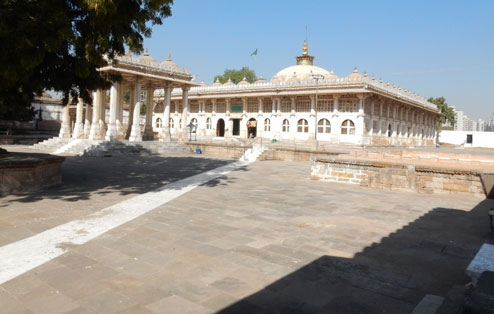
The strife notwithstanding, Ahmedabad can also boast of its fine monument to syncretism, the cornerstone of India's culture. It is the magnificently austere Sarkhej Roza architectural complex on the city's outskirts dating back to the time when it was established. It is associated with the great Sufi saint, Shaikh Ahmed Khattu Ganj Baksh, who was the spiritual leader of Sultan Ahmed Shah, after whom the city is named. In his last days, the saint, who was greatly venerated, retired to the remote village of Sarkhej. He was believed to have miraculous powers, and that belief is alive to this day. He lived to be 111, and upon his death in 1445, the ruler, Mohammed Shah, ordered a mausoleum to be built in his honour. Successive rulers developed it over time to include a pavilion and a palace, and dug a lake before it encircled by steps going down to the water. With its low-slung domes, clusters of columns, elaborate lattice work and simplicity of design, it could easily be mistaken for a Jain place of worship.
When Corbusier went to visit it, he told Doshi: "Why do you need to visit the Acropolis in Athens when you have this here?" Sarkhej Roza is in urgent need of repair.