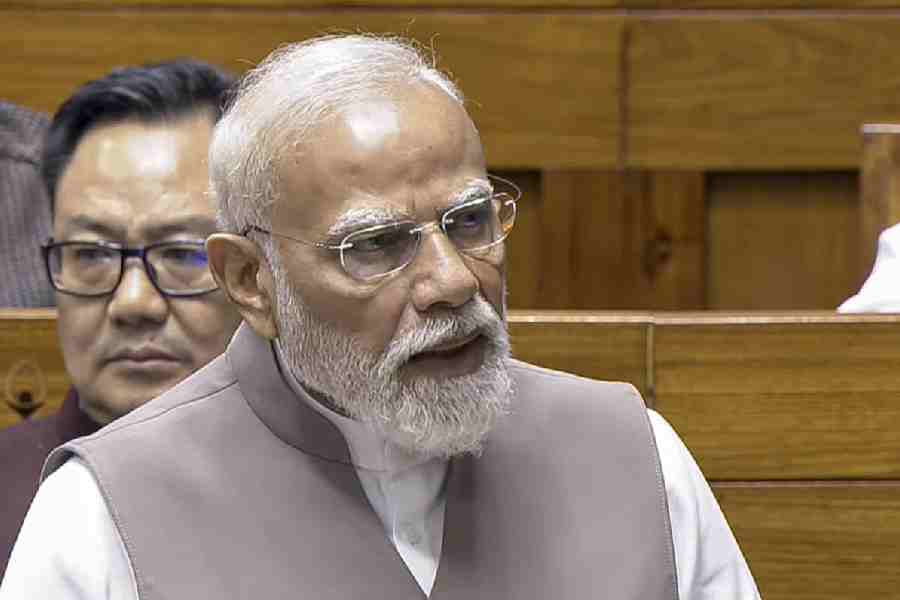
Narendra Modi has claimed that the proposal to reserve one-third seats in legislatures is being expedited in line with the Opposition’s wishes. It is true that the Nari Shakti Vandan Adhiniyam had been passed unanimously. But the Opposition, then and as is the case now, has been consistent in its criticism on a few pointers that deserve to be scrutinised.
Earlier, Mr Modi’s government had rejected the Opposition’s demand for the Act’s implementation in 2024 — the year of the last general election. Yet, it now appears that the Centre is keen on making higher women’s House representation applicable from 2029 — the year of the next general election — with tweaks to ensure that the delimitation exercise, central to expanding women’s parliamentary presence, is based on the 2011 census data. The regime’s haste and its willingness to shift the proverbial goal posts repeatedly reek of opportunism: this is one of the Opposition’s reservations. That Mr Modi decided to announce the push towards an expanded House quota for women during poll season featuring three states ruled by Opposition parties is also being seen as an attempt by the prime minister to gain electoral mileage. That is not all. The government’s attempt to bundle the issue of women’s reservation with delimitation, a contentious exercise that is expected to curtail the parliamentary slice of southern states, has also become a bone of contention.
There is no doubting the need for expansive political representation for women in a nation marked by patriarchal prejudice and discrimination. In the 18th Lok Sabha, only 14% of parliamentarians are women. So the political will coupled with legislative teeth to increase the number of women people’s representatives is welcome. But substance, not optics, must inform this transformation. The existing ironies are palpable. At a time when the prime minister is urging women’s reservation in legislatures, his party has been supportive of the Special Intensive Reservation that has culled a very high number of women voters, especially in Bengal. Women voters may have emerged as a key electoral constituency in recent years, forcing political parties to craft their welfare narrative accordingly. But nearly every Indian political party is comfortable with women as a voters’ bloc rather than as a constituency of leaders. The gender disparity in the pecking order of political parties points to this embedded bias.