|
|
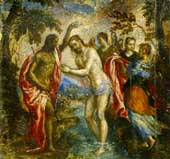
| The Baptism of Christ, El Greco |

Jesus and Yahweh The Names Divine
By Harold Bloom,
Riverhead, $ 24.95
Jesus of Nazareth and Jesus Christ are not the same persons, and the latter has nothing to do with Yahweh, the Jewish God celebrated in the first five books of the Bible. These are the two startling points argued by Harold Bloom in this brilliant but exasperating book.
Bloom is an admirer of Yahweh as he is of the writer J who made Yahweh famous. J, according to scholars of the Hebrew Bible, wrote chunks of the Genesis, Exodus and Numbers, and he always referred to God by the name Yahweh. The language of J, who Bloom argued in another book was a woman living around 1000 BC, brings to life Yahweh as an ?all too human? God prone to mischief, irony, jealousy, anger, revenge, breaking his covenant and thus nowhere near the perfection which Jesus Christ saw in his Father or abba.
This book, despite its name, is about three persons ? Yahweh, Jesus, and Jesus Christ ? who are ?totally incompatible?, even though they are supposed to form the same canonical tradition.
About Jesus, nothing reliable is known. The Gospels, which are supposed to be accounts of his life, were all written many years after his death by authors who did not know Jesus at all. The second is largely a creation of theology which is the handiwork of Paul. According to Bloom, Jesus Christ is ?smothered beneath the superstructure of historical theology?.
Another significant point that Bloom makes is the difference that exists between the Hebrew Bible and the Christian Bible. The Hebrew Bible becomes the Old Testament through a radical reordering of the books. More importantly, the Old Testament gets its meaning and salience from the New Testament. The Old is made to prefigure the New Testament. In so doing, the New Testament makes the Hebrew Bible, the Tanakh, ? a captive work dragged along in triumph by Christianity?s Greek New Testament.? Bloom thus believes that there is no such thing as a Judeo-Christian tradition. He denies that Christianity is a descendant of Judaism. As a literary critic, he also feels that the Hebrew Bible is aesthetically superior to the New Testament.
This last comparative judgement of literary and aesthetic merit is based on Bloom?s claim that there is nothing in the New Testament that measures up to the magnificent figure of Yahweh. Only Jesus of Mark?s Gospel matches Yahweh. Bloom writes, ?The unpredictable and abrupt Jesus of the Gospel of Mark is smoothly consistent when compared with the Yahweh of the oldest strand of Genesis, Exodus and Numbers.? The Jesus of Mark speaks in riddles and ironies and is ever-resistant to analysis. Bloom calls this ?the dark speaking of Jesus?. According to Bloom, ?whether in aphorisms or in parables, Jesus speaks riddles. He is the poet of the riddle, anticipating Dante, Shakespeare, Cervantes, John Donne, and even Lewis Carroll and James Joyce, as well as Kierkegaard, Emerson, Nietzsche, Kafka, and many others in the literary and spiritual tradition of the West.?
Bloom?s hero is Yahweh and the latter?s most attractive and enigmatic quality is the power to astonish. Bloom has the same quality in his writing and some of his pronouncements are Yahweh-like in their depth and irony.