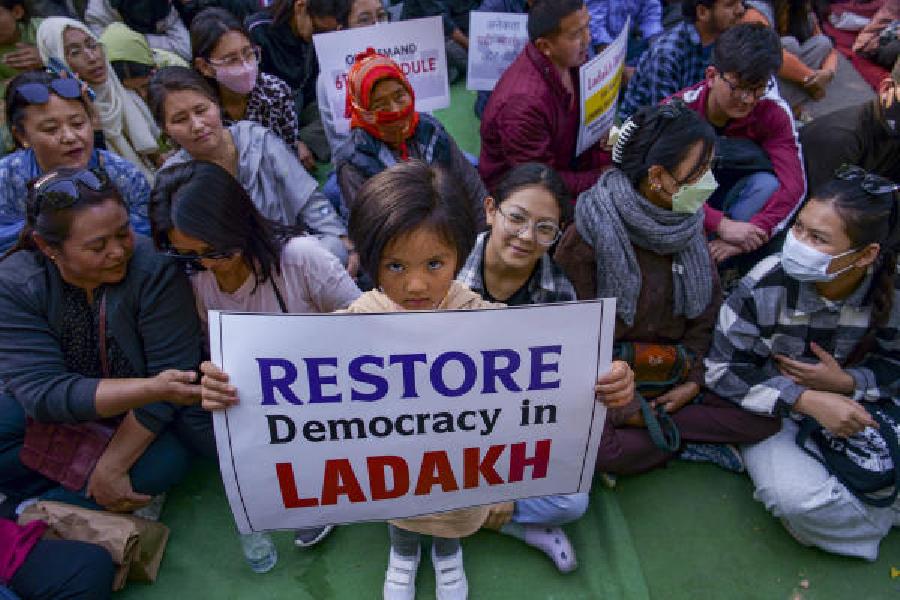
The continuing negotiations between the Union home ministry and the representatives of the Leh Apex Body and the Kargil Democratic Alliance could well turn out to be the most important political dialogue in Ladakh since its creation as a Union territory in 2019. Discussion is now underway on an idea that seemed unimaginable even 12 months ago: bespoke constitutional guarantees for Ladakh modelled on Article 371 of the Constitution and greater legislative, financial and administrative autonomy within the framework of the existing Union territory arrangement. Nothing has been agreed so far. Differences remain, especially on statehood and Sixth-Schedule status. But New Delhi has shown itself prepared to discuss a tailor-made constitutional package for Ladakh, something no government has countenanced for years. The snow may have melted in Leh but there is now a feeling that the ice is breaking.
This is about much more than tweaking administrative arrangements. At its core, this dialogue is about the relationship between India and one of its most loyal frontiers. A land that has too often been spoken about rather than spoken to. For geopolitical strategists, it is a frontier. For environmentalists, an increasingly fragile ecosystem. For tourists, a landscape of ethereal beauty. For politicians, a remote Union territory on the northern edge of India. What is forgotten are the people who call Ladakh home. They may inhabit an exotic landscape but they have a distinct history, a strong sense of collective identity, and a growing demand to craft their own future. That demand is expressed most often in terms of administrative arrangements. It is about much more than that. Overwhelmingly, young people from Buddhist-majority Leh and Shia-majority Kargil demand constitutional guarantees for their land and jobs, environmental protection and democratic empowerment; it was this unity of purpose that saw the birth of the LAB and the KDA as a joint platform: rarely, if ever, have Kargil and Leh spoken in one voice.
At stake is the question of how India should govern one of its most distinctive borderlands in the 21st century. Once an important trading outpost on the Silk Road where goods moved along with ideas among Tibet, Central Asia and Kashmir, Ladakh now finds itself renegotiating its ties with the Indian State. At issue is not just who should govern Ladakh but how Ladakh should be governed. As talks continue, there are at least two things that Delhi should keep in mind. First, Constitutions are more than documents; they are statements of intent. Symbols matter. Trust must be earned. When large parts of Ladakh woke up on August 5, 2019 to learn they had been finally, as they had for long hoped, detached from the Kashmir Valley and its problems and had become the nation’s ninth Union territory, there was hope. But instead of delivering empowerment, many residents felt subjected to Delhi-centred decision-making. On the edge of the world, at the roof of the world, a people who have survived through resilience, ingenuity and presence of mind are unlikely to relinquish their sense of identity so easily at the hands of a distant bureaucracy.
Second, and relatedly, the genius of Article 371 is not that it creates more districts in the Himalaya (though that may be one outcome). The genius of Article 371 is that it allows India to think differently about federalism. Asymmetrical federalism has been one of the important ways through which India has accommodated its diversity. India’s relationships with Jammu and Kashmir, Nagaland, Mizoram and Sikkim have all required different constitutional arrangements at different points in their relationship with the Union. The success of these accommodations has strengthened India, not weakened it. If there is promise in the current dialogue, it is in the possibilities that Article 371 opens. It is an invitation to creatively imagine a new constitutional compact for Ladakh as Union territory. Ladakh’s history and situation are unique. So too must be the constitutional guarantees it receives. Any constitutional agreement must be tailored to the unique history and the conditions of Ladakh as Union territory. It must protect local control of land and employment while preserving the cultural and the ecological uniqueness of Ladakh.
Consider the proposed increase in the number of districts. In a vast and difficult terrain, more districts can mean better service delivery and greater opportunities for local representation. But constitutional grandstanding alone will mean little unless it changes decision-making on the ground. A constitutional guarantee that merely places a fancy label over centralised decision-making will soon wear thin. More districts alone are not a guarantee of greater democracy. Indeed, there is something deeply undemocratic about district creation being held up as a solution to Ladakh’s democratic deficit. Where do districts come from? Districts are created. Who creates them? The Centre. A constitutional guarantee that does not meaningfully devolve powers to local institutions will struggle to gain legitimacy.
These negotiations must ultimately be understood within a much larger historical context. Before it was a frontier, Ladakh was a crossroads — a meeting place of faiths, cultures and ideas where caravans carrying pashmina, silk and turquoise moved among Tibet, Central Asia and Kashmir. History transformed it into a frontier. Geography made it a strategic necessity. Today, climate change, youth unemployment, ecological fragility and geopolitical competition are reshaping it once again, and faster than the system under negotiation is designed to manage.
The Centre deserves credit for reopening dialogue and for moving towards a more flexible framework. Ladakhi leaders deserve credit for choosing negotiation over confrontation. After years of mutual suspicion — including the four young lives lost in Leh in the protests in recent times — both sides appear to have recognised that the costs of drift are becoming unsustainable. But this moment should not be squandered. The glaciers are retreating. Young people are leaving. Livelihoods remain scarce. And while talks proceed, the Chinese are building bridges. Time is not a neutral actor in Ladakh.
The real question before Delhi is not whether Ladakh deserves trust. That question was settled long ago on the battlefields of Kargil, in the icy posts of Siachen, and on the windswept heights facing China. The loyalty of Ladakh is not in doubt. The question is whether the Indian State has the confidence to trust one of its most loyal frontiers with a greater measure of power over its own affairs. If the current negotiations succeed, they will do more than resolve a constitutional dispute. They will demonstrate that democracy can accommodate India's extraordinary diversity without fearing it, and that unity is strengthened by conceding difference, not by insisting upon uniformity. Ladakh is not asking for separation. It is asking to belong to India on terms that respect its history, identity and aspirations. For once, a wise Republic should know the difference.
Amitabh Mattoo is Dean and Professor, School of International Studies, JNU, and Honorary Professor at the Faculty of Arts, University of Melbourne