There is a peculiar institutional reflex in Indian welfare legislation wherein when the State does not know what to do with a body, it hands it to a doctor. The doctor issues a certificate. The certificate becomes the body's legal identity. And the person, somewhere in this chain of transactions, disappears.
A person with a disability will recognise this sequence. The Rights of Persons with Disabilities Act, 2016, hailed as a transformative law, retained the same medical certification architecture it was supposed to supersede. Persons with disability,
regardless of their experiences of impairment and exclusion, must obtain a Disability Certificate from a designated medical authority to access any of the Act's protections.
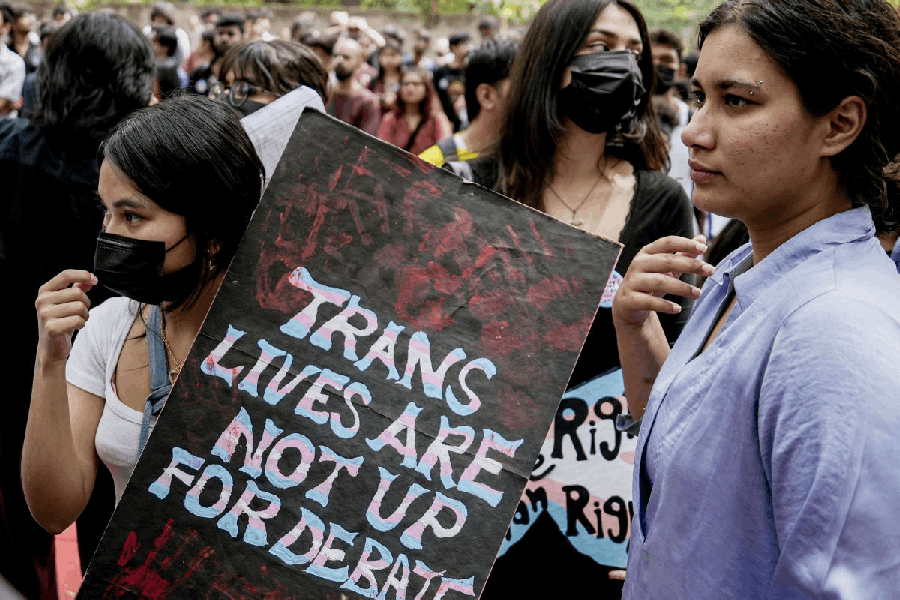
The Transgender Persons (Protection of Rights) Amendment Act, 2026 has now reproduced this architecture with even less ambiguity. Under the 2019 Act, a transgender person could apply to the district magistrate for a certificate of identity on the basis of self-perceived gender identity. The amendment scraps that right. Now the district magistrate will issue a certificate only after examining the recommendation of a designated medical board headed by a chief medical officer. The body must go to the doctor, once again, before the State will acknowledge it.
This is not accidental bureaucratic design but rather ideological. The medical model of gender understands trans identity not as a variation in human experience but as a condition to be diagnosed, treated, and certified. The model produces a gatekeeping function wherein only those who conform to the clinical narrative of gender dysphoria gain access to legal recognition.
The parallel with disability certification is not merely structural. It is philosophical. Both proceed from what disability studies scholars call the "medical model" —
eligibility for legal protection depends on one's body being assessed and classified by a medical professional. The disability rights movement has long argued for the
"social model", the understanding that disability is produced not by impairment but by the failure of society and institutions to accommodate human variation.
Trans rights scholars have mounted an identical critique. Florence Ashley, writing in the Canadian Medical Association Journal, argues that the presumptive right to gender self-determination follows from the core medical ethics principle of autonomy. When the State erects medical barriers to this self-determination, it treats being transgender as pathology rather than diversity. Incidentally, the Supreme Court had said otherwise. In NALSA vs Union of India, the court asserted that gender identity belongs to the individual, and the State cannot condition its recognition on medical procedures. By interposing a medical board between a person and legal identity, it creates the conditions NALSA judgment was meant to dismantle.
The Amendment's definitional narrowing makes the medical logic explicit. The 2019 Act recognised trans men and trans women regardless of whether they had undergone any medical procedure. The Amendment removes this entirely. It confines recognition to historically accepted socio-cultural categories like hijra,
kinner, aravani, jogta, and persons with medically recognised intersexed variations. Trans masculine persons disappear from the legal framework. Trans women who do not belong to these specific communities lose their footing. Genderqueer people, included in 2019, are struck out. The Amendment also adds a revealing category: persons "forced to assume a transgender identity" through mutilation or castration, effectively making victimhood the default frame for trans existence.
The medical model, whether applied to disability or gender, does not function as protection. It functions as a rationing of recognition, of rights, of the State's acknowledgement that a person legally exists. Parliament, which has congratulated itself on the 2016 RPwD Act, has enacted a transgender law that repeats that model's foundational error.
Shashank Pandey is a lawyer and the founder of the Politics and Disability Forum