|
|
| Racing on a tight rein |

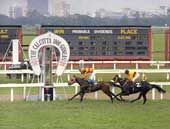
With soothing familiarity, history, like a montage, flashes through the mind as one looks out of the top-floor window of the clubhouse at the Royal Calcutta Turf Club — as women with Botticelli faces dot the course in chiffons, alongside dapper young men in their Saturday formals looking unconscionably eager to please. The Victoria Memorial stands stark against the horizon. There is the old clubhouse, with its grandstands built like galleries, and its members’ boxes, where the genteel sit with their gin and tonic and chitchat fills the silences as the women peer through their binoculars. The city outside is oblivious to the splendour nestling in its heart.
But the RCTC is changing. No Lester Piggott or Willie Carson rides his horse to victory, as those legendary international jockeys had done, winter after winter, in the Fifties and Sixties. Jockeyship today is of lesser mettle. With the fall of the Empire, no Maharajah of Burdwan or Coochbehar hobnobs with the burra sahibs of managing-agency houses over Pinot Noir and pedigree. The sport of kings today thrills not from the stands but at the bookmaker’s ring, where fortunes are made and shattered as runners charge through the starting stalls. The members’ gallery lies nearly barren on live racing days. The glamour of the game is all but a distant memory at the RCTC.
The inexorable decline of horse racing and its transition from a sport to an industry, where high stakes are pledged and big money changes hands, are all too conspicuous as one enters the bookmakers’ enclosure. The bookies’ ring is a flurry of activity, as furiously possessed with the business of moneymaking as a working day on Dalal Street. High rollers betting up to five- or six-figure sums with a cavalier wave of the finger is not new to the game of horse racing. The difference between then and now is in the profile of those involved in high-stakes gambling. One misses the flamboyance of a Lenny Dorji, Bhutanese royalty, more famous as the man who brought Shirley Maclaine and Jacqueline Bisset to India, and who featured in Playboy magazine’s annual list of top 10 playboys of the world in the Sixties. Or his brother, the former prime minister, Jigme Dorji, owner of some prize thoroughbreds, with his Yul-Brynner-like good looks. Racing is a mass sport, a classless sport. But the sight of henna-haired, embarrassingly dressed men ogling a lone woman in the betting ring, or of decrepit, dhoti-clad ones sitting on their haunches looking woebegone as they count their losses, does little for nostalgia and glamour.
Whatever happened to racing as a social event? “Horse racing takes place almost 300 days a year across centres in India. There’s been an overkill. The exclusivity of the sport is gone. There are too many fun events that people can choose from. Earlier, people came to the racecourse to be seen. Now, horse racing draws people as the only legalized form of gambling in the country,” explains Cyrus Madan, senior steward of the RCTC. Curiously reluctant to speak about the club’s plans to revive interest in the sport, he also omits reference to the abysmal lack of competition at the Calcutta races. The runners at the Calcutta centre predominantly belong to two camps — that of Deepak Khaitan and M.A.M. Ramaswamy. The horse strength here is nearly half that of other centres. This stark contrast with, say, the Mahalakshmi Race Course in Mumbai or the Bangalore Turf Club — where there are at least ten major owners — is attributed to the RCTC’s inability to match them in stake-money figures. Lower prize-money amounts per race naturally attract fewer participants. Where the amount of stake money offered at racing venues in Hong Kong, Japan or even Mumbai, is over one and a half times the cost of maintaining the horses, here the same ratio is a dismal 0.6:1. This discourages many racehorse owners, who depend largely on the stake money to look after their horses as well as increase their numbers.
In Bengal, the problem is also one of perception. In the middle-class households, interest in horse racing is tantamount to discarding traditional values, moral integrity, and for the most part, to just going to the dogs. Betting is met with stern disapproval by a class of people famously wary of risk and guarded about finances.
With the migration of the Anglo-Indian community, from which some of the best jockeys and trainers in Calcutta have come, sportsmanship is inferior today. Profitable career alternatives, lack of visibility and the perceived dishonour have lured youngsters away from making a profession of it. Besides, the cost of a horse could be anything from Rs 2 to 30 lakh, making the game an expensive pursuit.
“At other centres, the committee functions as a united body. Not so here, though the present body is making attempts at improvement,” concedes Babu Sengupta, a regular at the turf club for over three decades. “Dada” Osman, blithe spirit and grand old man of the club, suggests that RCTC should be selective about members.
Though the committee chooses to guard its modus operandi as though it were a national secret, word on the street is that its Russell-Street property, lying unused for years, will be renovated as a heritage clubbing address and boutique hotel. The club will be organizing a “breeze-up auction” where ‘racing-ready’ horses are handpicked from other centres and sold to prospective owners. Weekend racing has also been reintroduced, in addition to concurrent racing with other venues in India. The club is advised to circumvent government strictures and allow children within its premises. Rumour goes that plans are afoot to open Ladbrokes-like betting centres across eastern India and to introduce night-time races in the long run.
The old order changeth. Flury’s has been replaced by the Camellia Tea Bar and there isn’t much the club offers by way of an eatery. Yet, the shabbily liveried bearers are courteous and pleasant. When the bell for a race rings, the rush of hoi polloi to the fences and the sophisticated restraint of the elite betray the same arresting anxiety for their favourites. And when the septuagenarian J.K. Dutt walks to the winners’ enclosure, his dhoti perfectly draped, stroking Eveready Sir’s glistening mane as he tells me he’s never betted more than a paltry sum on any horse, his love for the game shows through. Behind me, someone shouts, “Come on, Devilish!” Another, crestfallen, pores through his racebook muttering, “Number 6 is 4 to 1?” to nobody in particular. My escort looks shifty-eyed, struggling to concentrate on our conversation. But as the horses pass the winning post, an ill-hidden twinkle of profit lights up his eyes. Devilish devours ground and cruises away.